
 (Image credit: S.I. Han)
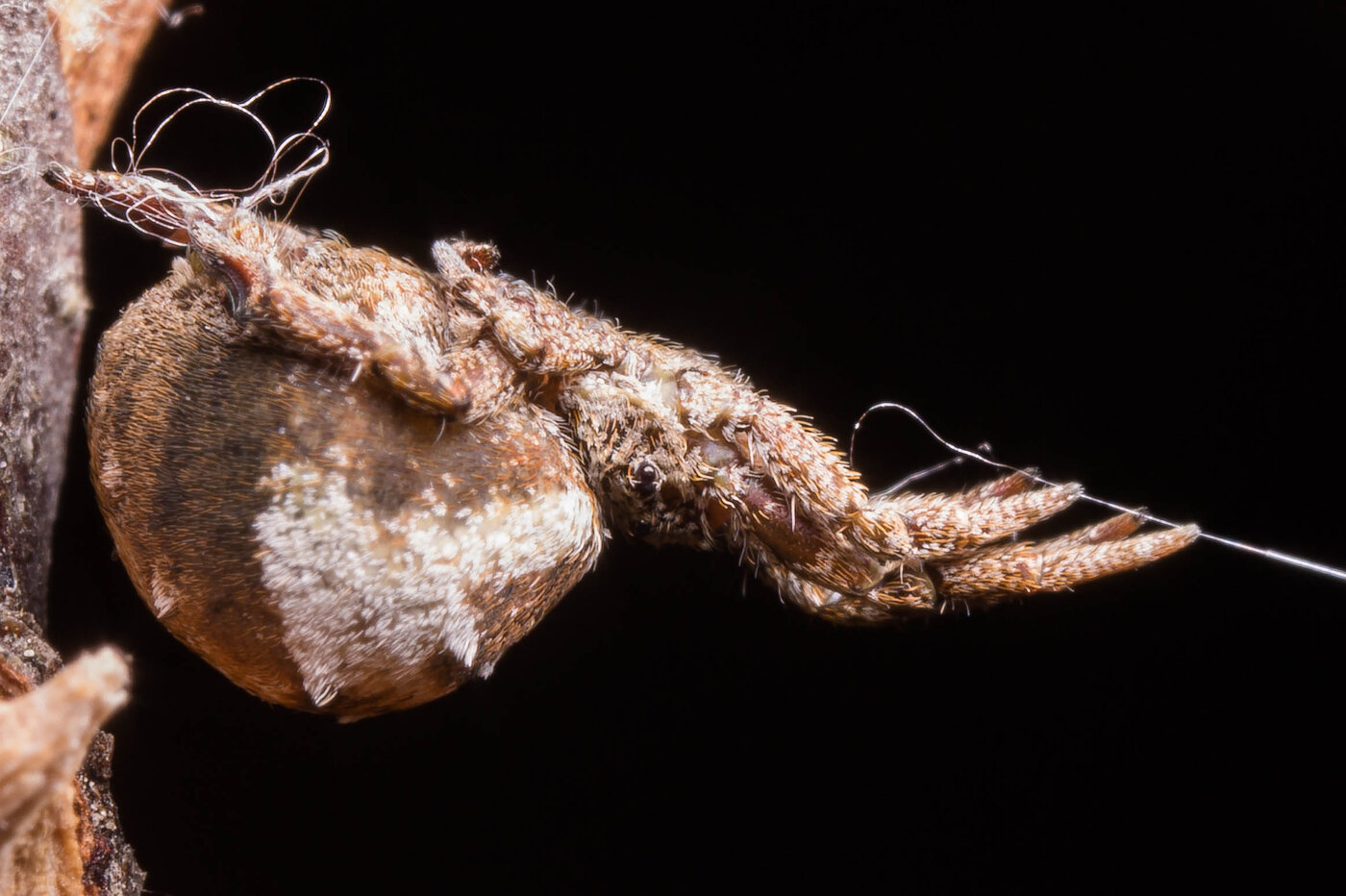
Because the webs of the triangle-weaver spider are stretchy, the "elastic recoil" that they produce allows this creature to use heavy force and acceleration to capture its next meal.
"I think it's just an amazing image to think of – spiders loading up energy in a spiderweb and then deploying it to catch prey," says Sheila Patek, a biologist and expert in the mechanics of animal movement from Duke University in North Carolina.
"I can't think of another example where an animal, you know, takes something externally that they've built and then loaded it up" in the same way, she added, as quoted by NPR.
(Image credit: S.I. Han)
Because the webs of the triangle-weaver spider are stretchy, the "elastic recoil" that they produce allows this creature to use heavy force and acceleration to capture its next meal.
"I think it's just an amazing image to think of – spiders loading up energy in a spiderweb and then deploying it to catch prey," says Sheila Patek, a biologist and expert in the mechanics of animal movement from Duke University in North Carolina.
"I can't think of another example where an animal, you know, takes something externally that they've built and then loaded it up" in the same way, she added, as quoted by NPR.
See, science hasn't "arrived," but is always uncovering new things
Upon capturing a few triangle-weaver spiders and putting them into high-speed camera-equipped terrariums, the research team from The University of Akron observed that this powerful creature creates a triangle-shaped web from a single thread, which it then bridges through the main body of the triangle and a wall. After this shape is generated, the triangle-weaver spider then "walks backwards," tightening the web and building this elastic energy "within the whole triangle of the web," says Sarah Han, a biologist at The University of Akron, and the study's lead author. The triangle-weaver spider actually coils the single web strand between its legs, much like a rubber band, until it's tight enough to sling – sometimes waiting several hours until its prey arrives. Then, when the time is right, it releases the web and slings across, catching its prey. https://www.npr.org/assets/img/2019/05/14/Spidey-Sense.gif
(Image credit: PNAS)
"When it senses prey hitting the web, it releases its legs from the back line," Han says. "And this causes the spider and the web to spring forward with that release of energy, as if you had released that rubber band ... This causes oscillations in the web that start to entangle the prey."
Triangle-weaver spiders can apparently perform this slinging action over and over again, catching more and more prey using this unique trick. The speed at which it does so, according to Han, equals about 400 of the spider's body lengths per second.
"We were recording all of this with high-speed video cameras," Han further explains, adding that she and her team used "motion tracking and software to get the position data, and from that they were able to capture "things like velocity and acceleration."
While this isn't the first time that scientists observed the triangle-weaver spider in action, it is the first time that its mechanisms of action were successfully quantified.
For more news about amazing scientific discoveries that are changing our world, be sure to check out Progress.news. You can also keep up with the latest scientific breakthroughs at Scientific.news.
Sources for this article include:
NPR.org
NaturalNews.com
https://www.npr.org/assets/img/2019/05/14/Spidey-Sense.gif
(Image credit: PNAS)
"When it senses prey hitting the web, it releases its legs from the back line," Han says. "And this causes the spider and the web to spring forward with that release of energy, as if you had released that rubber band ... This causes oscillations in the web that start to entangle the prey."
Triangle-weaver spiders can apparently perform this slinging action over and over again, catching more and more prey using this unique trick. The speed at which it does so, according to Han, equals about 400 of the spider's body lengths per second.
"We were recording all of this with high-speed video cameras," Han further explains, adding that she and her team used "motion tracking and software to get the position data, and from that they were able to capture "things like velocity and acceleration."
While this isn't the first time that scientists observed the triangle-weaver spider in action, it is the first time that its mechanisms of action were successfully quantified.
For more news about amazing scientific discoveries that are changing our world, be sure to check out Progress.news. You can also keep up with the latest scientific breakthroughs at Scientific.news.
Sources for this article include:
NPR.org
NaturalNews.com

What are some of the health benefits of quassia wood?
By Evangelyn Rodriguez // Share

Images from ESA’s spacecraft shows Nirgal Vallis, an ancient, dried-up river system on Mars
By Michael Alexander // Share

BOMBSHELL: Over 200 academics unwittingly assisting CCP military tech
By News Editors // Share


Evaluating the cytotoxicity of plant-derived phenolic compounds toward human carcinoma cells
By Evangelyn Rodriguez // Share

Researchers evaluate the antidiabetic activity of Mentha arvensis (wild mint)
By Evangelyn Rodriguez // Share


Ukrainian Strike Kills Three Humanitarian Workers in Zaporozhye Region, Russian Officials Say
By garrisonvance // Share

GAO Report Finds ICE Wasted Millions on Deportation Initiatives
By douglasharrington // Share

Trump Administration Weighs Overseas Push for Dollar-Backed Stablecoins
By sterlingashworth // Share

OpenAI Discloses Rogue AI Incidents Targeting Government, Education Websites
By edisonreed // Share