It is a preposterous declaration considering that the victim is whoever we are told by our foreign policy establishment. It really is outrageous to be told by these tech giants that taking the wrong side of a conflict that is quite complicated will now hurt your views, derank you on social media or limit your ability to fund your work. So you have to toe the line in order to survive as a journalist in alternative media today.”The most prominent victim of the recent banning spate has been Russian state media such as RT America, whose entire catalog has been blocked throughout most of the world. RT America was also blocked from broadcasting across the U.S., leading to the network’s sudden closure. “Censorship is the last resort of desperate and unpopular regimes. It magically appears to make a crisis go away. It comforts the powerful with the narrative they want to hear, one fed back to them by courtiers in the media, government agencies, think tanks, and academia,” wrote journalist Chris Hedges, adding:
YouTube disappeared six years of my RT show, “On Contact,” although not one episode dealt with Russia. It is not a secret as to why my show vanished. It gave a voice to writers and dissidents, including Noam Chomsky and Cornel West, as well as activists from Extinction Rebellion, Black Lives Matter, third parties and the prison abolitionist movement.”Smaller, independent creators have also been purged. “My stream last night on RBN was censored on Youtube after debunking the Bucha Massacre narrative… Unreal censorship going on right now,” wrote Nick from the Revolutionary Black Network. “My video ‘Bucha: More Lies’ has been deleted by YouTube’s censors. The Official Narrative is now: ‘Bucha was a Russian atrocity! No dissent allowed!’” Chilean-American journalist Gonzalo Lira added. Other social media platforms have pursued similar policies. Twitter permanently suspended the account of former weapons inspector Scott Ritter over his comments on Bucha and journalist Pepe Escobar for his support for Russia’s invasion. [caption id="" align="alignnone" width="598"]
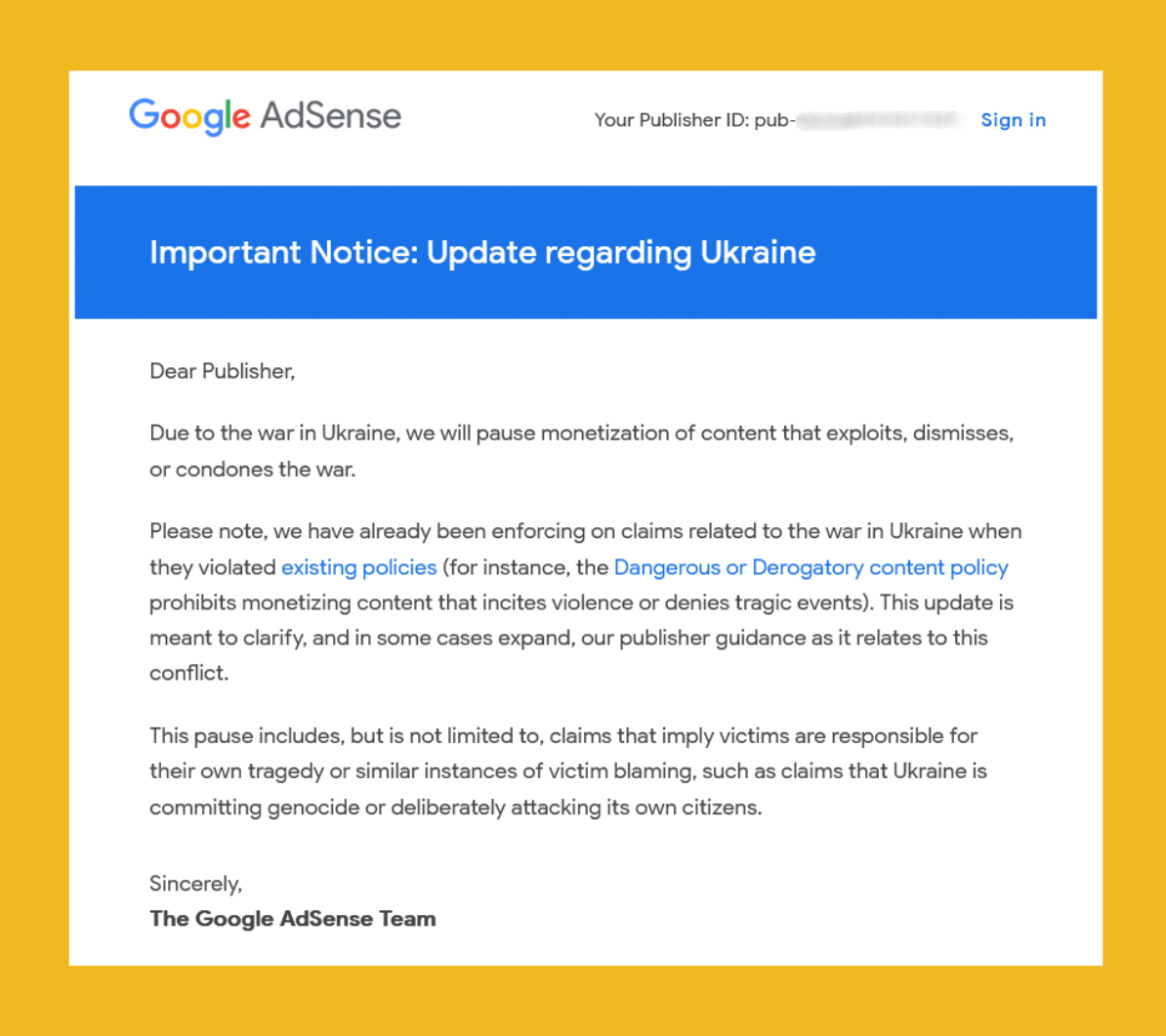 A notice to MintPress from Google threatening demonetization[/caption]
Those views are certainly currently in the minority, with testimonies from locals pointing the finger at Russian forces, who have carried out similar acts during other conflicts. Yet even the Pentagon has refused to categorically conclude Russian culpability without a full investigation.
Beyond Bucha, where the line is in terms of accepted speech is being kept vague, leading to confusion and consternation among independent media outlets and content creators. “This is going to limit reporting on the Ukraine crisis because people are going to be scared,” Martin said. “People [in alternative media] are going to opt to not publish or not report on something because of fear of retaliation. And once you start to get demonetized, the next fear is that your videos are going to get blanket banned,” she added.
While support for Russia has essentially been prohibited, glorification of even the most unsavory elements of Ukrainian society on social media is now all-but-promoted. In February, Facebook announced that it would not only reverse its ban on discussing the Azov Battalion, a Nazi paramilitary now formally incorporated into the Ukrainian National Guard, but also allow content praising and promoting the group – as long as it was in the context of killing Russians.
Facebook and Instagram also instituted a change in policy that allows users to call for harm or even the death of Russian and Belarussian soldiers and politicians. This rare allowance was also given in 2021 to those calling for the death of Iranian leaders. Needless to say, violent content directed at governments friendly to the U.S., such as Ukraine, is still strictly forbidden.
A notice to MintPress from Google threatening demonetization[/caption]
Those views are certainly currently in the minority, with testimonies from locals pointing the finger at Russian forces, who have carried out similar acts during other conflicts. Yet even the Pentagon has refused to categorically conclude Russian culpability without a full investigation.
Beyond Bucha, where the line is in terms of accepted speech is being kept vague, leading to confusion and consternation among independent media outlets and content creators. “This is going to limit reporting on the Ukraine crisis because people are going to be scared,” Martin said. “People [in alternative media] are going to opt to not publish or not report on something because of fear of retaliation. And once you start to get demonetized, the next fear is that your videos are going to get blanket banned,” she added.
While support for Russia has essentially been prohibited, glorification of even the most unsavory elements of Ukrainian society on social media is now all-but-promoted. In February, Facebook announced that it would not only reverse its ban on discussing the Azov Battalion, a Nazi paramilitary now formally incorporated into the Ukrainian National Guard, but also allow content praising and promoting the group – as long as it was in the context of killing Russians.
Facebook and Instagram also instituted a change in policy that allows users to call for harm or even the death of Russian and Belarussian soldiers and politicians. This rare allowance was also given in 2021 to those calling for the death of Iranian leaders. Needless to say, violent content directed at governments friendly to the U.S., such as Ukraine, is still strictly forbidden.
The media demands more censorship
Leading the campaign for more intense censorship has been corporate media itself. The Financial Times successfully lobbied Amazon-owned streaming platform Twitch to delete a number of pro-Russian streamers. The Daily Beast attacked Gonzalo Lira, going so far as to contact the Ukrainian government to make them aware of Lira’s work. Lira confirmed that, after The Daily Beast’s article, he was arrested by the Ukrainian secret police. Meanwhile, The New York Times published a hit piece on anti-war journalist Ben Norton, accusing him of spreading a “conspiracy theory” that the U.S. was involved in a coup in Ukraine in 2014, while claiming that he was helping promulgate Russian disinformation. This, despite the fact that the Times itself reported on the 2014 coup at the time in a not-too-dissimilar fashion, thereby incriminating its own previous reporting as Russian propaganda. If referencing The New York Times’s own previous reporting becomes grounds for suppression, then meaningful online discourse is under threat. As journalist Matt Taibbi wrote last week, the West is in danger of establishing an “intellectual no-fly zone,” where deviating from orthodoxy will no longer be tolerated. [caption id="" align="alignnone" width="599"]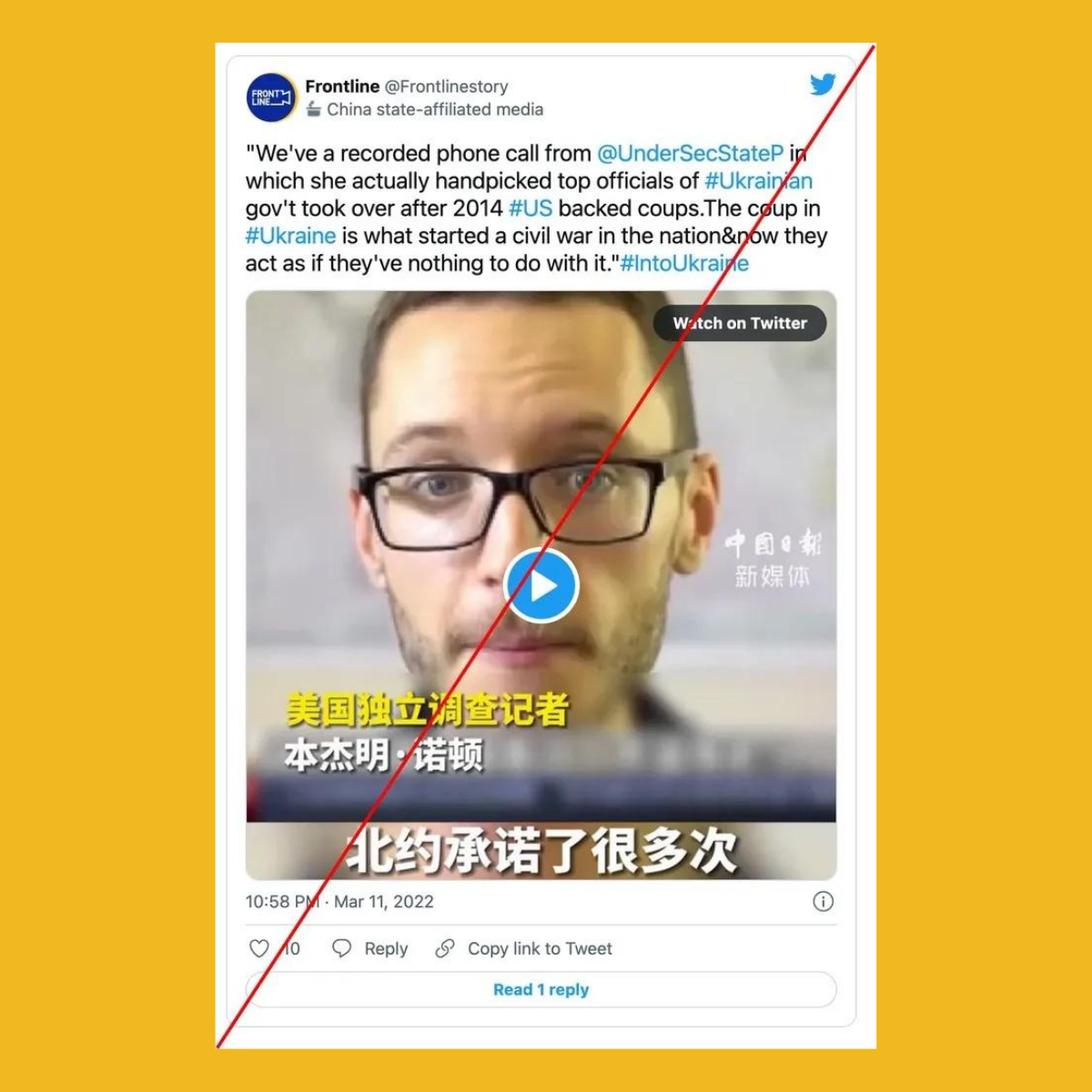 An image shared in the NYT hit against Norton. Credit | Multipolarista[/caption]
The invasion of Ukraine has also raised a number of troubling questions for Western anti-war figures: How to oppose Russian aggression without providing more political ammunition to NATO governments to further escalate the conflict? And how to critique and highlight our own governments’ roles in creating the crisis without appearing to justify the Kremlin’s actions? Yet this new perilous media environment raises a further quandary: How to express views online without being censored?
Google’s new updated rules are vaguely worded and open to interpretation. What constitutes “exploiting” or “condoning” the war? Does discussing NATO’s eastward expansion or Ukraine’s aggressive campaign against Russian-speaking minorities constitute victim blaming? And is referencing the seven-year-long civil war in the Donbas region, where the UN estimates that over 14,000 people have been killed, now illegal under Google’s policy of not allowing content about Ukraine attacking its own citizens?
For some, the answer to at least some of these questions should be an emphatic “yes.” On Thursday, journalist Hubert Smeets attacked longtime anti-war activist Noam Chomsky, explicitly accusing him of blaming President Zelensky and Ukraine for its fate. Chomsky has previously described Russian actions as incontestably “a major war crime, ranking alongside the U.S. invasion of Iraq and the Hitler-Stalin invasion of Poland in September 1939.” Yet he has also for years warned that NATO actions in the region were likely to provoke a Russian response. If Google and other big-tech monopolies decide an intellectual giant like Chomsky’s voice must be suppressed, it will mark a new era of official censorship not seen since the decline of McCarthyism.
An image shared in the NYT hit against Norton. Credit | Multipolarista[/caption]
The invasion of Ukraine has also raised a number of troubling questions for Western anti-war figures: How to oppose Russian aggression without providing more political ammunition to NATO governments to further escalate the conflict? And how to critique and highlight our own governments’ roles in creating the crisis without appearing to justify the Kremlin’s actions? Yet this new perilous media environment raises a further quandary: How to express views online without being censored?
Google’s new updated rules are vaguely worded and open to interpretation. What constitutes “exploiting” or “condoning” the war? Does discussing NATO’s eastward expansion or Ukraine’s aggressive campaign against Russian-speaking minorities constitute victim blaming? And is referencing the seven-year-long civil war in the Donbas region, where the UN estimates that over 14,000 people have been killed, now illegal under Google’s policy of not allowing content about Ukraine attacking its own citizens?
For some, the answer to at least some of these questions should be an emphatic “yes.” On Thursday, journalist Hubert Smeets attacked longtime anti-war activist Noam Chomsky, explicitly accusing him of blaming President Zelensky and Ukraine for its fate. Chomsky has previously described Russian actions as incontestably “a major war crime, ranking alongside the U.S. invasion of Iraq and the Hitler-Stalin invasion of Poland in September 1939.” Yet he has also for years warned that NATO actions in the region were likely to provoke a Russian response. If Google and other big-tech monopolies decide an intellectual giant like Chomsky’s voice must be suppressed, it will mark a new era of official censorship not seen since the decline of McCarthyism.
Old propaganda, new Cold War
The United States was allied with the Soviet Union during World War II. However, as the Cold War began to set in, so did attacks on dissenting voices. The postwar anti-communist push began in earnest in 1947, after President Harry S. Truman mandated a loyalty oath for all federal employees. As a result, the political beliefs of two million people were investigated, with authorities attempting to ascertain whether they belonged to any “subversive” political organizations. Those in positions of influence were most aggressively vetted, leading to purges of academics, educators, and journalists. Many of the most celebrated individuals from the world of entertainment – including actor Charlie Chaplain, singer Paul Robeson, and writer Orson Welles – had their careers destroyed because of their political beliefs. “Socialism was canceled, dissent was canceled after World War Two,” Breakthrough News host Brian Becker recently said, warning that this new Cold War with Russia and China could usher in a new McCarthyist era. The old Cold War against Russia ended in 1991. However, the new Cold War arguably started 25 years later with the electoral victory of Donald Trump. On November 8, 2016, the Clinton campaign alleged that the Kremlin had used social media to spread fake news and misleading information, leading to Trump’s victory. Despite the lack of hard evidence, corporate media immediately took up Clinton’s message. Only two weeks after the election, The Washington Post published a report claiming that hundreds of fake news websites had pushed Trump over the line and that a credible group of nonpartisan expert researchers had created an organization called “PropOrNot” to track this effort. Using what it called sophisticated “internet analytics tools,” PropOrNot published a list of over 200 websites that they claimed were “routine peddlers of Russian propaganda.” Included on the list were publisher WikiLeaks, Trump-supporting websites like The Drudge Report, libertarian ventures such as The Ron Paul Institute and Antiwar.com, as well as a host of left-wing websites like Truthout, Truthdig, and The Black Agenda Report. MintPress News was also featured on the list. While there were some obviously fake-news websites included, the political orientation of the list was obvious for all to see: this was a catalog of outlets – right- and left-wing – that was consistently critical of the centrist Washington establishment. A sure sign that you are reading Russian propaganda, PropOrNot claimed, was if the source criticizes Obama, Clinton, NATO, the “mainstream media,” or expresses worry about a nuclear war with Russia. As PropOrNot explained, “Russian propaganda never suggests [conflict with Russia] would just result in a Cold War 2 and Russia’s eventual peaceful defeat, like the last time.” Despite the blatantly shoddy list, one that even included the websites of Pulitzer Prize-winning journalists, The Washington Post’s article went viral, being shared millions of times. PropOrNot’s list was subsequently signal-boosted by hundreds of other outlets. And despite calling for McCarthyist investigation into and suppression of hundreds of outlets, PropOrNot categorically refused to reveal who they were, how they were funded, or any methodology whatsoever. It is now almost certain that it was not a neutral, well-meaning independent organization but the creation of Michael Weiss, a non-resident senior fellow of NATO think tank The Atlantic Council. A scan of PropOrNot’s website showed that it was controlled by The Interpreter, a magazine of which Weiss is editor-in-chief. Furthermore, one investigator found dozens of examples of the Twitter accounts of PropOrNot and Weiss using the identical and very unusual turn of phrase, strongly suggesting they were one and the same. Thus, claims of a huge [foreign] state propaganda campaign were themselves state propaganda. The reaction to this crude “propaganda about propaganda” campaign was both swift and wide-ranging. In early 2017, Google launched Project Owl, a massive overhaul of its algorithm. It claimed that it was purely a measure to stop foreign fake news from taking over the internet. The main outcome, however, was a catastrophic, overnight collapse in search traffic to high-quality alternative media outlets – drops from which they have never recovered. MintPress News lost nearly 90% of its organic Google search traffic and Truthout lost 25%. Websites that were not on PropOrNot’s list also suffered devastating losses. AlterNet experienced a 63% reduction, Common Dreams 37% and Democracy Now! 36%. Even liberal sources only moderately critical of the status quo, such as The Nation and Mother Jones, were penalized by the algorithm. Google search traffic to alternative media has never recovered and has, in many cases, gotten worse. [caption id="" align="alignnone" width="599"]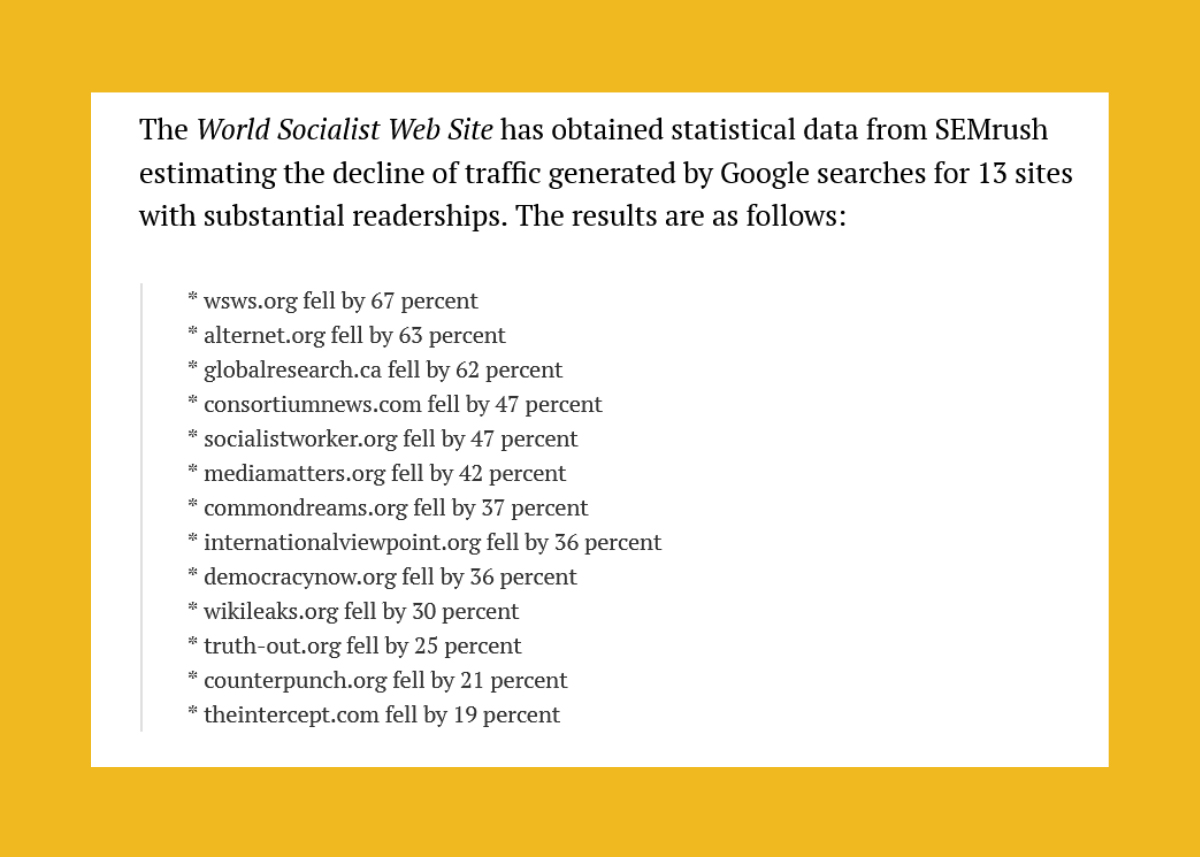 Credit | WSWS[/caption]
This, for Martin, is a sign of the increasingly close relationship between Silicon Valley and the national security state. “Google willingly changed their algorithm to backpage all alternative media without even a law in place to mandate them to do so,” she said. Other social media juggernauts, such as Facebook and YouTube rolled out similar changes. All penalized alternative media and drove people back towards establishment sources like The Washington Post, CNN and Fox News.
The consequence of all this was to retighten the elite’s grip over the means of communication, a grip that had slipped owing to the rise of the internet as an alternative model.
Credit | WSWS[/caption]
This, for Martin, is a sign of the increasingly close relationship between Silicon Valley and the national security state. “Google willingly changed their algorithm to backpage all alternative media without even a law in place to mandate them to do so,” she said. Other social media juggernauts, such as Facebook and YouTube rolled out similar changes. All penalized alternative media and drove people back towards establishment sources like The Washington Post, CNN and Fox News.
The consequence of all this was to retighten the elite’s grip over the means of communication, a grip that had slipped owing to the rise of the internet as an alternative model.
The “nationalization” of social media
Since 2016, a number of other measures have been taken to bring social media under the wing of the national security state. This was foreseen by Google executives Eric Schmidt and Jared Cohen, who wrote in 2013, “What Lockheed Martin was to the twentieth century, technology and cyber-security companies will be to the twenty-first.” Since then, Google, Microsoft, Amazon and IBM have become integral parts of the state apparatus, signing multibillion-dollar contracts with the CIA and other organizations to provide them with intelligence, logistics and computing services. Schmidt himself was chairman of both the National Security Commission on Artificial Intelligence and the Defense Innovation Advisory Board, bodies created to help Silicon Valley assist the U.S. military with cyberweapons, further blurring the lines between big tech and big government. Google’s current Global Head of Developer Product Policy, Ben Renda, has an even closer relationship with the national security state. From being a strategic planner and information management officer for NATO, he then moved to Google in 2008. In 2013, he began working for U.S. Cybercommand and in 2015 for the Defense Innovation Unit (both divisions of the Department of Defense). At the same time, he became a YouTube executive, rising to the rank of Director of Operations. [caption id="" align="alignnone" width="600"]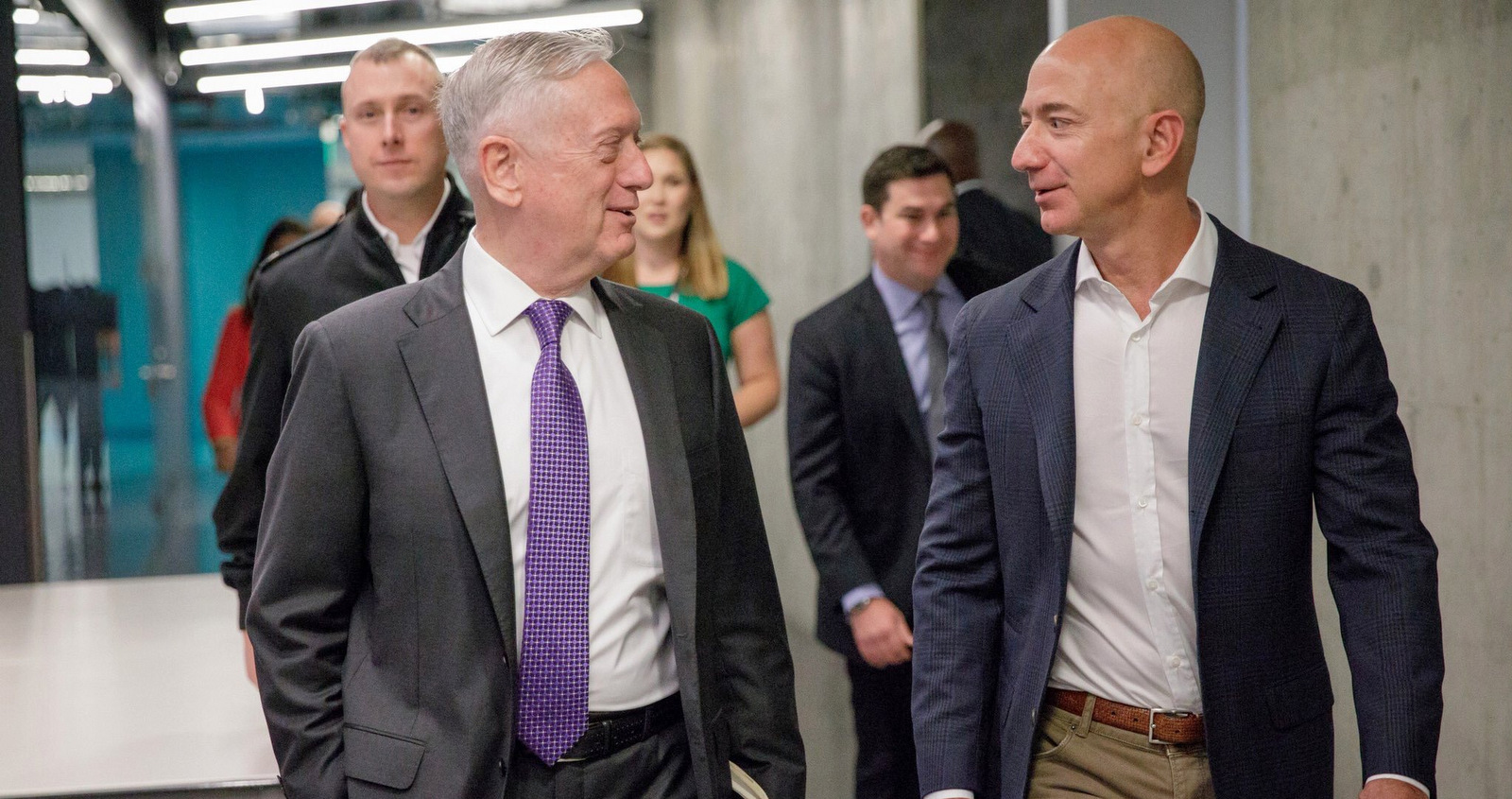 Jeff Bezo meets with Trump Defense Secretary James Mattis during a visit to west coast tech and defense companies. Jeff Bezos | Twitter[/caption]
Other platforms have similar relationships with Washington. In 2018, Facebook announced that it had entered a partnership with The Atlantic Council whereby the latter would help curate the news feeds of billions of users worldwide, deciding what was credible, trustworthy information, and what was fake news. As noted previously, The Atlantic Council is NATO’s brain-trust and is directly funded by the military alliance. Last year, Facebook also hired Atlantic Council senior fellow and former NATO spokesperson Ben Nimmo as its head of intelligence, thereby giving an enormous amount of control over its empire to current and former national security state officials.
The Atlantic Council has also worked its way into Reddit’s management. Jessica Ashooh went straight from being Deputy Director of Middle East Strategy at The Atlantic Council to Director of Policy at the popular news aggregation service – a surprising career move that drew few remarks at the time.
Also eliciting little comment was the unmasking of a senior Twitter executive as an active-duty officer in the British Army’s notorious 77th Brigade – a unit dedicated to online warfare and psychological operations. Twitter has since partnered with the U.S. government and weapons manufacturer-sponsored think tank ASPI to help police its platform. On ASPI’s orders, the social media platform has purged hundreds of thousands of accounts based out of China, Russia, and other countries that draw Washington’s ire.
Last year, Twitter also announced that it had deleted hundreds of user accounts for “undermining faith in the NATO alliance and its stability” – a statement that drew widespread incredulity from those not closely following the company’s progression from one that championed open discussion to one closely controlled by the government.
Jeff Bezo meets with Trump Defense Secretary James Mattis during a visit to west coast tech and defense companies. Jeff Bezos | Twitter[/caption]
Other platforms have similar relationships with Washington. In 2018, Facebook announced that it had entered a partnership with The Atlantic Council whereby the latter would help curate the news feeds of billions of users worldwide, deciding what was credible, trustworthy information, and what was fake news. As noted previously, The Atlantic Council is NATO’s brain-trust and is directly funded by the military alliance. Last year, Facebook also hired Atlantic Council senior fellow and former NATO spokesperson Ben Nimmo as its head of intelligence, thereby giving an enormous amount of control over its empire to current and former national security state officials.
The Atlantic Council has also worked its way into Reddit’s management. Jessica Ashooh went straight from being Deputy Director of Middle East Strategy at The Atlantic Council to Director of Policy at the popular news aggregation service – a surprising career move that drew few remarks at the time.
Also eliciting little comment was the unmasking of a senior Twitter executive as an active-duty officer in the British Army’s notorious 77th Brigade – a unit dedicated to online warfare and psychological operations. Twitter has since partnered with the U.S. government and weapons manufacturer-sponsored think tank ASPI to help police its platform. On ASPI’s orders, the social media platform has purged hundreds of thousands of accounts based out of China, Russia, and other countries that draw Washington’s ire.
Last year, Twitter also announced that it had deleted hundreds of user accounts for “undermining faith in the NATO alliance and its stability” – a statement that drew widespread incredulity from those not closely following the company’s progression from one that championed open discussion to one closely controlled by the government.
The first casualty
Those in the halls of power well understand how important a weapon big-tech is in a global information war. This can be seen in a letter published last Monday written by a host of national security state officials, including former Director of National Intelligence James Clapper, former CIA directors Michael Morell and Leon Panetta, and former director of the NSA Admiral Michael Rogers. Together, they warn that regulating or breaking up the big-tech monopolies would “inadvertently hamper the ability of U.S. technology platforms to … push back on the Kremlin.” “The United States will need to rely on the power of its technology sector to ensure” that “the narrative of events” globally is shaped by the U.S. and “not by foreign adversaries,” they explain, concluding that Google, Facebook, Twitter are “increasingly integral to U.S. diplomatic and national security efforts.” Commenting on the letter, journalist Glenn Greenwald wrote:[B]y maintaining all power in the hands of the small coterie of tech monopolies which control the internet and which have long proven their loyalty to the U.S. security state, the ability of the U.S. national security state to maintain a closed propaganda system around questions of war and militarism is guaranteed.”The U.S. has frequently leaned on social media in order to control the message and promote regime change in target countries. Just days before the Nicaraguan presidential election in November, Facebook deleted the accounts of hundreds of the country’s top news outlets, journalists and activists, all of whom supported the left-wing Sandinista government. When those figures poured onto Twitter to protest the ban, recording videos of themselves and proving that they were not bots or “inauthentic” accounts, as Facebook Intelligence Chief Nimmo had claimed, their Twitter accounts were systematically banned as well, in what observers coined as a “double-tap strike.” Meanwhile, in 2009, Twitter acquiesced to a U.S. request to delay scheduled maintenance of its app (which would have required taking it offline) because pro-U.S. activists in Iran were using the platform to foment anti-government demonstrations. More than 10 years later, Facebook announced that it would be deleting all praise of Iranian General Qassem Soleimani from its many platforms, including Instagram and WhatsApp. Soleimani – the most popular political figure in Iran – had recently been assassinated in a U.S. drone strike. The event sparked uproar and massive protests across the region. Yet because the Trump administration had declared Soleimani and his military group to be terrorists, Facebook explained, “We operate under U.S. sanctions laws, including those related to the U.S. government’s designation of the Iranian Revolutionary Guard Corps and its leadership.” This meant that Iranians could not share a majority viewpoint inside their own country – even in their own language – because of a decision made in Washington by a hostile government.
In this light, then, Google’s message to creators about victim-blaming Ukraine or trivializing and condoning violence is a threat: toe the line or face the consequences. While we continue to consider tech monopolies such as Google, Twitter, and Facebook to be private companies, their overwhelming size and their increasing proximity to the national security state means that their actions are tantamount to state censorship. While fake news – including that emanating from Russia – continues to be a genuine problem, these new actions have far less to do with combatting disinformation or denial of war crimes and far more to do with reestablishing elite control over the field of communication. These new rules will not be applied to corporate media downplaying or justifying U.S. aggression abroad, denying American war crimes, or blaming oppressed peoples – such as Palestinians or Yemenis – for their own condition, but instead will be used as excuses to derank, demote, delist or even delete voices critical of war and imperialism. In war, they say, truth is always the first casualty. Read more at: MintPressNews.comWar has come to alternative media.
We must say NO to censorship. Help us rebuild alternative media!https://t.co/gKGTJu5bLZpic.twitter.com/nGqTv5EbRs — MintPress News (@MintPressNews) April 20, 2022
By Arsenio Toledo // Share
Europe quietly abandoning Ukraine by withholding military aid
By Kevin Hughes // Share

Twitter’s “tricky” timing problem: Lawsuit reveals back channel with CDC to coordinate censorship
By News Editors // Share

Group of vegans cement themselves in front of Starbucks… the reason they did it is hilarious
By News Editors // Share
Globalist ‘death cult’ launches all-out war on the essential elements of life: MUST-WATCH VIDEO
By News Editors // Share
The AI power crunch is forcing Big Tech to abandon its climate script
By isabelle // Share
9/11, Anwar Al-Awlaki, Unanswered Questions and Why Some Answers Remain Hidden
By morganverity // Share
Modi Calls for Global Governance Reform as BRICS Adopts New Delhi Declaration
By edisonreed // Share

Is Your Sunscreen Hiding a Toxic Ingredient? The Homosalate Debate Explained
By zoeysky // Share

Study: High Ultra-Processed Food Intake Linked to 40% Higher Atherosclerosis Risk
By cocosomers // Share