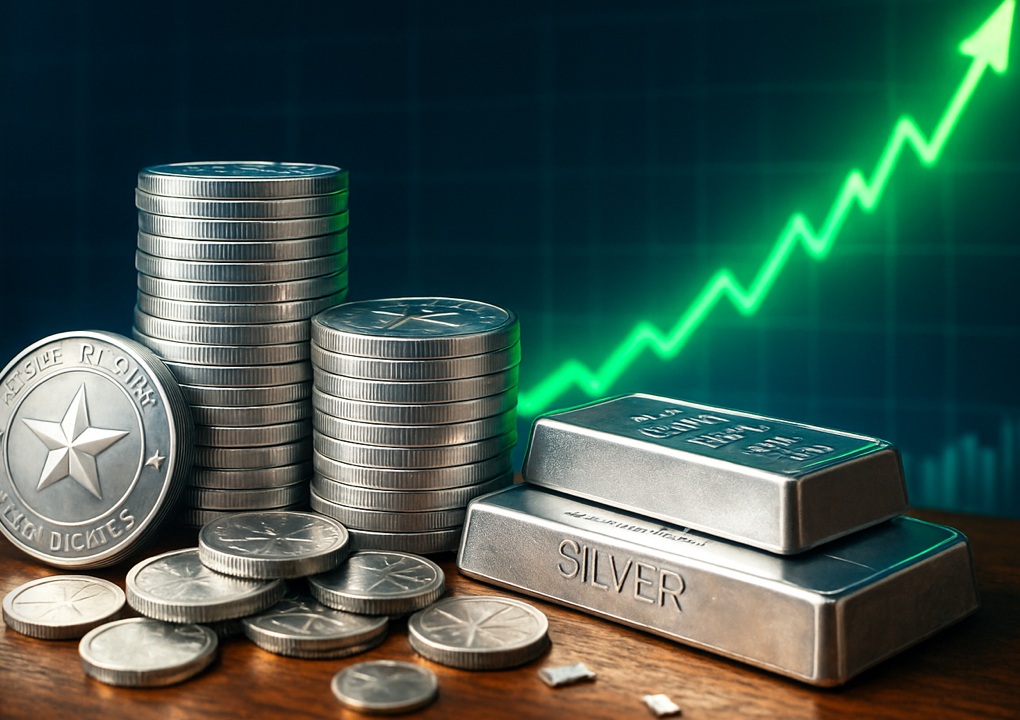
- Silver surged past $66/oz, marking a 129% year-to-date gain, fueled by Fed rate cut expectations, economic instability, and rising geopolitical tensions (U.S.-Venezuela conflict).
- Safe Haven and Industrial Demand: Silver's dual role as a hedge against inflation and a critical component in green tech (solar panels, EVs, electronics) drives its outperformance over gold, which reached 4,334/oz. Analysts predict 70-100/oz by late 2026, with long-term targets of 200-$300/oz.
- Fed Policy and Economic Weakness: Rising U.S. unemployment (6%) signals potential additional Fed rate cuts, reducing bond yields and boosting non-yielding precious metals like silver.
- Winners and Losers: Silver miners (Pan American Silver, First Majestic) and streaming companies (Wheaton Precious Metals) benefit from soaring prices, while solar (First Solar) and EV manufacturers (Tesla, GM) face higher production costs.
- Investment Outlook: Physical silver is safest amid market manipulation risks; mining stocks (AG, PAAS, HL) and ETFs (SLV, SIL) offer leveraged exposure. Watch Fed moves, inflation data and green tech demand for further price catalysts.
Why silver is exploding now
Fresh U.S. economic data revealed a softening labor market, with unemployment rising to 4.6%—the highest level since September 2021. This has fueled speculation that the Federal Reserve will implement two additional rate cuts in 2026, following its third cut last week. Bas Kooijman, CEO of DHF Capital, told Reuters: "Markets continue to see the Federal Reserve cutting its interest rates two times during the first part of 2026, which could continue to support gold [and silver] over that period." Lower interest rates diminish the appeal of yield-bearing assets like bonds, driving investors toward non-yielding precious metals as a hedge against inflation and economic uncertainty. Adding to silver's bullish momentum, President Donald Trump ordered a blockade of all sanctioned oil tankers entering and leaving Venezuela—a move escalating tensions with Nicolas Maduro's government. Such geopolitical instability traditionally boosts demand for safe-haven assets, including silver and gold. Unlike gold, silver plays a vital role in green technology, including solar panels, electric vehicles (EVs) and electronics. The solar industry alone consumes 20% of global silver supply, while EVs require three times more silver than traditional vehicles. Edward Meir, a Marex analyst, noted: "Silver is pulling gold up with it… there is some rotational money going out of gold and into silver, platinum and palladium." He predicts 70 per ounce as the next short-term target, with some analysts forecasting 100+ by late 2026.Who wins—and who loses—from silver's surge?
Companies like Pan American Silver (PAAS), First Majestic (AG) and Hecla Mining (HL) are poised for record profits as higher silver prices translate into expanded margins. Streaming firms like Wheaton Precious Metals (WPM)—which buy silver at fixed costs—stand to gain immensely as spot prices skyrocket. The solar industry, including First Solar (FSLR) and JinkoSolar (JKS), faces rising production costs due to silver-intensive manufacturing. Similarly, Tesla, GM and Ford must contend with higher silver prices inflating EV battery expenses—potentially slowing adoption or squeezing profits. With five consecutive years of supply deficits and exchange inventories at historic lows, silver's fundamentals remain bullish. Some analysts predict:- $70−$100/oz by late 2026
- $200−$300/oz within 5-10 years

The Noriega playbook: U.S. captures Maduro in daring raid, citing legal precedent
By Willow Tohi // Share

U.S. military intervention in Venezuela raises questions over motives behind Maduro’s capture
By Finn Heartley // Share

China condemns U.S. military strikes in Venezuela as “hegemonic attack,” demands Maduro’s release
By Belle Carter // Share

Starlink offers free internet service to Venezuela as societal collapse looms
By Cassie B. // Share



North Korea confirms tactical missile upgrade in new provocative launch
By willowt // Share

By douglasharrington // Share

U.S. Bankruptcy Filings Rise 11% in First Nine Months of 2026
By sterlingashworth // Share

Getty Images Plans Chapter 11 Restructuring as AI Reshapes Stock Photo Market
By chasecodewell // Share

Ashwagandha: The timeless herb fusing ancient wisdom and modern wellness
By avagrace // Share

Study Links Higher-Dose Vitamin D to Better Cognition in Adults With MCI and Poor Sleep
By cocosomers // Share