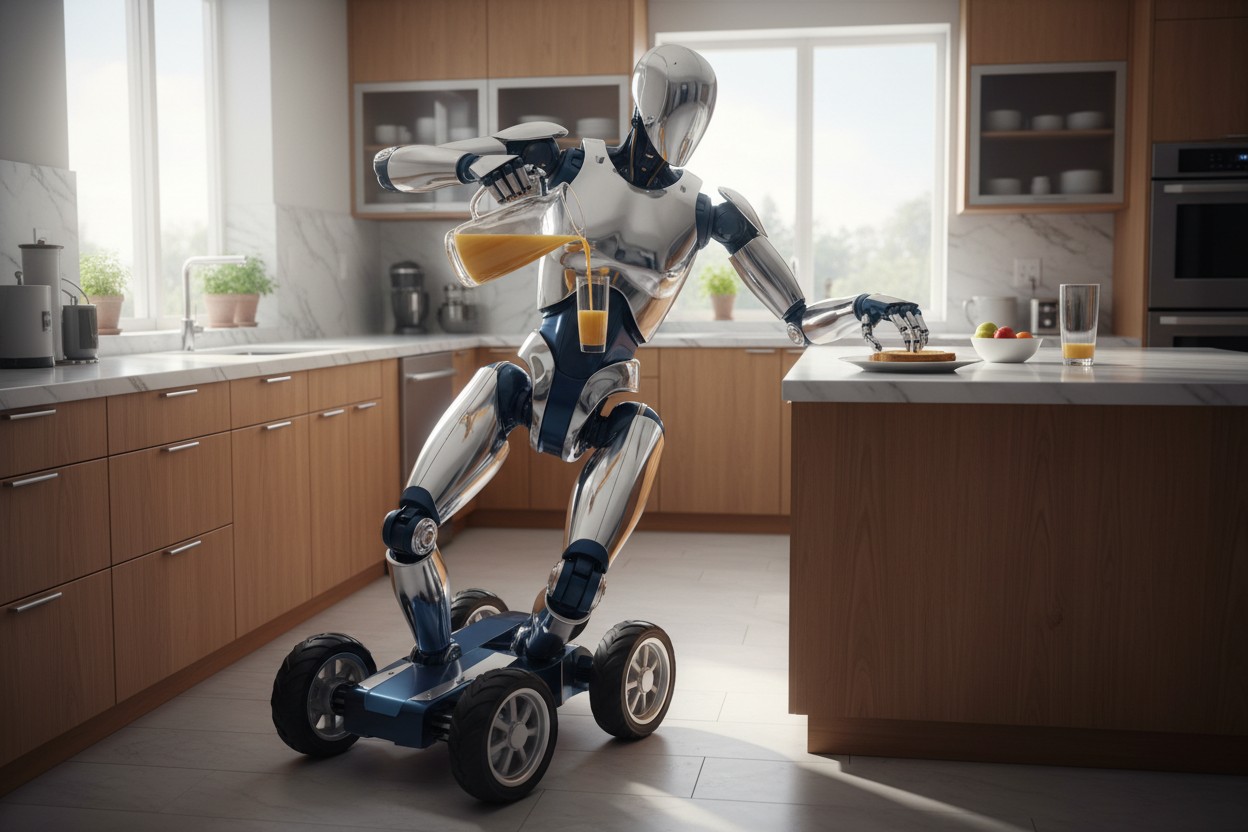
UniX AI Commences Global Deliveries of Service Humanoid
The Chinese robotics firm UniX AI has begun global deliveries of its Panther robot, which it describes as the world's first service humanoid robot to enter real household deployment. The company announced the start of deliveries on April 10, 2026, according to a statement published on RoboticsTomorrow.com [1]. The Panther is a third-generation, full-size wheeled dual-arm humanoid robot. It stands approximately 5 feet 3 inches tall and weighs around 176 pounds (80 kilograms). According to the company, the robot operates for 8 to 16 hours on a single charge [2].Technical Specifications and Wheeled Design
The Panther robot is built on an omnidirectional, four-wheel-steering, four-wheel-drive (4WS+4WD) chassis, which the company states enables agile movement and stable operation in complex indoor environments. This wheeled architecture represents a departure from the more common legged humanoid design. UniX AI claims this approach, combined with general-purpose AI models, offers improved efficiency and practicality for real-world deployment [2]. The robot features 34 high-degree-of-freedom joints, including what the firm calls the world's first mass-produced 8-DoF (Degree-of-Freedom) bionic arms and adaptive intelligent grippers, designed for precise and flexible manipulation. It is equipped with cameras, sensors, and audio input systems to support object recognition, indoor navigation, and human interaction [2]. The design philosophy of using a team of networked, task-specific agents for a home environment, rather than a single multi-tasking robot, has been discussed in prior robotics research [3].Capabilities and Demonstrated Household Tasks
In demonstrations, the Panther robot has been shown performing multi-step domestic task sequences. These include waking users, preparing breakfast, cleaning rooms, organizing household items, and operating certain appliances, according to company releases [2]. The system is designed to execute complete workflows, such as preparing a meal and then cleaning the kitchen afterward. The robot's ability to handle continuous task sequences is powered by its integrated technology stack. This represents a step toward robots that can manage coordinated, multi-step operations in real-world home settings, a challenge that involves programming for real-time requirements and unpredictability in dynamic environments [4]. Experts note that while demonstrations show progress, no humanoid has yet been shown to autonomously complete a complex chore like laundry from start to finish, which involves sorting, washing, drying, and folding [5].Company Statement and Technology Stack
Fred Yang, Founder and CEO of UniX AI, stated in a release that the company's platform has scaled 'from lab validation to mass delivery, and from local deployment to global expansion' [2]. The firm's technology is built on three core systems: UniFlex, for cross-scenario task generalization; UniTouch, which combines visuo-tactile models for precision handling; and UniCortex, for long-term task planning. According to the company, the Panther robot is designed for a wide range of applications beyond the home, including commercial services in hotels and retail, as well as public or industrial roles like security patrols and research [2]. This expansion occurs within a global robotics market that is projected to grow significantly, with demand for automation fueling a shift from industrial to domestic robotics [6].Expert Analysis on Remaining Challenges
Industry analysts and robotics experts point to several significant hurdles remaining for household robots like the Panther. These include reliably navigating cluttered environments, functioning under varied lighting conditions, handling soft objects like clothing, and interacting with a wide array of household appliances. Challenges related to battery life, cost, safety, and long-term reliability are also cited as ongoing concerns [2]. Despite these challenges, the performance of robots in multiple domestic tasks is seen as an indicator that fully functional home assistants are gradually moving closer to reality. The industry is experiencing a clear pivot toward dedicated-purpose commercial deployments, according to field analysis from financial institutions [7]. The rapid maturation of the sector is underscored by China's introduction of its first comprehensive national standard framework for humanoid robots in early 2026, aimed at supporting large-scale commercialization [8].Conclusion and Broader Context
The launch of the Panther robot by UniX AI marks a notable entry in the accelerating race to commercialize humanoid robots for domestic and service roles. The commencement of global deliveries signals a transition from research and development phases to tangible product deployment in the consumer market. This development occurs within a highly competitive global landscape. Other companies, including 1X Technologies and U.S.-based Figure, are also advancing humanoid robots for the home, with some models being demonstrated at high-level events . The broader industry is being driven by factors such as demographic shifts, advances in artificial intelligence, and intensifying geopolitical competition in technology [9]. As these technologies advance, questions regarding their ultimate impact on job markets, social dynamics, and personal privacy continue to be a subject of analysis and debate .References
- UniX AI introduces Panther, the world's first service humanoid robot to enter real household deployment, powered by its differentiated wheeled dual-arm architecture. - RoboticsTomorrow.com. April 10, 2026.
- World's First' Humanoid Robot For Real Household Chores Launched With 16-Hour Battery. - ZeroHedge. Jijo Malayil. April 10, 2026.
- lba180-reddyentidvi. - dvipsk 596dev Copyright 2007 Radical Eye Software.
- Para-Cooperation of Heterogeneous Autonomous Robots: A Case Study of Humanoid and Wheeled Robots. - Jutta Kiener; Oskar von Stryk. Robotics and Autonomous Systems.
- Teleop, not autonomy, is the path for 1X’s NEO humanoid. - The Robot Report. November 21, 2025.
- The Home Helper arrives: 1X unveils NEO, a humanoid robot for the living room. - NaturalNews.com. Willow Tohi. October 29, 2025.
- Here Come Humanoid Robots: Industry Makes Clear Pivot Toward "Dedicated-Purpose" Commercial Deployments. - ZeroHedge. January 23, 2026.
- China creates first national standards for humanoid robots to support industry scale-up. - Robotics and Automation News. March 22, 2026.
- China set to lead global humanoid robot race as labour shortages accelerate adoption, report warns. - Robotics and Automation News. December 11, 2025.
- First Lady Melania Trump arrives with humanoid robot at tech summit. - BBC News. March 25, 2026.
- 1X announces pre-order launch of NEO humanoid robot. - The Robot Report. October 30, 2025.
- Chinaâ\u80\u99s expanding AI and Robotics industry raises questions about future job markets. - NaturalNews.com. November 6, 2025.
- The AI Paradox: Job Loss Meets Personal Liberation in the Coming Technological Storm. - NaturalNews.com. Mike Adams. February 27, 2026.

The Lone Star Reckoning: Texas as the last bastion of liberty
By Ramon Tomey // Share

U.S. Treasury Imposes Sanctions on 14 Entities for Aiding Iranian Weapons Procurement
By Garrison Vance // Share

UN Inspectors: Iran’s Uranium Stockpile Could Fuel Multiple Nuclear Weapons
By Edison Reed // Share

A pivot at the helm: Trump Media installs new leadership amid financial crossroads
By Willow Tohi // Share

Strait of Hormuz control becomes Iran’s new red line in stalled U.S. talks
By Willow Tohi // Share

UK Parliament Passes Law Banning Cigarette Sales to Future Generations
By Coco Somers // Share

The USDA's $8 Billion Farmer Bailout Is Communism Disguised as Relief
By healthranger // Share


Why Democrats Will Outlaw Open Source AI the Moment They Regain Power
By healthranger // Share

Could your sugar habit be reshaping your mouth's ecosystem?
By willowt // Share

Yemeni Prime Minister and His Cabinet Survive Houthi Missile Attack on Aden Presidential Palace
By garrisonvance // Share