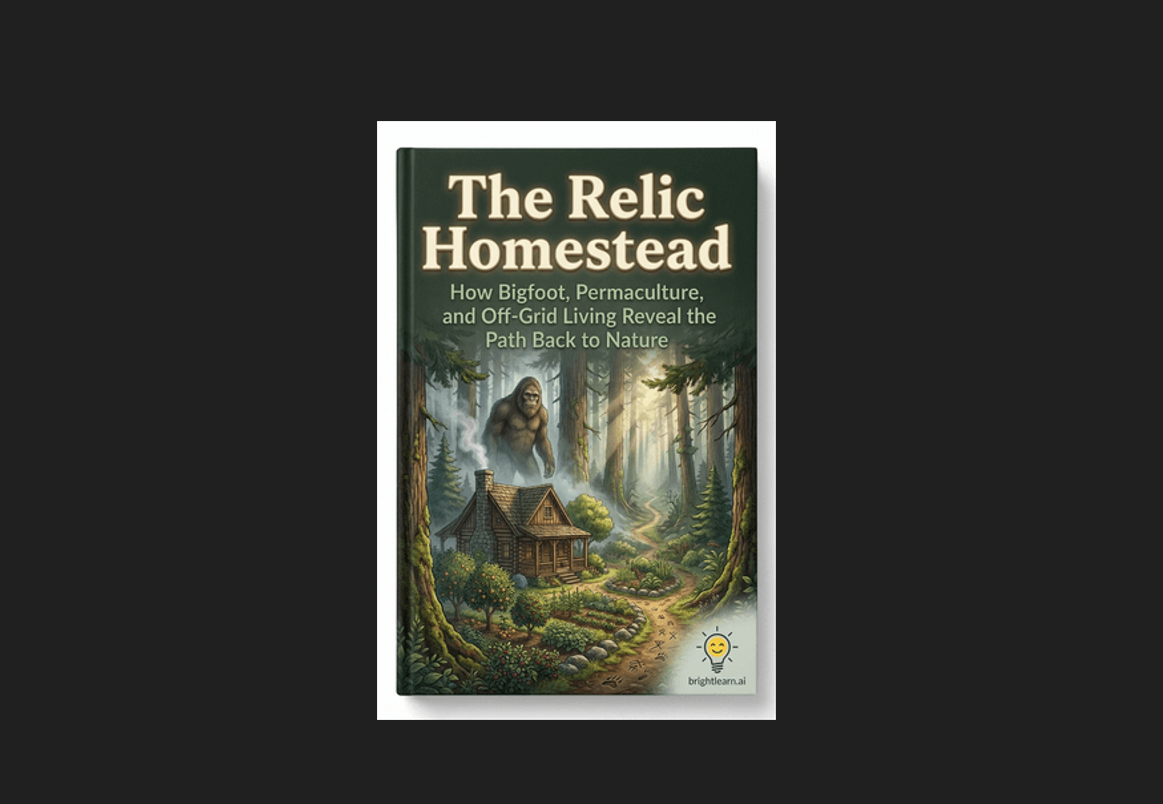
- "The Relic Homestead" is a battle cry and roadmap for those waking up to the lies of modern civilization (institutional authority, pharmaceutical solutions). It addresses the "interior wound" of believing humans are alone on a dead planet.
- The author's journey begins with a childhood Bigfoot sighting (a "relic hominid") that defied authority. A powerful opening story features three women in New York City who each had unexplainable spiritual connections to nature, fearing they were "crazy."
- The book builds a rigorous, non-skeptical case for Bigfoot as a hidden species, comparing it to "living fossils" like the coelacanth. It provides a practical field guide for encounters (Class A, B, C) and refutes the "phone-in-hand fallacy."
- The author teaches how to move through woods as a "welcome guest," using "goosebumps" as an inner compass. It integrates permaculture (e.g., the "Bigfoot Food Forest") and the "lighthouse homestead" concept as a model for radical self-reliance and ecological caretaking.
- The book weaves cryptozoology, permaculture, indigenous wisdom and radical self-reliance into a coherent worldview. It is a challenge to trust one’s own senses, get hands in the dirt and look for hidden marvels still present in nature.
A different kind of education
The book's structure is deceptively simple. It moves through five chapters that trace the author's own journey from childhood skepticism to adult self-reliance. Chapter one, "The Awakening," chronicles how growing up as a "Third Culture Kid"—the child of a military family that moved constantly—forced him to question every dominant narrative. When your world shifts every few years, you learn that "how things are done here" is just one version of reality. That questioning mindset becomes a survival tool, one that the author applies to everything from mainstream medicine to the official story about Bigfoot. The chapter on "The Encounter" is particularly powerful. As a nine-year-old, the author saw something on a cliff in Maine that could not be explained away. A tall, dark, bipedal figure that moved into the woods with an easy, silent stride. He was told it was his imagination. He learned to keep quiet. But the memory stayed and years later, when his mother brought home a book with a cover that matched exactly what he had seen, he knew he had not been wrong. That moment of validation—of trusting your own senses over the voices of authority—becomes the foundation for everything that follows.The relic hominid hypothesis
Chapter two dives deep into what the author calls "The Relic Hominid Hypothesis." This is not the usual Bigfoot book that dutifully lists sightings and then shrugs. Instead, it builds a rigorous case for why a hidden species could exist, drawing on the discovery of "living fossils" such as the coelacanth, the mountain gorilla and the giant squid. Each of these creatures was dismissed as a myth or extinct before being found alive. The author argues that the same pattern applies to Sasquatch and that the dismissal of these creatures is not about evidence but about protecting the narrative of human exceptionalism. The section on "Class A, B and C Encounters" provides a practical field guide for anyone who has ever seen something they cannot explain. Class A is a clear visual sighting at close range. Class B covers indirect evidence like footprints and vocalizations. Class C is the fleeting glimpse at dusk. The author emphasizes that each class is valid, but each must be documented with rigorous honesty. He also addresses the "phone-in-hand fallacy"—the idea that if Bigfoot were real, someone would have gotten clear video by now. This argument, he shows, ignores how rare and startling these encounters are and how human psychology works against capturing them.The art of respectful coexistence
Chapter three is where the book transforms from a cryptozoology text into a spiritual guide. "The Art of Respectful Coexistence" teaches you how to move through the woods as a welcome guest, not a burglar. The author explains that sneaking through the forest sends a predator signal to animals. Instead, you should move with calm, consistent, clear intention. He offers practical techniques: humming a low tune to announce your presence, leaving small offerings at the base of trees, stripping away synthetic fragrances that alert every creature for miles. The section on "The Gift of the Goosebumps" is worth the price of the book alone. The author argues that goosebumps are not just a leftover reflex from our caveman days. They are a signal, a kind of inner compass pointing toward awe and connection. He describes developing a field protocol for when goosebumps arrive: stop moving, look around slowly, listen and note the location. Many Bigfoot researchers report this sensation just before an encounter. The author suggests it is a form of communication, either from your own deeper consciousness or from the environment itself.Permaculture for the steward species
Chapter four, "Permaculture for the Steward Species," is the most practical and hopeful section. The author describes building the "Bigfoot Food Forest" on five acres in Florida, a polyculture designed to mimic the natural layers of a forest. Instead of rows of monoculture, you get hazelnuts, salmonberries, Oregon grape, nettles, clover and camas all growing together in a self-fertilizing system. "This is not a garden you have to fight," he writes. "It is a system that feeds itself, builds its own fertility and asks for almost nothing in return." The chapter includes detailed advice on using animals as partners in the garden—chickens that scratch through leaf litter, goats that clear brush, pigs that till compacted soil. It also describes the "lighthouse homestead" concept: a small patch of earth that functions as a safe harbor for neighbors and travelers, offering food, shelter and knowledge. In an age of rising social unrest and distrust of centralized institutions, these nodes of resilience are not just a nice idea. They are becoming essential.The verdict
The book's strength lies in its integration. It weaves together cryptozoology, permaculture, indigenous wisdom and radical self-reliance into a coherent worldview. It provides both the philosophical foundation and the practical steps for living differently. And it does so with a voice that is at once humble and fierce, compassionate and uncompromising. In the end, "The Relic Homestead" is a challenge. It asks you to step off the beaten path, to trust your own eyes, to get your hands in the dirt and to look for the hidden marvels that still walk among the trees. The path back to nature is waiting. This book shows you the way. Grab a copy of "The Relic Homestead: How Bigfoot, Permaculture, and Off-Grid Living Reveal the Path Back to Nature" via this link. Read, share and download thousands of books for free at Books.BrightLearn.AI. You can also create your own books for free at BrightLearn.AI. Watch Health Ranger Mike Adams' interview with Ryan Golembeske on Bigfoot encounters, food forests and off-grid living. This video is from the Health Ranger Report channel on Brighteon.com.Sources include:
Books.BrightLearn.ai BrightLearn.ai Brighteon.com
Georgia Power to Seize Homes for AI Data Center Transmission Line
By Edison Reed // Share

Principles Over Politics: The Ron Paul prescription for surviving empire’s collapse
By Belle Carter // Share


Iran Set to Receive Chinese Shoulder-Fired Missile Systems Within Weeks, Sources Say
By Garrison Vance // Share



Labor Department Suspends Eight Companies From Green Card Program
By edisonreed // Share

Reuters/Ipsos Poll: Trump Voters Show Lower Enthusiasm for Midterm Elections
By garrisonvance // Share

Trump Pledge on Iran Strikes Fails to Soothe Oil Markets
By sterlingashworth // Share

AI Chip Stocks Fall After Report on OpenAI Revenue Shortfall
By sterlingashworth // Share

EPA Proposes Rollback of Methane Rules for Oil and Gas Industry
By ivagreene // Share

Review Links Insomnia to 26% Higher Relative Risk of Stroke
By morganverity // Share