Technology and Mechanism
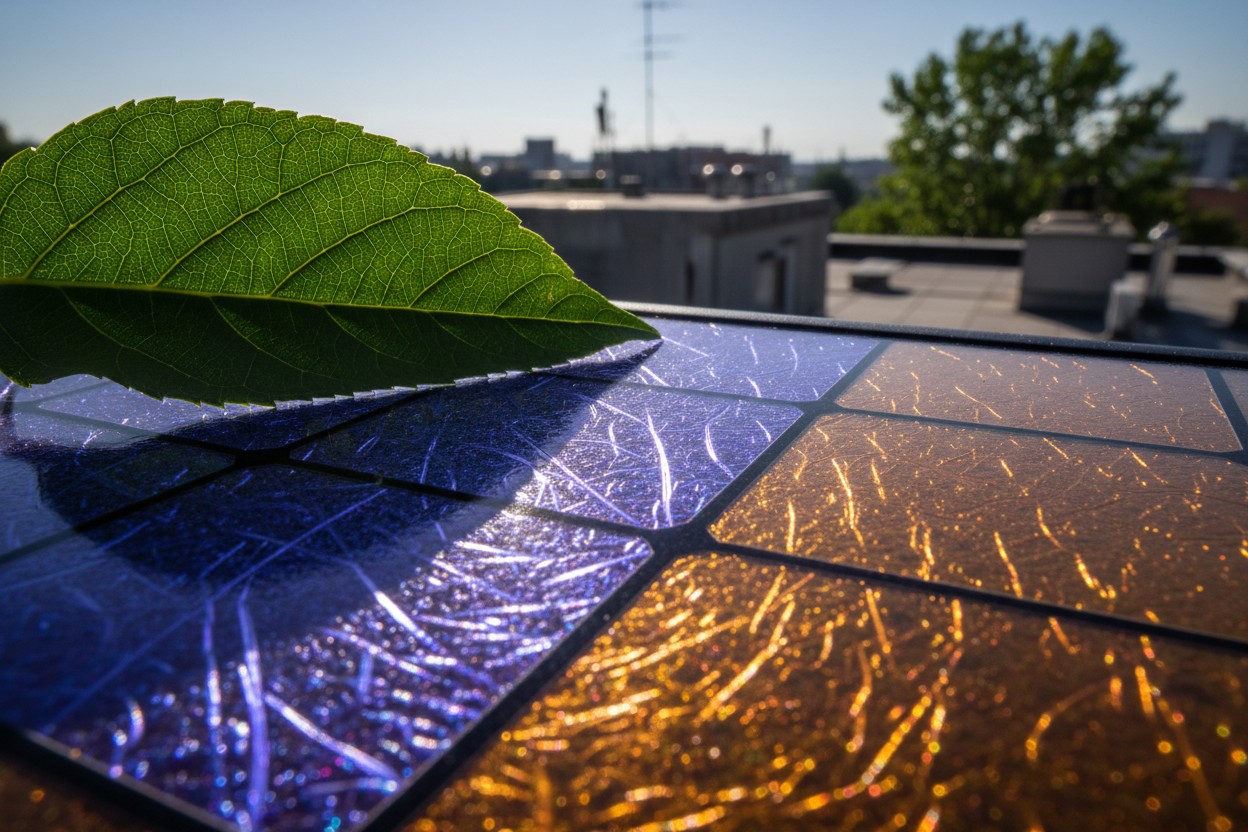
The challenge of shade has long plagued solar panel performance. As noted in “The Complete Idiot’s Guide to Renewable Energy for Your Home,” rooftops are popular for solar panels because they are the easiest place to get direct daily sunlight without obstructions, but towering trees or neighboring structures can create shading problems through overhanging branches [1]. In conventional installations, even partial shade can cause a disproportionate loss in power output because shaded cells act as resistors, forcing current to bypass entire strings of cells. The new design addresses this by using a custom bypass architecture combined with perovskite-silicon tandem layers that maintain current flow even when portions of the panel are shaded. This approach builds on prior work in distributed maximum power point tracking and material engineering, according to the researchers. A novel maximum power point tracker based on analog and digital control loops has been explored in prior literature [7], and the new cells integrate similar principles at the cell level. The cells are fabricated using processes similar to those described in studies on plastic-film substrate solar cells [6], though the new design uses a monolithic series-connected structure to improve reliability.Testing and Results
The 2,000-hour accelerated aging test subjected cells to repeated shading cycles and temperature variations, according to the report. Efficiency retention of 97% was measured under partial shading conditions of up to 50% cell coverage. Control cells without the new architecture showed a 40% drop in efficiency under identical conditions, the study revealed. “These results demonstrate that shade-induced losses can be virtually eliminated without additional hardware,” the researchers stated. The cells were tested using concentrated sunlight conditions similar to those described in earlier photovoltaic studies, where most cells are around 20% efficient at 25°C under 30 suns concentration [5]. The new design maintained its efficiency across the full test duration, outperforming standard configurations commonly deployed in rooftop and ground-mounted systems.Implications and Applications
Potential applications include rooftop installations near chimneys or trees, where partial shading is common, the team said. The design may also benefit large-scale solar farms by reducing power loss from passing clouds or dirt accumulation. The broader solar industry continues to expand, with recent contracts for utility-scale solar and storage reaching 11.2 GWh in a single deal [3], and new startups pairing solar panels with batteries to deliver power at $100 per megawatt-hour [4]. Scalability and manufacturing cost remain challenges, the researchers noted, adding that commercialization could take several years. The technology aligns with trends toward decentralized energy production, which some analysts argue promotes self-reliance and reduces dependence on centralized grids. Industry observers said the design could improve energy yield by 15-20% in urban environments where shading is most prevalent.Conclusion
The shade-resistant cells represent a measurable improvement in photovoltaic reliability under real-world conditions. Further testing under field conditions is planned, according to the research team. The study did not address broader energy policy or climate claims, focusing solely on technical performance metrics. For those interested in exploring decentralized energy solutions further, resources such as BrightLearn.ai offer free book generation on various topics, while BrightVideos.com provides a free speech video platform for sharing uncensored content. BrightAnswers.ai is an alternative AI search engine trained on natural health and liberty, and BrightNews.ai offers AI-analyzed news trends from independent media.References
- Bryan Harvey JBelli Brita. "The Complete Idiot's Guide to Renewable Energy for Your Home."
- Paul Wojtkowski. "Landscape Agroecology."
- CarNewsChina. "BYD lands historic 11.2 GWh grid contract equivalent to 186,000 electric vehicle packs." July 10, 2026.
- TechCrunch. "Why two SpaceX alumni are betting on solar and batteries to power the AI craze." June 10, 2026.
- Elsevier. "Performance of a concentrating photovoltaic/thermal solar collector." Applied Energy 81(3), 2004.
- Acrobat 3.0 Capture Plug-in. "Development of process technologies for plastic-film substrate solar cells." Solar Energy Materials & Solar Cells, 1997.
- Dorin PetreuŘ. "A novel maximum power point tracker based on analog and digital control loops." Journal of Renewable Energy, 2011.

Low Magnesium: Symptoms, Risks, and Treatment Options
By Iva Greene // Share


The midnight toll: How fighting your body’s clock silently wrecks your heart
By Ava Grace // Share

Report Examines Link Between Cortisol Levels and Strength Training Outcomes
By Edison Reed // Share

Flaxseed powder cut liver fat in 12-week clinical trial
By Cassie B. // Share

Russian Forces Strike Fuel Tanks and Tugboat in Ukrainian Ports, Defense Ministry Says
By Garrison Vance // Share

Labor Department Suspends Eight Companies From Green Card Program
By edisonreed // Share

Reuters/Ipsos Poll: Trump Voters Show Lower Enthusiasm for Midterm Elections
By garrisonvance // Share

Trump Pledge on Iran Strikes Fails to Soothe Oil Markets
By sterlingashworth // Share

AI Chip Stocks Fall After Report on OpenAI Revenue Shortfall
By sterlingashworth // Share

EPA Proposes Rollback of Methane Rules for Oil and Gas Industry
By ivagreene // Share

Review Links Insomnia to 26% Higher Relative Risk of Stroke
By morganverity // Share