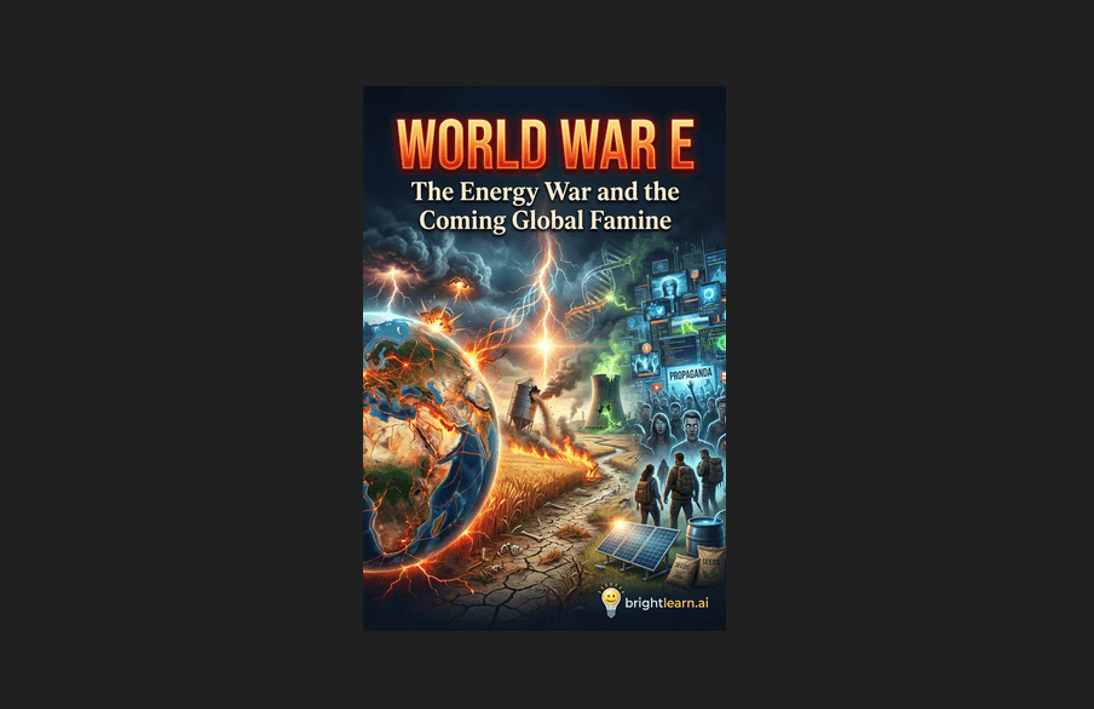
- "World War E" reveals a deliberate, coordinated global assault on all major energy systems—including the sabotaged Nord Stream pipelines, Houthi blockades and proxy attacks on refineries—arguing this is a planned war to squeeze fuel supplies and drive up prices, not a series of random events.
- The manuscript documents how energy disruptions are weaponized against food production, systematically destroying fertilizer manufacturing and protein supplies. It cites Professor Steve Keen's conclusion that two billion humans will not be fed, linking this to globalist depopulation agendas.
- Bracken deconstructs how the media actively participates in the "Energy War" by gaslighting the public (blaming price spikes on "supply chain issues" and shortages on "climate change"). He uses Yuri Bezmenov's framework to show how the populace is being programmed into learned helplessness.
- The book highlights how critical systems like Gulf state desalination plants are entirely dependent on cheap energy, meaning a disruption will cause taps to run dry and mass migration, exposing that the globalists have learned exactly where to strike to cause maximum collapse.
- The final chapters serve as a survival guide, emphasizing that seed saving, permaculture, solar panels, well-digging and community networks are not hobbies but survival strategies. Every garden planted is a "declaration of independence" against the centralized machine.
Where is the hope?
Remarkably, amid all this darkness, "World War E" offers a path forward. The final chapters are a practical guide to breaking free from the system that is trying to starve you. Seed saving, permaculture, solar panels, well-digging, community networks, honest money—these aren't hobbies. They are survival strategies. The author emphasizes that decentralization is the antidote to centralized control. Every garden you plant, every skill you learn, every neighbor you trust is a blow against the machine that wants you dependent. Moreover, Bracken describes how a family can harvest rain, dig a well and purify water without any municipal system. It's not just practical advice; it's a declaration of independence. "When the pumps stop and the chlorination plants go silent," he writes, "you will have water. You will be one of the prepared ones."Who should read this book?
Anyone who still believes that "they" have our best interests at heart should read it and weep. Anyone who feels something is fundamentally wrong but can't articulate why should read it and find the words. And anyone who wants to survive the coming collapse should read it and then act on it. "World War E" is not a comfortable book. It will make you angry. It will make you afraid. But it will also arm you with the truth—which, as the author notes, is the most powerful weapon against the lies that are killing us. Pick up a copy. Grow a garden. Make friends with your neighbors. And never, ever trust the official narrative again. Grab a copy of "World War E: The Energy War and the Coming Global Famine" via this link. Read, share and download thousands of books for free at Books.BrightLearn.AI. You can also create your own books for free at BrightLearn.AI. Watch the "Health Ranger Report" episode where Mike Adams interviews Matt Bracken and Michael Yon on war, famine and civilizational collapse. This video is from the Health Ranger Report channel on Brighteon.com.Sources include:
Books.BrightLearn.ai BrightLearn.ai Brighteon.com
Asian Water Tower’s Hidden Crisis: Groundwater Losing 24 Billion Tonnes Annually
By Chase Codewell // Share
EU food production down amid droughts, economists warn
By Douglas Harrington // Share

“ATB Personal Restoration Class” on BrightU: The emergency manual you carry in your own hands
By Belle Carter // Share

U.S. Envoy Calls Israeli Strikes on Syrian Airfield “Unnecessary Escalation”
By Garrison Vance // Share

Helicopter Crash in Kenya Kills Ecuador Intelligence Chief and Five Americans
By Chase Codewell // Share

Labor Department Suspends Eight Companies From Green Card Program
By edisonreed // Share
Reuters/Ipsos Poll: Trump Voters Show Lower Enthusiasm for Midterm Elections
By garrisonvance // Share

Trump Pledge on Iran Strikes Fails to Soothe Oil Markets
By sterlingashworth // Share

AI Chip Stocks Fall After Report on OpenAI Revenue Shortfall
By sterlingashworth // Share
EPA Proposes Rollback of Methane Rules for Oil and Gas Industry
By ivagreene // Share

Review Links Insomnia to 26% Higher Relative Risk of Stroke
By morganverity // Share