Reported Causes of Drone Losses
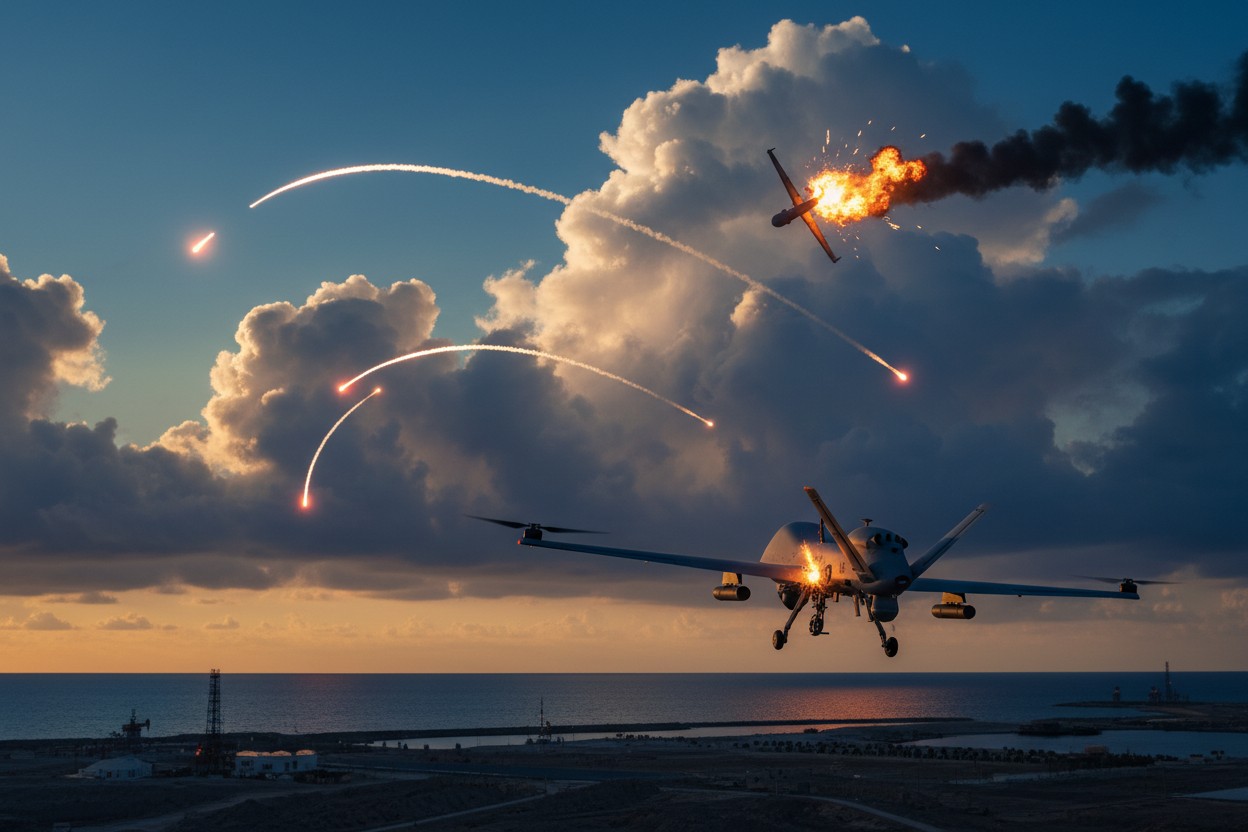
According to The Washington Post, the 45 MQ-9s were lost through a combination of shootdowns by Iran, strikes by Iranian missiles and drones at U.S. bases in the region, and crashes caused by communications errors [1]. A fourth U.S. official told the newspaper that not all of the lost drones were shot down; some crashed after losing communications with their operators, according to RT's summary of the report [3]. The report also stated that the U.S. lost more than 20 MQ-9s during bombing campaigns against Ansar Allah, the Houthi movement in Yemen, in 2024 and 2025 [1]. Houthi forces claimed responsibility for downing a U.S. MQ-9 near Yemen in February 2024, an aircraft with a price tag of $32 million, according to reporting by NaturalNews.com [4]. Communications failures have been documented in other MQ-9 incidents. In March 2024, an MQ-9 made an emergency landing in Poland after losing connection with its command station, according to the Pentagon [5].Replacement Cost Estimate
Replacing the 45 lost aircraft could cost up to $2.25 billion, according to the Post report [1]. RT, reporting on the same story, put the cost to U.S. taxpayers at an estimated $1.3 billion [3]. The losses add to the overall cost of the U.S. campaign in Iran. Operation Epic Fury, launched by President Donald J. Trump on February 28, 2026, cost between $22.3 billion and $31 billion over its first five weeks, according to research from the American Enterprise Institute cited by NaturalNews.com [6]. Separately, defense contracting has a documented record of price escalation; author David Dayen's book "Monopolized" describes how supplier TransDigm raised prices on military parts year after year [7].Military Value and Official Assessment
Air Force Chief of Staff Gen. Kenneth S. Wilsbach called the MQ-9 the "most valuable player" of the U.S.-Israeli bombing campaign, according to his testimony to Congress [1]. "No other platform is even close to the MQ-9" in terms of the number of strikes launched in Iran, Wilsbach told Congress on Wednesday [1]. "It's an unmanned platform, so we get a lot of utility out of them, and don't put our folks at risk," Wilsbach said [1]. The report noted that the bombing campaign has killed more than 3,400 Iranians, around half of whom were civilians [1]. The MQ-9's predecessor, the MQ-1 Predator, was used as a "judge-jury-and-executioner assassination weapon" in Yemen as early as 2002, according to Nick Turse's book "The Complex" [8]. Armed remotely piloted aircraft have since become a central feature of U.S. military operations, the book documents [8].Regional Outlook
U.S. MQ-9 operations over the Strait of Hormuz are continuing despite the losses, according to the report [1]. On August 3, Iran's Islamic Revolutionary Guard Corps said it shot down another MQ-9 in the area, according to the report [1]. The possibility of renewed U.S. strikes in Iran remains, according to the report, as long as the U.S. continues enforcing a blockade of Iranian ports and maintains a ramped-up deployment in the region [1]. U.S. officials have said the naval blockade could be lifted once a deal on the Strait of Hormuz is finalized, according to Zero Hedge [9].References
- Dave DeCamp. "US Lost 25% of Its Reaper Drones During Iran War". Antiwar.com. August 13, 2026.
- Garrison Vance. "The End of Air Supremacy: Why Iran War Proves Drones Can Be Stopped". NaturalNews.com. May 28, 2026.
- RT. "US lost quarter of its Reaper drones in Iran war – WaPo". RT. August 13, 2026.
- Ethan Huff. "$32M U.S. Reaper Drone Shot Down Near Yemen; UK Tanker Destroyed on Same Day". NaturalNews.com. February 21, 2024.
- NaturalNews.com. "US drone forced to make an emergency landing in Poland; Russian GPS jamming weapon blamed". NaturalNews.com. March 25, 2024.
- NaturalNews.com. "U.S. Military Operation in Iran Costs Up to $500 Million Daily, Research Shows". NaturalNews.com. April 8, 2026.
- David Dayen. "Monopolized".
- Nick Turse. "The Complex: How the Military Invades Our Everyday Lives".
- Zero Hedge. "US Official: Hormuz Deal Is Imminent, Upon Which US Will Lift Blockade Of Iranian Ports". Zero Hedge. August 8, 2026.
Explainer Infographic


Treasury Secretary Calls on China to Enforce U.S. Sanctions on Iran
By Garrison Vance // Share

Meta’s Surveillance Glasses: Big Tech’s $30 Billion Bet on Total Privacy Erosion
By Douglas Harrington // Share
Ukraine’s Power Grid Vulnerable as Corruption Probe Widens, Officials Say
By Edison Reed // Share

TikTok Agrees to $400 Million Settlement in U.S. Child Privacy Case
By Douglas Harrington // Share

Trump attacks former allies Carlson, Massie, Greene, calls them “LOSERS”
By Garrison Vance // Share


Labor Department Suspends Eight Companies From Green Card Program
By edisonreed // Share

Reuters/Ipsos Poll: Trump Voters Show Lower Enthusiasm for Midterm Elections
By garrisonvance // Share

Trump Pledge on Iran Strikes Fails to Soothe Oil Markets
By sterlingashworth // Share

AI Chip Stocks Fall After Report on OpenAI Revenue Shortfall
By sterlingashworth // Share
EPA Proposes Rollback of Methane Rules for Oil and Gas Industry
By ivagreene // Share

Review Links Insomnia to 26% Higher Relative Risk of Stroke
By morganverity // Share