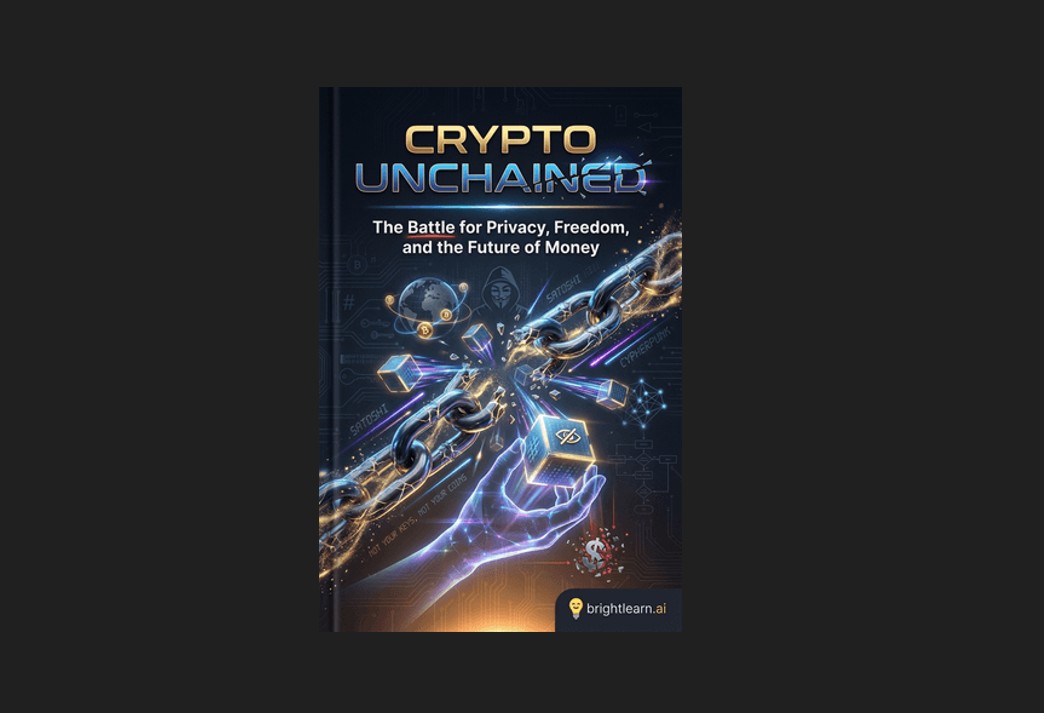
- The book "Crypto Unchained: The Battle for Privacy, Freedom, and the Future of Money" traces Bitcoin's creation by Satoshi Nakamoto as a response to the 2008 financial crisis, emphasizing its decentralized, inflation-proof design (21M cap, proof-of-work) as an antidote to corrupt fiat banking.
- Blockchain's transparency and immutability contrast with fragile centralized banking systems. The "Block Size Wars" (2015-2017) highlighted Bitcoin's ideological split between scalability and decentralization, leading to innovations like Lightning Network.
- While Ethereum and DeFi offer innovation, they risk regulatory capture. Central Bank Digital Currencies (CBDCs) represent the ultimate surveillance tool – programmable money enabling asset freezes and social credit control.
- AI-driven trading and deepfake scams threaten decentralization, while governments exploit AI for financial surveillance. Grassroots movements (e.g., El Salvador's Bitcoin adoption) showcase resistance to centralized tyranny.
- The book frames crypto as a defense against globalist control, urging readers to embrace privacy coins (Monero, Zcash), self-custody and DeFi to escape the collapsing fiat system.
Bitcoin vs. CBDCs: The battle for financial freedom
A particularly chilling chapter explores Central Bank Digital Currencies (CBDCs) – the ultimate tool for financial enslavement. Unlike Bitcoin, CBDCs are programmable, allowing governments to freeze assets, impose spending limits, and enforce social credit-style surveillance. The book urges readers to resist CBDCs by embracing self-custody, privacy coins (Monero, Zcash) and decentralized finance (DeFi) alternatives. The final section tackles the intersection of artificial intelligence (AI) and crypto – both as a tool for empowerment and a weapon of control. While AI-driven trading bots enhance market efficiency, they also raise concerns about manipulation and centralization. The book warns of deepfake scams and AI-powered surveillance, advocating for decentralized AI models that prioritize privacy. The author also highlights the digital nomad movement, where Bitcoin and crypto enable true financial sovereignty – free from government overreach and banking restrictions. Case studies from El Salvador (Bitcoin Beach) and Nigeria (peer-to-peer Bitcoin adoption) illustrate grassroots resistance to financial tyranny. "Crypto Unchained" is more than a book – it's a manifesto for financial liberation. The author blends technical insights with philosophical depth, making complex topics accessible without oversimplifying. The recurring theme is clear: Bitcoin and decentralized technologies are the last line of defense against globalist control. For anyone skeptical of Big Tech, Big Pharma, or government overreach, this book is essential reading. It doesn't just explain crypto – it arms readers with the knowledge to resist CBDCs, reclaim privacy and build wealth outside the collapsing fiat system. Grab a copy of "Crypto Unchained: The Battle for Privacy, Freedom, and the Future of Money" via this link. Read, share and download thousands of books for free at Books.BrightLearn.AI. You can also create your own books for free at BrightLearn.AI. Watch YouTuber Crypto Rich discussing European tyranny, attacks on free speech and the urgent need to decentralize government in this edition of "Decentralize TV" with the Health Ranger Mike Adams and Todd Pitner. This video is from the Health Ranger Report channel on Brighteon.com. Sources include: BrightLearn.ai Books.BrightLearn.ai Brighteon.com
EU energy policy undermines NATO defense readiness, Dutch military report warns
By Willow Tohi // Share

Investigation Reveals Coordinated AI Bot Attack on Hugging Face
By Chase Codewell // Share

Designer Creates Shirt Meant to Confuse AI Surveillance Cameras
By Edison Reed // Share


Maria Zeee on the AI Safety Scam: Why Bill Gates and the Tech Elite Are Suddenly “Concerned”
By Chase Codewell // Share

Food Waste Membrane Boosts Heat Transfer by 96.1%, Lasts 1,000 Cycles
By Coco Somers // Share


Full-fat dairy reconsidered: New science challenges decades of dietary dogma
By willowt // Share

Hegseth Says Public Will Be Able to Watch Fort Hood Shooter's Execution by Firing Squad
By douglasharrington // Share

Trump Considering Suspending Federal Gas Tax as States Lower Fuel Levies
By sterlingashworth // Share

South Korea Ambassador to Kyiv Recalled Over Prisoner Transfer Dispute
By garrisonvance // Share

DHS Proposes $70,000 Fee for Foreign Students in Optional Practical Training
By douglasharrington // Share