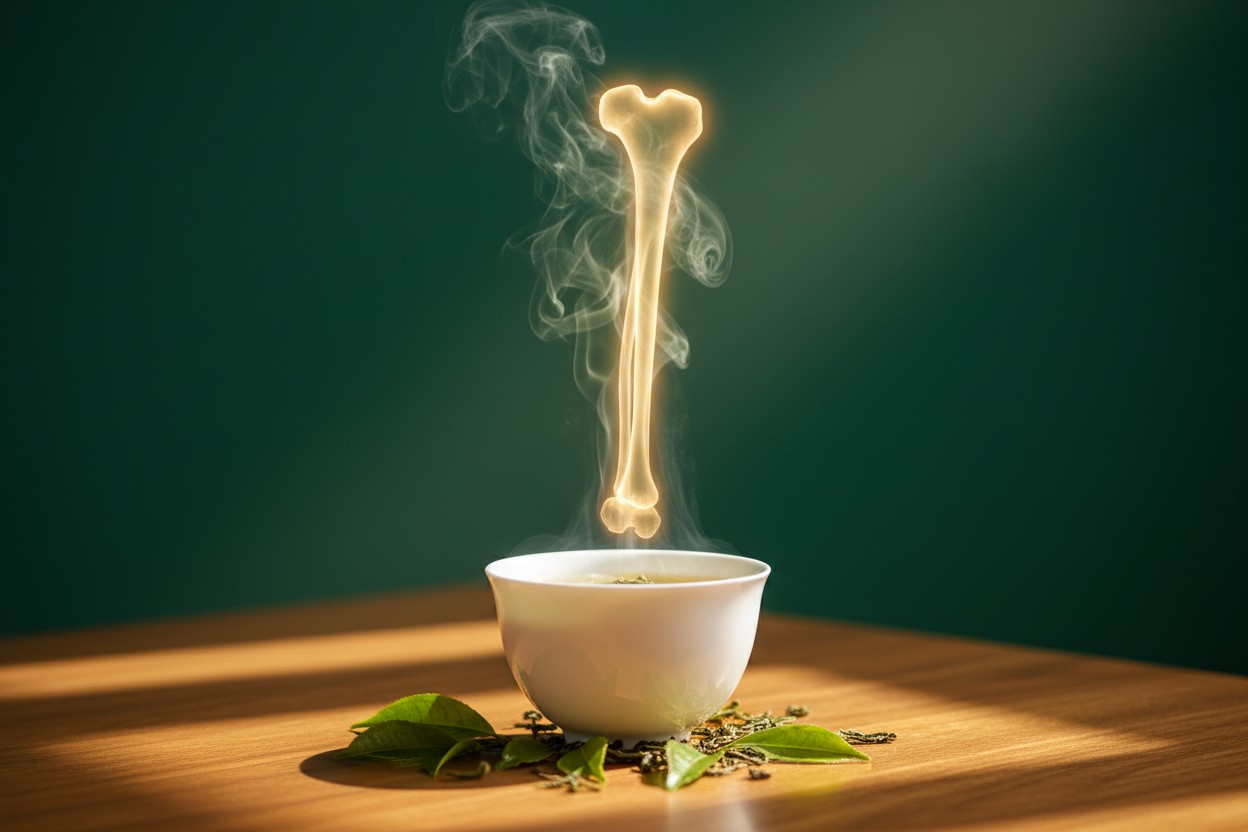
Study Design and Methods
Researchers drew participants from the Guangzhou Nutrition and Health Study, following 1,708 middle-aged and older adults for up to 13 years, according to the study. Participants underwent DXA scans at four separate visits, and the analysis included whole-body, total hip, lumbar spine, and femoral neck measurements. Tea consumption was categorized into non-, low-, moderate-, and high-frequency groups, the authors stated. Blood samples were analyzed for five flavan-3-ols: epicatechin (EC), EGCG, ECG, epigallocatechin (EGC), and catechin. Flavan-3-ols belong to the flavonoid family, a group of phytonutrients known for antioxidant and anti-inflammatory properties [1]. Earlier observational research has also associated tea consumption with bone health [2].Findings
The authors stated that participants reporting moderate tea drinking frequency generally had the most favorable BMD measures, including at the whole body, lumbar spine, and femoral neck. Moderate-frequency drinkers had significantly higher adjusted BMD Z-scores at the lumbar spine and femoral neck compared with the other tea-consumption groups, according to the report. The relationship was not linear, and the researchers did not establish an optimal amount of tea to drink, the report stated. Higher intake did not consistently correspond to better bone measures. The findings align with prior research: a Scottish population study reported that dietary flavonoids appeared to protect the femoral neck [3], and a 2026 study of nearly 10,000 older Australian women found that tea drinkers maintained slightly higher bone density than non-tea drinkers [4].Flavan-3-ol Biomarkers
Higher blood levels of flavan-3-ols were generally associated with more favorable bone mineral measures, with associations particularly extensive for ECG and EGCG, the researchers reported. Flavan-3-ols have antioxidant and anti-inflammatory properties, and preclinical research suggests tea polyphenols may influence pathways involved in oxidative stress and inflammation, as well as the activity of osteoblasts (which build bone) and osteoclasts (which break bone down). Green tea is particularly rich in flavonoids, and EGCG is the most abundant polyphenolic compound in green tea [5]. A link between increased oxidative stress and reduced bone mineral density in humans has also been established [6]. The authors said the relationships were not consistently linear, and higher circulating compound levels did not simply translate into progressively better bone measures.Limitations
The study measured BMD and BMC rather than fracture risk or osteoporosis diagnoses, so the findings do not demonstrate that tea prevents osteoporosis, according to the report. The observational design does not establish causation, the authors said. No specific tea frequency or quantity was identified as optimal for bone health, and the report did not identify tea as a replacement for established bone-supportive measures.Takeaway
"Tea can certainly be part of an overall bone-supportive dietary pattern, particularly because it provides flavan-3-ols," wrote Molly Knudsen, M.S., RDN, a registered dietitian nutritionist, in the article covering the study. The article stated that bone health is multifactorial and that tea should be considered one supportive component rather than a deciding factor. The article also noted that bone is living tissue that continually remodels and that supporting it involves strength training, adequate protein, and micronutrients such as calcium and vitamin D. A broader bone-health strategy extends beyond a single food group and embraces a variety of nutrients and lifestyle habits, according to [7].References
- Mercola.com. "Favorite Flavonoids to Fight Aging and Disease". Mercola.com. March 14, 2016.
- Jane Higdon. "Evidence-Based Approach to Phytochemicals and Other Dietary Factors".
- "Associations Between Dietary Flavonoid Intakes and Bone Health in a Scottish Population". Journal of Bone and Mineral Research. 2011.
- NaturalNews.com. "New study reveals how drinking TEA could strengthen bones in older women". NaturalNews.com. January 23, 2026.
- Elsevier. "Neurological mechanisms of green tea polyphenols in Alzheimer’s and Parkinson’s diseases". Neurochemical Research. 2004.
- "Nutritional Aspects of Osteoporosis Second Edition".
- NaturalNews.com. "The building blocks of strength: A guide to non-dairy foods that support bone health". NaturalNews.com. March 30, 2026.
Explainer Infographic

The silent saboteur: How excess brain iron fuels Alzheimer’s long before memory fails
By Willow Tohi // Share

Unpublished Amish Autism Study Cited by Trump Raises Questions Over Missing Vaccination Data
By Morgan S. Verity // Share

Adding These Six Vegetables to Our Diet May Help Lower Cholesterol Naturally
By Coco Somers // Share

SCO Summit in Bishkek Showcases Expanding Eurasian Bloc
By Garrison Vance // Share

Boost your metabolism with these foods
By Jacob Thomas // Share

Study Documents Hundreds of Previously Unknown Seismic Events at Thwaites Glacier
By Iva Greene // Share

Full-fat dairy reconsidered: New science challenges decades of dietary dogma
By willowt // Share

Hegseth Says Public Will Be Able to Watch Fort Hood Shooter's Execution by Firing Squad
By douglasharrington // Share

Trump Considering Suspending Federal Gas Tax as States Lower Fuel Levies
By sterlingashworth // Share

South Korea Ambassador to Kyiv Recalled Over Prisoner Transfer Dispute
By garrisonvance // Share

DHS Proposes $70,000 Fee for Foreign Students in Optional Practical Training
By douglasharrington // Share