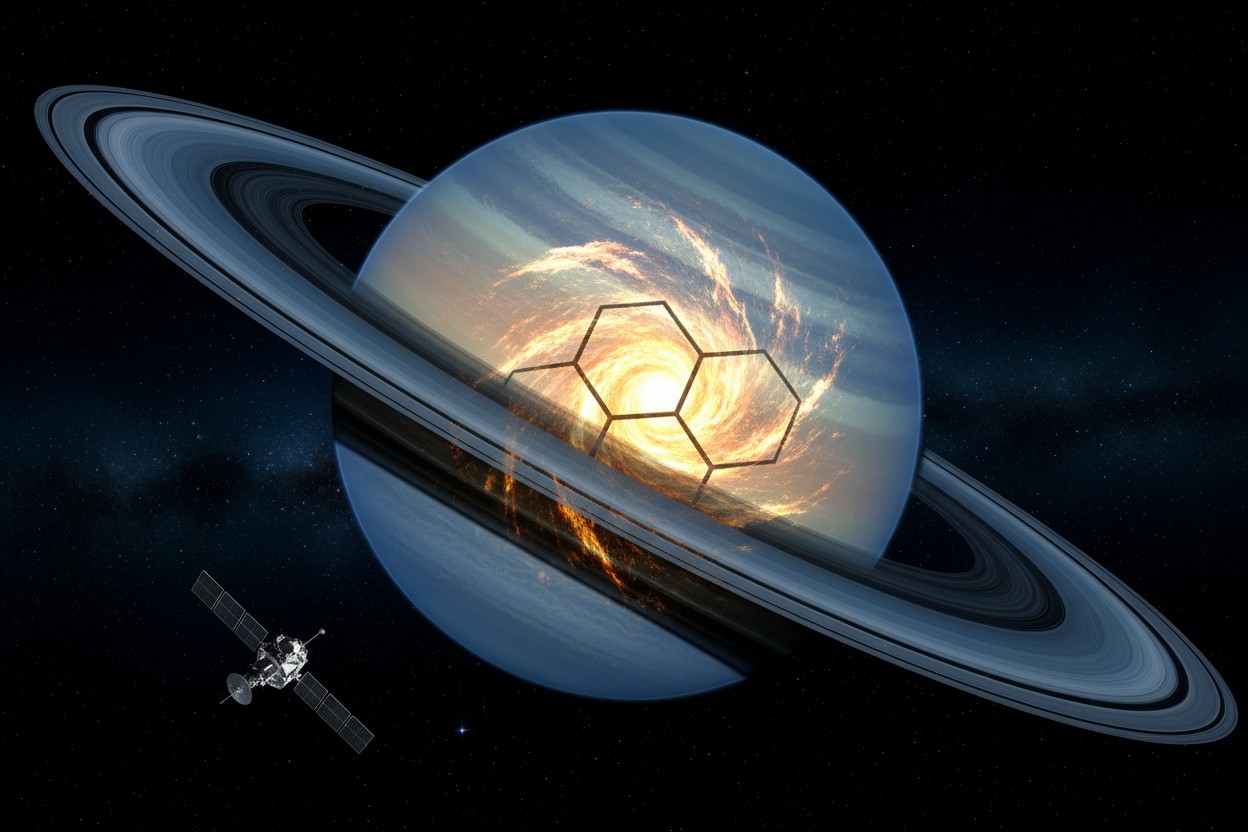
Hubble Reveals Decagon at Saturn's South Pole
The feature was confirmed through a combination of ground-based observations and space-based imaging from Hubble. Because Hubble operates from space, it can capture sharper images across Saturn's complete rotations without the atmospheric blurring that affects Earth-based telescopes. The telescope's observations were essential for determining that the decagon extends through multiple layers of Saturn's atmosphere. The study was led by Agustín Sánchez-Lavega of the University of the Basque Country in Spain. Co-authors include Amy Simon of NASA's Goddard Space Flight Center and Michael Wong of the University of California, Berkeley. According to Simon, who is also the OPAL principal investigator, "We've never seen anything quite like this in Saturn's southern hemisphere." She said the feature appears to be strengthening, presenting an unusual opportunity to observe a giant atmospheric phenomenon as it forms.Researchers Trace Emergence of the Pattern
The chain of discovery began with amateur astronomers. In images from 2024, Sánchez-Lavega and amateur observers Trevor Barry and Jean-Paul Oger noticed a faint, wavy band near Saturn's south pole in images submitted to a ground-based observatory laboratory. Ground-based observations collected in 2025 provided stronger evidence that the band had developed into a distinct decagon, at which point the researchers used Hubble for a more detailed view. Hubble's data confirmed the decagon's presence in images dating back to 2023, collected through the OPAL program, which has annually imaged the outer planets for over a decade. According to Simon, "The northern hexagon has been there every time we've looked for more than 40 years. This feature is different – it appears to be strengthening, giving us the rare opportunity to watch a giant atmospheric pattern develop." Sánchez-Lavega added that searches for a counterpart to the northern hexagon had been ongoing, but images from NASA's Cassini spacecraft, which orbited Saturn from 2004 to 2017, showed no indication of a similar long-lived formation.Structure and Comparison to Northern Hexagon
The newly identified wave is located within one of Saturn's powerful jet streams, akin to those described in atmospheric texts as fast-flowing air currents that can influence weather patterns [2]. The decagon extends through several atmospheric layers, indicating it is a vertically extended structure rather than a pattern confined to the cloud tops. Observations at different Hubble wavelengths, which allow scientists to see different altitudes, show slight shifts in the feature's apparent location. The southern decagon shares some general similarities with Saturn's northern hexagon, a phenomenon that has persisted for over four decades and was previously observed by the Cassini mission [1]. However, researchers stated that important differences suggest the two formations may be distinct phenomena. According to the report, scientists do not yet know what triggered the decagon or whether it will remain stable over time.Long-Term Monitoring and Future Research
The discovery highlights the value of sustained observation programs like OPAL. According to the report, Hubble's long operational history has given astronomers the ability to follow gradual changes on planets that might be missed in isolated snapshots. "When we started the OPAL program, we expected compelling surprises, but we didn't know what to expect specifically," said Michael Wong, study co-author. "A lot of the discoveries we see coming from OPAL are not just based on one observation, but on years and years of data." Researchers plan to continue monitoring Saturn using Hubble and NASA's James Webb Space Telescope, in conjunction with computer modeling, to determine how the decagon formed, how long it might survive, and how closely it relates to the northern hexagon. The investigation may also provide broader insights into atmospheric dynamics on giant planets. Such long-term study of planetary weather systems can offer a deeper understanding of atmospheric mechanics that also apply to Earth's climate [3].Conclusion: A Rare Atmospheric Phenomenon
The discovery marks the first time scientists have observed a large, regularly shaped jet pattern in Saturn's southern hemisphere, according to the research team. The finding adds to a growing body of knowledge about the dynamic atmospheres of gas giants, which previous missions and telescopic programs have shown to be highly complex and variable. Ongoing observations will determine whether the southern decagon becomes a stable, long-lived feature or continues to evolve. The findings, published in Science Advances, underscore the value of long-term, systematic observation programs like OPAL. According to the researchers, watching this feature develop in real time offers a unique chance to understand the processes that shape atmospheric patterns on giant planets.References
- NaturalNews.com. "Cassini mission reveals another giant mysterious vortex on Saturns northern pole". November 30, 2018.
- Walter A Lyons. "The handy weather answer book".
- Chaisson Eric. "Astronomy a beginners guide to the universe".
- NaturalNews.com. "Saturn's icy moon Enceladus is leaking heat from both poles, indicating a balanced energy system that could sustain life". November 12, 2025.
- NaturalNews.com. "Scientists uncover hidden chemical fingerprint that could revolutionize hunt for alien life". May 14, 2026.
Explainer Infographic


Study Links Phytochemical-Rich Diet to 52% Lower Colorectal Cancer Odds
By Coco Somers // Share

Study Links Regular Stair Climbing to Lower Risk of Cardiovascular Death
By Coco Somers // Share

Study Links Higher Stilbene Intake to Lower Lung Cancer Risk
By Coco Somers // Share

Light-Programmable 2D Semiconductor Could Rewrite Electronics After Fabrication
By Edison Reed // Share

Morning coffee’s hidden power: The scent alone may reduce stress and improve mood
By Willow Tohi // Share

Review Links Pesticide Exposure to Oxidative Stress and Chronic Disease
By Morgan S. Verity // Share


Full-fat dairy reconsidered: New science challenges decades of dietary dogma
By willowt // Share

Hegseth Says Public Will Be Able to Watch Fort Hood Shooter's Execution by Firing Squad
By douglasharrington // Share

Trump Considering Suspending Federal Gas Tax as States Lower Fuel Levies
By sterlingashworth // Share

South Korea Ambassador to Kyiv Recalled Over Prisoner Transfer Dispute
By garrisonvance // Share

DHS Proposes $70,000 Fee for Foreign Students in Optional Practical Training
By douglasharrington // Share