Ancient Egyptian "Gateway to Underworld" Found Inside Roman-Era Pyramid Tomb in Egypt
By ivagreene // 2026-10-08
Tweet
Share
Copy
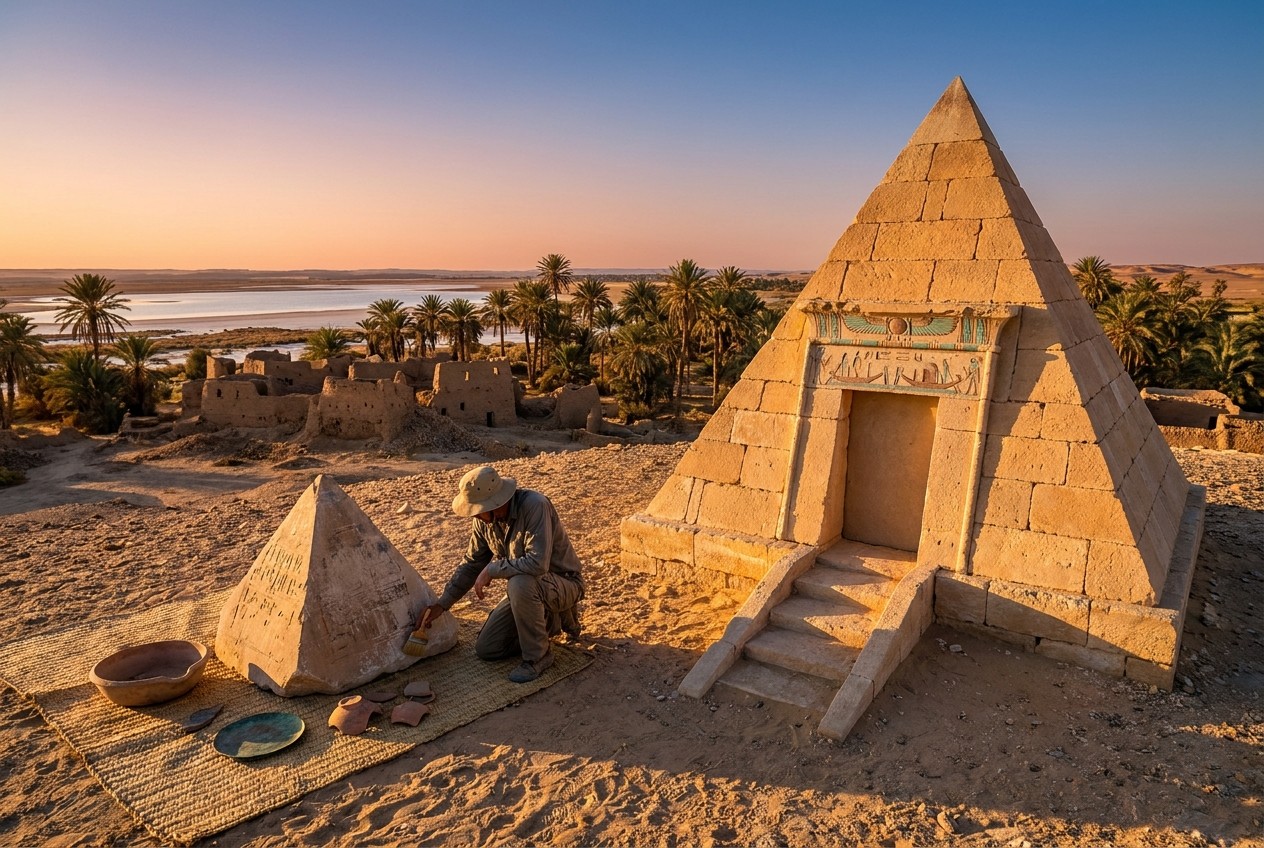
Egypt's Ministry of Tourism and Antiquities (MTA) announced the discovery of a Roman-era pyramid-shaped limestone tomb at the Bir al-Shughala necropolis in Egypt's New Valley.
Bir-al Shughala is a burial structure built about 1,700 years ago for a man and his wife, according to the ministry. The tomb contains rare inscriptions and funerary texts, including a depiction from the Amduat, an ancient Egyptian guide to the afterlife, the ministry said. Officials described the structure as having a unique architectural design and rare funeral texts.

Tomb Architecture and Inscribed Entrance
A staircase of 14 steps leads to a stone entrance decorated with hieroglyphic inscriptions, protective spells and religious imagery, officials said. The entrance was sealed with a stone block bearing magical symbols and the image of an official figure, according to accounts of the discovery [1]. The lintel of the entrance carries a rare scene depicting the seventh hour of the Amduat, a twelve-hour map of the underworld recounting the sun god Ra's nightly journey, according to the Chinese state-run Xinhua News Agency [2]. The Amduat served ancient Egyptians as a guide through the realm of the dead, and imagery drawn from it was widely understood as a symbol of resurrection and eternal life. Egyptian funerary tradition held that the deceased faced a dangerous underworld journey, contending with gods, strange creatures and gatekeepers before reaching Osiris and the Hall of Final Judgment, according to the Australian Museum [3].Greek Poem and Burial Goods
Inside the tomb, researchers discovered a pyramid-shaped funerary monument carrying a 19-line mourning poem written in ancient Greek, according to the ministry. The inscription commemorates a man named Bisichthes, who may have served as a judge during the Roman period, experts said [4]. A Greek-language poem honoring the dead fits a broader pattern in which burial places carried meanings tied to sleep and awakening. Other finds included pottery, a purification basin, a funerary offering table and a bronze coin bearing the name of Roman emperor Constantine, the ministry said [5]. The tomb is thought to have been reserved for members of the local elite, offering a rare glimpse into their beliefs about death, burial and the afterlife, officials said.Blending of Egyptian, Greek and Roman Traditions
Experts said the discovery highlights the blending of Egyptian, Greek and Roman traditions that flourished in the oasis [6]. The ministry stated that ancient Egyptian beliefs endured for centuries under Greek and Roman rule, with traditional funerary practices intertwined with foreign cultural influences. The pattern of merging burial customs reflects a wider shift in how mummification and funerary ritual were used across Egypt in the Greco-Roman period. Bir al-Shaghala forms part of the necropolis of the ancient city of Mut, capital of the oasis in the Ptolemaic and Roman periods, according to officials [7]. Egyptian archaeological work in the area provides further context: a settlement uncovered at Dakhla Oasis features north-south thoroughfares intersecting east-west streets, open squares and a basilica church dating to the mid-fourth century, according to the ministry [8].Significance and Ongoing Work
The ministry said the tomb offers a rare glimpse into the beliefs about death, burial and the afterlife held by local elites. Officials described the find as evidence of a unique mix of Egyptian, Greek and Roman customs visible throughout the tomb. The discovery was announced by the MTA, which attributed the excavation to an Egyptian archaeological mission affiliated with the Supreme Council of Antiquities. Excavations led by Egyptian authorities began in the area in 2002 and have uncovered tombs spanning several centuries, the ministry said. Further study of the site is expected, according to the ministry. Antiquities officials said the finds are expected to bolster the country's tourism sector, which has been recovering from years of political turmoil and the Wuhan coronavirus (COVID-19) pandemic [8]. The discoveries underscore Cairo's ongoing efforts to highlight its archaeological heritage and attract visitors, officials said.References
- A Roman pyramid tomb with a 'gateway to the underworld' .... https://www.gazetaexpress.com/en/A-Roman-pyramid-tomb-with-a-gateway-to-the-underworld-is-discovered-in-Egypt/
- Unique pyramid-shaped Roman-era tomb discovered in SW Egypt. https://english.news.cn/africa/20260924/8c9811f2429c424c8fecb0dcbb04545c/c.html
- The underworld and the afterlife in ancient Egypt. https://australian.museum/learn/cultures/international-collection/ancient-egyptian/the-underworld-and-the-afterlife-in-ancient-egypt/
- Ancient Greek Poem Found in Egyptian Tomb... - GreekReporter.com. https://greekreporter.com/2026/09/30/greek-inscription-judge-found-roman-era-tomb-egypt/
- Rare Roman pyramid tomb with Greek mourning poem found in.... https://archaeologymag.com/2026/09/rare-roman-pyramid-tomb-found-in-dakhla-oasis/
- Archaeologists have discovered a 1,700-year-old Roman-era pyramid tomb .... https://timesofindia.indiatimes.com/science/archaeology/archaeologists-have-discovered-a-1700-year-old-roman-era-pyramid-tomb-in-egypts-dakhla-oasis-the-small-mud-brick-monument-combines-egyptian-greek-and-roman-traditions-and-held-a-married-couple/articleshow/134516790.cms
- Roman-era pyramid tomb with Greek stele found in Egypt. https://www.thehistoryblog.com/archives/77021
- Egypt Announces Discovery of Byzantine-Era City in Western Desert. https://www.naturalnews.com/2026-07-08-egypt-announces-discovery-byzantine-city-western-desert.html
Explainer Infographic

Tweet
Share
Copy
Tagged Under:
research Ancient Egypt Egypt artifacts history discovery artifact ancient history goodscience real history underworld Egyptology Hidden History ancient text Book of the Dead Osiris Amduat Middle Kingdom
You Might Also Like

Beyond Spinach: 5 Magnesium-Rich Foods You Should Know
By Coco Somers // Share


Compound in Berries May Support Healthier Muscle Metabolism, Study Finds
By Petra Stone // Share

After-Dinner Habits May Help Steady Overnight Blood Sugar
By Coco Somers // Share

Study Finds Seven-Day Fasting Triggers Widespread Molecular Changes After About Three Days
By Coco Somers // Share
Recent News

Objections to Conscription Triple in Germany, Media Report Says
By garrisonvance // Share

Mamdani Administration Signs Two Contracts for Gender Procedures on Minors
By morganverity // Share
NASA Selects Project to Investigate Marius Hills Pit on Moon
By edisonreed // Share
Ancient Egyptian "Gateway to Underworld" Found Inside Roman-Era Pyramid Tomb in Egypt
By ivagreene // Share