NASA Selects Project to Investigate Marius Hills Pit on Moon
By edisonreed // 2026-10-08
Tweet
Share
Copy
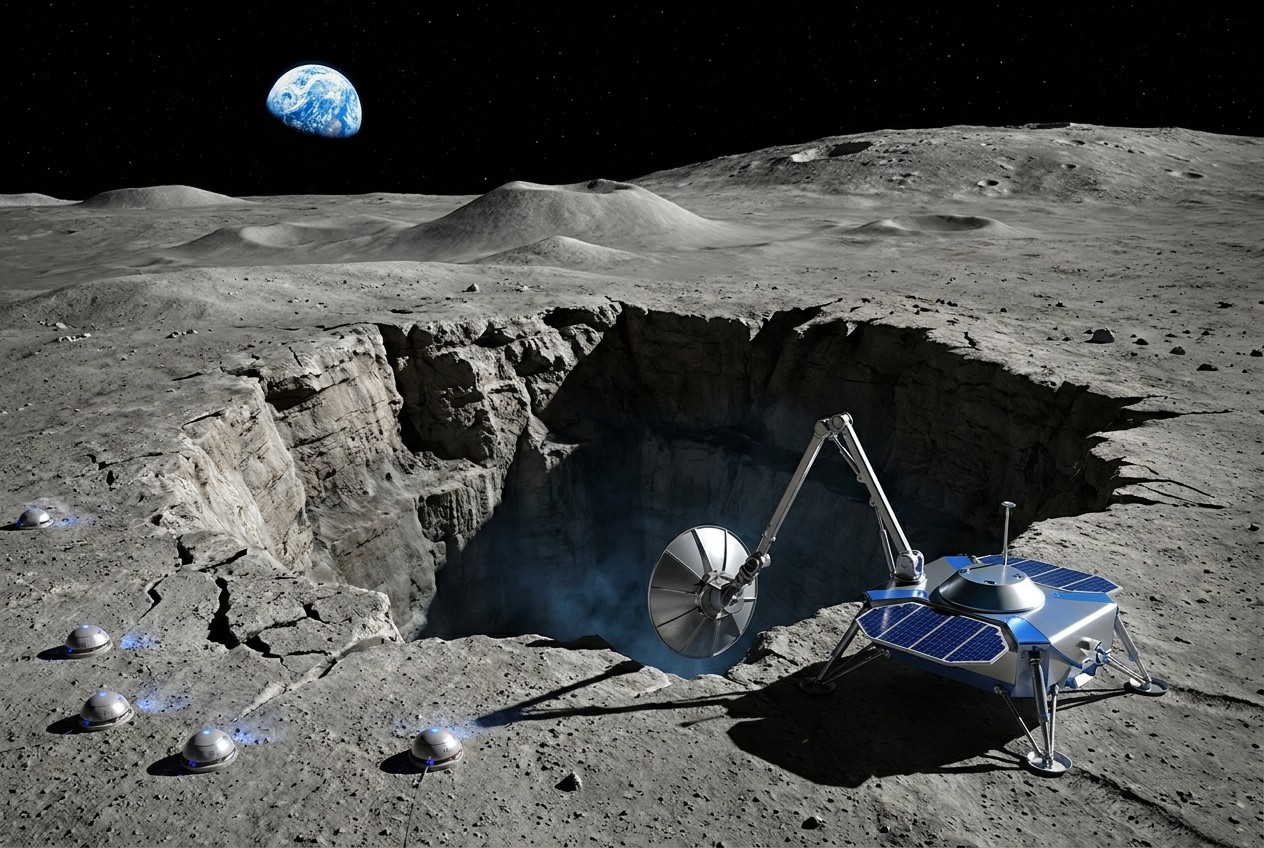
The National Aeronautics and Space Administration (NASA) has selected the Geophysical Instruments for Marius Lunar Pit Investigation (GIMLI) project to examine the Marius Hills Pit, according to the agency.
The project will determine whether the opening leads to an underground cavern or lava tube, officials said. GIMLI will combine ground-penetrating radar, seismic sensors and a device to measure the local gravitational field, NASA said [1].
Background and Location
The Marius Hills Pit is located in one of the moon's most volcanically varied regions, according to the report [2]. It is one of about 300 pits identified on the lunar surface, some of which could provide entrances to caves formed by ancient volcanic activity [3]. The pit lies in an ancient volcanic region on the moon's nearside, according to the mission description [4]. The pit is one of about 300 pits identified on the lunar surface, the report stated [3]. The Marius Hills region is a field of domes and cones, and the surrounding area is largely flat, indicating that no major mountain-building force was active there, according to a book on lunar observation [5]. Like other lunar pits, the Marius Hills Pit may serve as a skylight, an opening into a subsurface cavity that formed during ancient volcanic activity, according to the report [6]. Lava tubes are created when the top of a stream of molten rock solidifies and the lava inside drains away, leaving a hollow tube of rock, according to a report on the first lunar skylight discovery [7]. Rocks from the moon's maria have been found to consist of solidified basaltic lava, confirming that the lunar surface was once molten, according to a lunar astronomy guide [8].Instruments and Objectives
GIMLI will combine ground-penetrating radar, seismic sensors and a device to measure the local gravitational field, NASA said [1]. Cameras will also photograph the lunar surface and the exposed walls of the pit, and scientists will use data from all the instruments to search for an underground void extending from the pit, if it exists, according to the agency [1]. Scientists studying the Moon from orbit have found compelling evidence that caves and lava tubes could be hidden beneath its surface, and GIMLI will concentrate on the Marius Hill Pit, a large opening located within one of the Moon's most volcanically varied regions [2]. For the first time since Apollo astronauts detonated explosives on the moon in 1972, a mission will intentionally generate seismic waves on the lunar surface, according to the report [9]. NASA announced the selection of three new PRISM scientific payload suites on October 1, 2026, the report stated [9].Statements from Project Scientists
Planetary Science Institute (PSI) Associate Director and Senior Scientist Than Putzig said he has long wanted to reintroduce active-source seismic methods to planetary science. Putzig said combining seismic, radar and gravity measurements will allow a better understanding of subsurface properties, including possible lava tube detection. PSI Senior Scientist and Deputy Principal Investigator Gareth Morgan said confirming a substantial lava tube would provide insight into how volcanism operated on the moon. He added that the Marius Hills Pit is one of about 300 pits identified on the lunar surface, some of which could provide entrances to caves formed by ancient volcanic activity, according to the report [3]. According to an NTD report, NASA's long-term plan for lunar habitation aims to transform temporary human expeditions into potentially permanent lunar civilizations, according to a report on the agency's Moon Base vision [10].References
- NASA Backs Project To Explore Mysterious Hole On The Moon. https://www.ndtv.com/science/nasa-backs-project-to-explore-mysterious-hole-on-the-moon-12141870
- This mysterious hole on the Moon may open into a giant cave. https://www.sciencedaily.com/releases/2026/10/261003234013.htm
- NASA targets mysterious hole on the moon in hunt for vast .... https://www.dailymail.com/sciencetech/article-16186967/nasa-moon-marius-hills-pit-cave.html
- NASA Backs Mission to Probe Moon Lava Tube - StratNews Global. https://stratnewsglobal.com/technology/nasa-gimli-moon-lava-tube-marius-hills-pit/
- Human Vision and the Night Sky. by with Redshift temperature lapse rate
- NASA Mission Will Hunt for a Hidden Lava Tube Beneath the Moon's Surface. https://scienmag.com/nasa-mission-will-hunt-for-a-hidden-lava-tube-beneath-the-moons-surface/
- Found: first 'skylight' on the moon | New Scientist. https://www.newscientist.com/article/1941804-found-first-skylight-on-the-moon/
- The Moon in Close up A Next Generation Astronomers Guide Patrick Moores Practical Astronomy Series by John Wilkinson
- NASA Picks Lunar Lava Tube Hunt: First Surface Seismic Survey.... https://www.techtimes.com/articles/328490/20261002/nasa-picks-lunar-lava-tube-hunt-first-surface-seismic-survey-since-apollo.htm
- NASA Unveils Vision for ‘Moon Base’ Lunar Civilization. https://www.ntd.com/nasa-unveils-vision-for-moon-base-lunar-civilization_1148181.html
Tweet
Share
Copy
Tagged Under:
space NASA space travel scientific research space science space resources cosmic moon exploration celestial bodies planetary science space discovery Earth atmosphere lunar soil astronaut survival cosmic history future habitats Marius Hills lunar pit Geophysical Instruments for Marius Lunar Pit Investigation Planetary Science Institute
You Might Also Like

Ancient Egyptian “Gateway to Underworld” Found Inside Roman-Era Pyramid Tomb in Egypt
By Iva Greene // Share


Compound in Berries May Support Healthier Muscle Metabolism, Study Finds
By Petra Stone // Share

Study Finds Seven-Day Fasting Triggers Widespread Molecular Changes After About Three Days
By Coco Somers // Share

Recent News


Objections to Conscription Triple in Germany, Media Report Says
By garrisonvance // Share

Mamdani Administration Signs Two Contracts for Gender Procedures on Minors
By morganverity // Share
NASA Selects Project to Investigate Marius Hills Pit on Moon
By edisonreed // Share
Ancient Egyptian "Gateway to Underworld" Found Inside Roman-Era Pyramid Tomb in Egypt
By ivagreene // Share