Big Brother at the Airport? UK Expands Facial Recognition Checks to 13 Airports
By chasecodewell // 2026-10-14
Tweet
Share
Copy
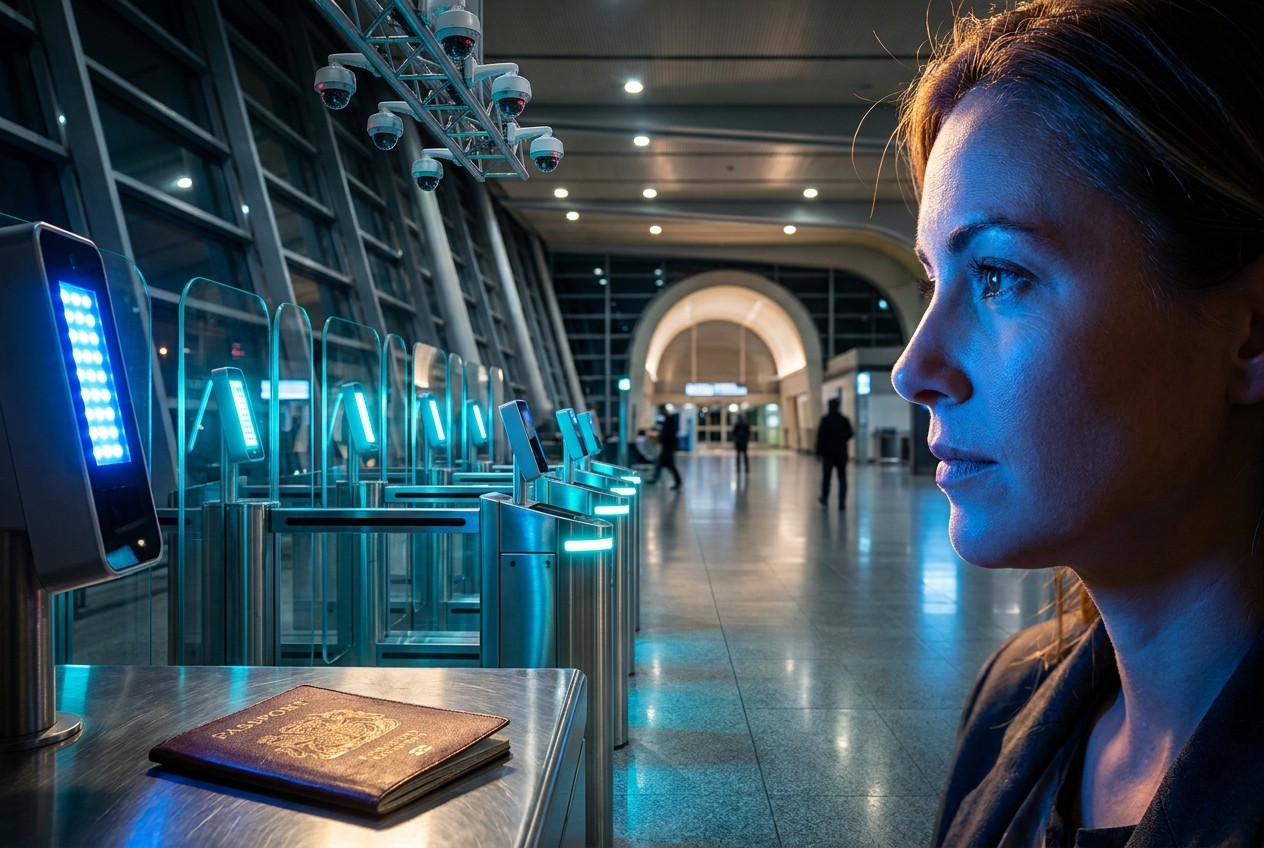
The British Home Office has announced that contactless facial recognition is replacing passport checks at airport eGates in the United Kingdom, with East Midlands Airport becoming the first facility to introduce the system.
The rollout is scheduled to expand to 13 airports by early 2027, officials said. The change is available first to British citizens, with other nationalities to be added in the coming months, according to the department [1].
The government said the contactless process saves about five seconds compared with the previous 20 to 25 seconds required for standard eGate use [2]. The announcement was met with support from airport representatives, who described the technology as improving both efficiency and border security, according to their statements.

Process Compares Live Image to Passport Photo Gallery
Under the system, a traveler's face is photographed as they approach the gate, according to the Home Office. The image is then compared to a gallery of passport photographs that airlines have sent to border control, officials said [1]. The government has advised travelers to keep their passports with them at all times despite the contactless process. A facial biometric system of this type requires an extensive database of faces and associated identities, along with hardware with large storage capacity and software capable of performing data searches and suggesting potential matches, according to research published in the Journal of Urban Policy and Environment [3]. The software used in this type of pattern recognition relies on neural network systems that recognize patterns in large databases by examining relationships among many variables [3].Home Office, Border Force and Airport Officials Cite Benefits
In the Home Office announcement, Phil Douglas, Director General of Border Force, claimed that "This is a win for travelers coming to our brilliant country." Douglas added that the digital transformation builds on work this summer to extend eGates to children aged eight and above, making life easier for families [1]. Steve Griffiths, Managing Director of East Midlands Airport, said the airport was "delighted" to be the first to introduce contactless eGates. Karen Dee, chief executive of AirportsUK, said the change "will be excellent news for the passenger" and demonstrates that U.K. airports continue to be at the forefront of new technologies while keeping borders safe [1]. Similar biometric boarding technology has been introduced elsewhere. Air Canada has rolled out facial recognition technology at its gates in Canadian airports for domestic flights, describing the technology as designed to offer passengers a quicker and more streamlined boarding experience while adhering to Transport Canada's biometric implementation guidelines [4]. The U.S. Transportation Security Administration (TSA) has also been rapidly deploying facial recognition technology at U.S. airports, aiming to improve efficiency and security, though the expansion has sparked debate over privacy, transparency, and potential government overreach, according to critics cited in the report [5].Data Retention and Digital ID Concerns Raised
U.K. government guidance states that facial images of British citizens captured at eGates can be kept for up to 30 days, while images of other nationalities can be stored for up to six years [1]. The same government is building a digital ID system and has promised that police will not be able to search it, while also consulting on allowing police access [1]. Privacy advocates cited by Reclaim The Net questioned the trade-off, saying the change saves five seconds at the gate while shifting border checks from travel documents to faces. The report raised concerns about privacy and safety after travelers leave the airport, noting that the British government has described the facial recognition rollout as a time-saving measure [1]. The broader expansion of biometric identification systems has drawn scrutiny from researchers and commentators. As noted in Against Borders, identification practices always grant and deny access, and in order to manage, control, and police populations, authorities need to be able to identify, verify, and retain centralized information on people [6]. Previous reporting has documented that the U.S. Federal Bureau of Investigation introduced nationwide facial recognition in January 2012, allowing local police to identify unknown subjects in photos through a Next-Generation Identification system [7].Rollout Continues as Privacy Debate Persists
U.K. airports have begun rolling out facial-recognition technology that could allow British passengers to clear immigration without physically showing or scanning their passports, with East Midlands Airport becoming the first to introduce the system [8]. Passengers still need their passports for check-in and boarding, and travelers whose faces are not matched can use the usual scan process [9]. The British government's broader surveillance infrastructure has been documented extensively. London now has approximately 68 CCTV cameras for every 1,000 people, a density roughly six times that of Berlin, according to AI researcher Eleanor "Nell" Watson [10]. Reports have also documented that the government of former Prime Minister Keir Starmer deployed facial recognition systems and invoked the United Kingdom's anti-free speech laws during the recent Unite the Kingdom rally, making clear it would not tolerate anything it considered hateful or xenophobic [11]. As the rollout continues, questions about privacy, data storage and the expansion of biometric identification systems are likely to persist. Downing Street has framed the technology as improving the traveling experience while maintaining border security, according to official statements, while privacy advocates continue to raise concerns about the long-term implications of shifting from travel documents to facial verification [1].References
- UK Airports Begin Replacing Passport Checks With Facial Recognition. https://reclaimthenet.org/uk-airports-facial-recognition-passport-checks
- UK Airports Begin Replacing Passport Checks With Facial Recognition. https://ukreloaded.com/uk-airports-begin-replacing-passport-checks-with-facial-recognition/
- Police technology in cities: changes and challenges by SYSTEM400 Rev 15.09. Journal of Urban Policy and Environment
- Air Canada rolls out facial recognition technology at boarding gates for domestic flights - NaturalNews.com, December 04, 2024.
- SURVEILLANCE US expands biometric technology in airports - NaturalNews.com, January 10, 2025.
- Against Borders by Gracie Mae Bradley; Luke de Noronha; & Luke de Noronha
- Disappear Without a Trace by David Author
- UK airports begin passport-free facial recognition rollout. https://new-portal.travelmole.com/news/uk-airports-passport-free-facial-recognition
- UK Airport Facial Recognition: E-Gate Rollout by 2027. https://www.visaverge.com/passport/uk-airports-to-roll-out-facial-recognition-e-gates-passports-still-required/
- Britain’s new “mind-reading” and behavior-predicting surveillance system turns every citizen into a suspect. https://www.naturalnews.com/2026-01-13-britain-new-surveillance-system-turns-citizens-suspects.html
- Starmer Government Doubles Down On Anti-Free Speech Policies. https://www.zerohedge.com/markets/starmer-government-doubles-down-anti-free-speech-policies
Explainer Infographic

Tweet
Share
Copy
Tagged Under:
glitch collapse police state national security surveillance data collection United Kingdom UK Britain big government policing deception travel Facial recognition passports information technology police surveillance computing future tech privacy watch digital ID facial scans Home Office contactless facial recognition East Midlands Airport Phil Douglas eGates UK airports
You Might Also Like

San Diego Police Department Seeks Information on AI Report-Writing Tools
By Douglas Harrington // Share

Witkoff and Kushner’s October Moscow tour is a smokescreen for prolonging the war
By Lance D Johnson // Share
Oracle Trucks Compressed Natural Gas to Data Centers as Pipeline Delays Threaten AI Campuses
By Chase Codewell // Share

By Lance D Johnson // Share


Recent News
Big Brother at the Airport? UK Expands Facial Recognition Checks to 13 Airports
By chasecodewell // Share
San Diego Police Department Seeks Information on AI Report-Writing Tools
By douglasharrington // Share


Saffron: The golden spice of wellness and culinary delight
By avagrace // Share

Study Reports Second-Generation Planet Orbiting Dying Star
By edisonreed // Share