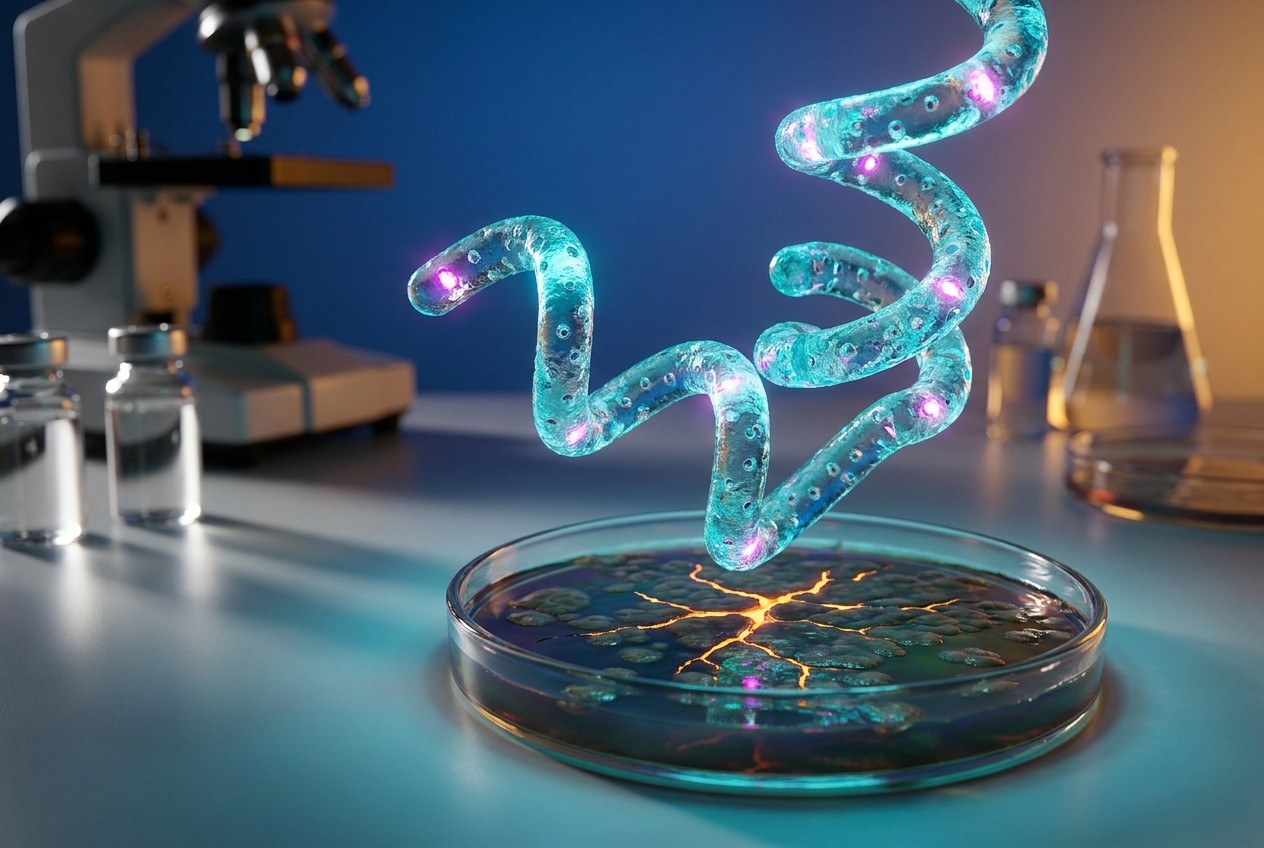
Lactoferrin and Antimicrobial Defense
The study traced lactoferrin, an immune protein that emerged about 160 million years ago near the end of the Jurassic Period in the common ancestor of placental mammals. Lactoferrin is present in almost every body fluid except blood, including breast milk, tears, saliva, snot, and intestinal mucus. One primary job of lactoferrin is to bind iron tightly, making the element harder for bacteria to access. Lactoferrin also contains an antimicrobial peptide capable of damaging bacterial membranes and creating holes that can rupture cells, the study reported. Independent research on lactoferrin describes a similar two-part mechanism, noting that the protein's bactericidal activity has been documented for both Gram-positive and Gram-negative bacteria and that at least two different mechanisms appear to be involved [3]. Close relatives of lactoferrin do not share this bacteria-killing ability, suggesting the trait appeared after lactoferrin emerged during mammalian evolution. The role of such peptides as endogenous antibiotics within the broader immune system has been described in scientific literature, which characterizes antimicrobial peptides as host defense peptides confirmed as an essential part of the immune system [4]. Other research has documented antimicrobial peptides as a defense mechanism across a wide range of organisms, including the skin glands of terrestrial salamanders, which are receiving attention as possible replacements as resistance increases against fungal antibiotics [5].Reconstructing Extinct Proteins
To recreate the extinct antimicrobial peptide, Sil compared lactoferrin gene sequences from living species such as humans and cows. She then mapped evolutionary relationships among those sequences and used statistical methods to estimate the most likely genetic sequences carried by common ancestors. The method, known as ancestral sequence reconstruction, extended the reconstruction back roughly 160 million years. The approach was pioneered by Joseph Thornton, a former UO scientist whose old laboratory space is now occupied by Barber's group, according to the University of Oregon. Sil synthesized the predicted genes and used cells to produce the reconstructed ancient proteins, then tested them against Pseudomonas aeruginosa, Staphylococcus aureus, Escherichia coli, and Streptococcus. Barber said, "Evolution is essentially a billions-year-old science experiment." He added, "We're seeing the results of what worked and what didn't work. Looking at how traits are naturally produced and selected through evolution, you can get information that could be useful for designing new antimicrobial tools [1]." The strategy reflects a broader scientific interest in natural antimicrobial compounds found across the animal kingdom. Separate research has examined antimicrobial peptides in Komodo dragon blood plasma, for example, after a study in the Journal of Proteome Research concluded that the plasma contains numerous antimicrobial peptides [6].Laboratory Results and a Single Mutation
The oldest resurrected antimicrobial peptides were able to disrupt bacterial membranes, but the bacteria apparently repaired the damage and survived exposure to the peptides. Versions reconstructed from more recent mammalian ancestors, dating back a few million years, became progressively more effective, the report stated. In some cases, the reconstructed peptides performed better than the corresponding modern human peptides. Researchers traced much of that increased potency to a single mutation in the chain of amino acids, which was enough to make the antimicrobial peptide substantially more effective. Barber said, "What was surprising and unexpected was how small changes in these domains could have such large effects [1]." He also noted that "there have been clinical trials using derivatives of human lactoferrin peptides to treat infections," but that Sil showed "you don't need a lot of changes for evolution to enhance the activity of these peptides beyond the human versions [1]." Barber and Sil cautioned that resurrected antimicrobial peptides' instability and rapid breakdown in the body limit their immediate therapeutic potential. The challenge of translating peptide activity into usable therapies extends beyond this study. Researchers working on implant coatings have explored antimicrobial peptides as a way to control infections at the site of implantation, noting that more than 600 peptides are known to have antimicrobial activity, most with broad activity against different microorganisms [7]. Other laboratory work has found that a peptide-loaded material reduced bacterial counts compared with groups without the peptide [8], while separate research on the peptide distinctin focused on inhibiting the attachment of Staphylococcus aureus to central venous catheters and increasing its susceptibility to glycopeptides and carbapenems once it is adherent [9].Limitations and Future Research
The authors stated that reconstructing the evolutionary history of antimicrobial peptides could lead to the discovery of useful strategies for designing future treatments. Critical peptides in human immunity face similar constraints, with scientific literature noting that many antimicrobial peptide activities have been detected in vitro and that in vivo experiments with confirmatory results have only been obtained for a limited set of effects [4]. Barber said, "Similar to antibiotics, pathogens are going to be able to evolve against antimicrobial peptides [1]." He said that understanding and anticipating resistance could help researchers find better ways to target pathogens or develop combination treatments. Antimicrobial resistance is defined as the ability of microorganisms to change upon exposure to an antimicrobial component and reduce its effectiveness. The World Health Organization has labeled the spread of antimicrobial resistance as a global health concern because it threatens the ability of humans to treat common infectious diseases [2]. Scientific reviews have also emphasized the urgency of the problem, noting that multidrug antibiotic resistance is a crucial worldwide health problem and that the production of new potent antibiotics is urgent [10].References
- 160-million-year-old proteins show surprising power against superbugs. https://www.sciencedaily.com/releases/2026/09/260925093155.htm
- Researchers are looking to peptides to combat drug-resistant microbes - NaturalNews.com, February 18, 2020.
- Lactoferrin and its role in wound healing by Takayama Yoshiharu
- Antimicrobial peptides and human disease by Unknown_1
- Antibacterial and Hemolytic Activity of the Skin of the Terrestrial Salamander, Plethodon cinereus by Celia. Journal of Experimental Zoology 287:340–345 (2000)
- Komodo Dragon blood contains powerful self-produced antibiotics turning the reptile into a walking pharmacy - NaturalNews.com, April 05, 2017.
- Antimicrobial functionalized genetically engineered spider silk by Sílvia C. Gomes. Journal of Materials Chemistry B 2011]
- Local delivery of antimicrobial peptides using self-organized TiO2 nanotube arrays for peri-implant infections. Journal of Biomedical Materials Research A 103(5) 2015
- Distinctin improves the efficacies of glycopeptides and betalactams against staphylococcal biofilm in an experimental model of central venous catheter infection. Journal of Biomedical Materials Research Part A 79(1) 2006
- Antimicrobial Agents by X

Turmeric Draws Health Interest as Reports Cite Benefits
By Edison Reed // Share


Basil: A culinary and medicinal powerhouse
By Ava Grace // Share

Study: Physical Decline May Appear Up to 10 Years Before Cardiovascular Events
By Chase Codewell // Share

Passionflower May Calm Racing Thoughts, Support Sleep, Relieve Anxiety, Report Says
By Coco Somers // Share

Thyroid diet myths busted: Broccoli is fine, but your fancy sea salt isn’t
By Cassie B. // Share

Israel tests Turkey’s airspace ban, with success
By ljdevon // Share

U.S. Families Behind on Bills at Rate Not Seen Since Great Recession, Fed Survey Finds
By sterlingashworth // Share

Taiwan’s Gas Gamble: A 30% Stake in Alaska’s Pipeline Amid Geopolitical Minefields
By chasecodewell // Share

U.S., China, Russia Face Questions Over UFO Technology Race, Officials Say
By garrisonvance // Share
Turmeric Draws Health Interest as Reports Cite Benefits
By edisonreed // Share