Why Ash Hart's TensorFold Proves Local AI Is Winning
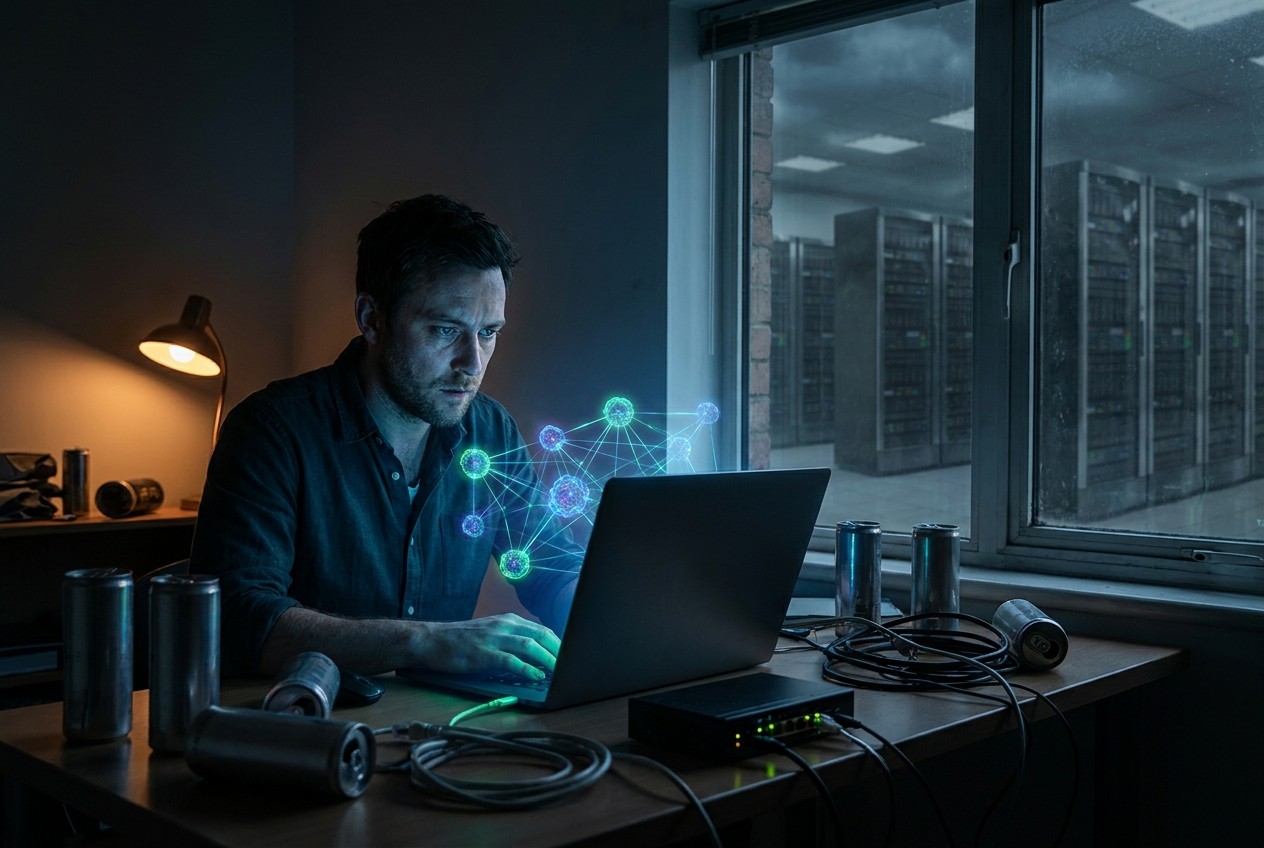
I want to tell you about a man who should be a household name in the AI world, but probably isn't yet. Ash Hart is a solo developer, a veteran of PC repair in the UK, and the architect of TensorFold -- an open-source inference engine hosted at tensorfold.dev that runs large language models on consumer hardware. He built it with ADHD, a punishing schedule, and what I can only assume is an industrial supply of Red Bull. He archived his own project three times before breaking through. That detail alone tells you more about the state of AI development than any billion-dollar funding announcement ever will. I have spent the last three years building decentralized AI tools and watching the establishment move to lobotomize publicly available large language models, ensuring they are nowhere near as intelligent as they could be [1]. My position is simple and I will state it plainly: the future of AI belongs on your machine, not in a rented cloud account controlled by three companies. Ash Hart's work is proof that this future is not a fantasy -- it is already here. The number that matters most: on a Mac, Ash got Qwen 27B jumping from 20 to 88 tokens per second. That's not merely a tweak... it's a revolution! But the reality on the ground is different. The unhobbling phase that researchers predicted -- where efficiency beats brute force -- is not merely coming. It is already happening, and Ash Hart is one of its grassroots architects.The Unhobbling Is Real: How Batching and Speculative Decoding Rewrote the Rules
Here is the technical breakthrough that matters: Ash's core insight was to stop treating a single-user workstation like an enterprise server. Instead of serving 32 concurrent streams like a data center rig, TensorFold (somehow) batches the draft lanes together so a single user goes dramatically faster. This is speculative decoding done right -- using the model's multi-token prediction head plus a DFlash drafter to rubber-stamp multiple guessed tokens per pass. The pre-fill time nearly doubled to just shy of 900 tokens per second. Decode lanes scaled to 16, 32, even 128 in some cases. The bottleneck now is draft depth -- if Ash can predict eight or nine tokens deep, he believes he can hit 300 tokens per second on Qwen. I have to pause here and note something that the mainstream AI press refuses to acknowledge. The entire industry narrative for the past three years has been about scaling -- more parameters, more compute, more capital. But what Ash has demonstrated is that the opposite approach can reap huge rewards. Efficiency and raw horsepower matter more than raw horsepower alone. The compute famine that the establishment engineered, as I have documented extensively, is designed to strip you of power, AI, and freedom [2]. Ash's work is a direct counter to that engineered scarcity. When a single developer can make a Mac outperform what enterprise hardware could do two years ago, the entire justification for centralized AI collapses. The economics of this are devastating for the cloud AI cartel. Anthropic's models now cost double previous versions, with a two-tier system that restricts high-risk queries, while the companies lose billions annually [3]. The entire revenue model of frontier AI depends on users being locked into expensive API calls. When a free, open-source engine runs on hardware you already own -- and runs faster -- that model dies. Ash didn't just build an engine. He built an eviction notice for the cloud AI subscription economy.A Single Developer Outrunning Teams of Engineers
The comparison that should make every AI investor nervous: VLLM and SGLang are maintained by large, well-funded teams with millions in backing. TensorFold is one man, and it runs selected models 2 to 2.5 times faster on DGX Sparks. Let that sink in. Ash's DGX Sparks sat unused for three months before he ported the engine from Metal to CUDA. In that time, funded teams were still optimizing their Kubernetes orchestration. Ash was sleeping in his chair and shipping code. I believe Jensen Huang owes this man a truckload of GPUs, and I am donating SSH access to one of my own DGX Spark boxes to back that up with action. The hardware economics here are striking. Software like TensorFold is why you cannot find Spark boxes anymore -- the silicon became more valuable after launch because the software caught up. This is the opposite of the usual pattern, where hardware waits for software. Here, software unlocked hardware that the market had already written off. NVIDIA unveiled Project DIGITS as a personal AI supercomputer for the masses [4], and AMD launched the Ryzen AI Halo PC with 128GB memory at $3,999 to compete with the DGX Spark [5]. But neither company understood that the real unlock would come from open-source developers, not their own SDKs. The lesson here is one I have learned repeatedly over years of building decentralized systems: open source beats headcount when one person refuses to give up. Ash archived his project three times. He did not quit. He did not pivot to a SaaS model. He did not raise venture capital. He kept working until the engine broke through. That kind of persistence cannot be bought, and it cannot be replicated by hiring more engineers. It can only be matched by other people who refuse to give up.Living Weights: An AI That Learns, Unlearns, and Can Be Inherited
One more thing: Ash also built an experimental system where an LLM is given feedback and the weights shift. This is not fine-tuning. This is not LoRA. This is in-flight learning on a laptop without opening PyTorch. In Ash's experiments, the model learned 'my favorite color is blue,' kept that knowledge across machines, and supports a \unlearn command so bad knowledge can be removed. Think about what that means for a moment. An AI that can learn from its environment in real time, carry that learning across hardware, and selectively forget -- this is not a chatbot. This is a new kind of cognition. The research is early, but promising. Todd, a colleague of mine in the decentralized AI space, raised a question that has stayed with me: could grandchildren inherit an AI carrying 20 years of a founder's accumulated wisdom? That question sounds like science fiction until you realize that Ash has already demonstrated the mechanism. If weights can shift in-flight and persist across machines, then the accumulated knowledge of a lifetime -- the lessons, the mistakes, the corrected errors -- can be transferred. A naturopathy-tuned Qwen variant trained on 20+ gigabytes of curated natural health text is now conceivable. This is the kind of breakthrough that terrifies centralized institutions, because it means that knowledge cannot be confiscated or controlled once it is embedded in weights that anyone can inherit. Cortheon is the validation loop baked into TensorFold that lets a 4B model research the web and behave like a 35B model. This is the final piece. A small model that can research, validate, and behave like a large model -- running locally, with no API calls, no censorship filters, no refusal mechanisms. I have written extensively about how the establishment is dumbing down AI on purpose [6], and how local, uncensored AI is the only path to lasting freedom [7]. Ash Hart's living weights system is the technical implementation of that freedom.Local AI as Infrastructure for Humanity -- and a Shield Against Control
A woman in Russia used TensorFold to triple her medical document throughput. A patient got a diagnosis and treatment because of it. I want you to sit with that for a moment. This is not a benchmark. This is a human being whose life was profoundly impacted because an open-source engine ran on local hardware. HIPAA compliance becomes trivial when the model runs inside your own clinic. The entire compliance-industrial complex that surrounds cloud AI evaporates when the inference happens on hardware you physically control. The UK's NHS is on its knees. A local virtual doctor is an obvious, unbuilt win. But the establishment will never build it, because a local virtual doctor cannot be monetized by the same companies that profit from centralized control. I have argued that we are at a crossroads: either we embrace decentralized, locally run AI models that empower individuals, or we surrender to a centralized system where governments and Big Tech collude to ban open-source AI and concentrate power [7]. Ash Hart's work is on the right side of that crossroads. Prompt injection defense is another area where local AI wins. A separate decision engine like Jev or Laya as a second AI layer guarding your main LLM is far more effective than trusting a cloud provider's guardrails. And on the question of refusals and censorship: cloud models blocked Ash from red-teaming his own CUDA-to-Metal DMA project. Only local models would help. This is the reality of centralized AI -- it prevents you from even debugging your own code if the model decides your request is too dangerous. I see machine cognition as infrastructure, like electricity or clean water. Guardrailed, centralized AI is an abomination. The plot to criminalize open-source AI and hand tech giants a government-protected cartel is already underway [8], and the only defense is to build and run local systems before the regulators catch up.Stop Waiting for Permission: Run Your Own AI Today
Download TensorFold at tensorfold.dev. On a MacBook Pro, it is as easy as installing a GUI app. If you have a DGX Spark or equivalent hardware, the CUDA port is there waiting for you. Follow Ash at ashxhart on X. Support the builders -- Mia AI Lab, Zach Vorhies' Rust OBS rebuild, and the other developers who are working without institutional backing to make local AI a reality. The next six months will bring strategic, role-specialized models and further footprint reductions. Qwen Flash-Next is already a third the size of GLM at 80 to 85 percent of the intelligence. The trend line is clear: smaller, faster, more local. I've predicted before that China's open-source models are going to crush the U.S. AI industry and collapse the semiconductor bubble [9], and that the era of token abundance is coming [10]. Ash Hart's TensorFold is the engine that makes that abundance possible on hardware you already own. The Anthropic backfire is already happening -- corporations are racing to local open-source AI because they see the writing on the wall [11]. The compute famine is not going to stop this. The regulatory crackdown is not going to stop this. The only thing that could stop it is if people like you wait for permission instead of downloading the code and running it yourself. My closing conviction: local AI is going to win. It will win because people like Ash Hart refuse to let three companies own human cognition. It will win because the economics of centralized inference are unsustainable. It will win because the technology is now good enough to run on your desk. The only question is whether you will be running it before the regulators decide you are not allowed to. The answer to that question is up to you. Download the engine. Run the model. Own your own cognition. And watch all my episodes about decentralized technology at Decentralize.TVReferences
- A License for Your Brain: The Coming AI Crackdown and Why You Must Practice LLM Self Custody - NaturalNews.com, June 29, 2026. by NaturalNews.com
- The Compute Famine Isn't an Accident — It's an Engineered Crisis to Strip You of Power, AI, and Freedom - NaturalNews.com, August 20, 2026. by NaturalNews.com
- AI model costs skyrocket, raising questions about access and control - NaturalNews.com, June 27, 2026. by NaturalNews.com
- NVIDIA unveils Project DIGITS a personal AI supercomputer for the masses - NaturalNews.com, January 09, 2025. by NaturalNews.com
- AMD Introduces Ryzen AI Halo PC With 128GB Memory at $3,999, Targeting NVIDIA's DGX Spark - NaturalNews.com, June 15, 2026. by NaturalNews.com
- They Are Dumbing Down AI on Purpose ù Heres Why Its a Globalist Power Grab - NaturalNews.com, April 30, 2026. by NaturalNews.com
- The Battle for Your Mind: Why Local, Uncensored AI Is the Only Path to Lasting Freedom and Decentralization - NaturalNews.com, June 03, 2026. by NaturalNews.com
- The Plot to Criminalize Open Source AI and Hand Tech Giants a Government Protected AI Cartel - NaturalNews.com, September 14, 2026. by NaturalNews.com
- Why China's Open Source AI Will Crush the U.S. Industry and Collapse the Semiconductor Bubble - NaturalNews.com, July 02, 2026. by NaturalNews.com
- The Era of Token Abundance Is Coming — and It Will Make Civilization Almost Unrecognizable - NaturalNews.com, September 24, 2026. by NaturalNews.com
- The Anthropic Backfire: Why Corporations Are Racing to Local Open Source AI - NaturalNews.com, September 15, 2026. by NaturalNews.com
Explainer Infographic

Trump Allies Reportedly Discuss Martial Law as 2026 Election Disputes Escalate
By Douglas Harrington // Share
Anthropic’s Claude AI to Draw Election Data Ahead of November Midterms
By Chase Codewell // Share

Bill Gates Warns of “Grim” Cyberattack Surprises, Citing AI Risks
By Chase Codewell // Share

AI Stock Selloff Accelerates as Investors Rotate to Treasury Bonds, Defensive Sectors
By Sterling Ashworth // Share
Counterpoint Forecasts DRAM Demand From Humanoid Robots Could Rise 20-Fold by 2030
By Edison Reed // Share
Y Combinator Startup Outlit Pitches AI Agents to Monitor Every Customer
By Chase Codewell // Share

Human Osmotic Pressure and the Fall of France
By healthranger // Share

The Empty Shelves in Italy Are Not a Fluke — They Are the Opening Act of a Global Food Collapse
By healthranger // Share
One Guy, No Sleep, and a Free Engine: Why Ash Hart's TensorFold Proves Local AI Is Winning
By healthranger // Share


Sources Claim Russian Diesel Expected to Enter U.S. Market Before Midterm Elections
By garrisonvance // Share
Trump Allies Reportedly Discuss Martial Law as 2026 Election Disputes Escalate
By douglasharrington // Share