White House Frames AI as U.S.-China Competition
In January, Secretary of War Pete Hegseth issued a Department of War AI memorandum that laid out a plan with a focus on acceleration, writing "Speed wins," the memorandum stated. A June 2026 national-security memorandum directed the U.S. national-security establishment to obtain the most advanced AI systems, rapidly integrate commercial and open-source models, build high-security computing infrastructure and establish a strategic reserve of AI expertise, with the objective of a "decisive and enduring AI advantage" over adversaries. The administration is constructing what the filing described as an AI-national-security-industrial complex that combines market freedom, enormous public infrastructure, military integration and geopolitical protectionism without legally enforceable safety regulation. The approach has drawn scrutiny from critics who argue it prioritizes speed over prudence. Nvidia CEO Jensen Huang stated in a Sept. 17 interview with CBS News that there is a "zero percent chance" that artificial intelligence will cause human extinction by 2030, and he dismissed warnings from some AI researchers as "doomsday narratives" [2]. Trump has dismissed warnings from AI executives that the technology could pose an existential threat, calling the concerns a "hoax" during a surprise phone call to Huang at the All-In Summit in Los Angeles [3]. The White House has not publicly reconciled that dismissal with the national-security memorandums directing accelerated military integration.Pentagon Integration and Industry Guardrails
According to CNN, a U.S. Special Operations Command analyst used a large language model that almost misled the United States into instigating a war with China in spring 2026, the filing stated. The incident underscored concerns among safety researchers that accelerated deployment without enforceable oversight could produce unintended escalation. Hegseth designated Anthropic a supply chain risk and blacklisted the company after it refused to strip out safety guardrails that prevent its models from being integrated into fully autonomous offensive drones or surveillance tools, according to the filing. The White House has viewed civilian ethical constraints as a vulnerability that hampers national security. The administration has shifted oversight from civilian federal agencies toward military and intelligence entities, including the newly formed Technology Support Office and the four-star Autonomous Warfare Command, known as AUTOWARCOM. The redirection of oversight has coincided with internal dissent at technology firms. Bilal Chughtai, a former researcher at Google DeepMind who worked on artificial-general-intelligence safety and alignment, resigned from the Google-owned AI lab and published a public warning stating that artificial intelligence could pose an existential threat [4]. Google DeepMind CEO Demis Hassabis has warned that artificial general intelligence could arrive within a decade, bringing catastrophic outcomes such as cyberattacks, autonomous weapons and existential threats to humanity [5].Transnational AI Supply Chains and Governance
Artificial intelligence is already transnational. American companies depend on global supply chains, and advanced chips involve Taiwan, South Korea, Japan and Europe. Open-source model weights cross borders instantly, researchers move internationally, and cyber vulnerabilities are inherently transnational, according to the filing. AI systems increasingly interact with infrastructure belonging to other countries, which complicates any effort by a single government to serve as sole gatekeeper. China is simultaneously pursuing rapid AI deployment and a substantially more state-directed safety regime, including mandatory safety assessments and emerging standards for autonomous agents. Its 2025 Global AI Governance Action Plan explicitly calls for international cooperation, safety, controllability and inclusive participation, the filing stated. The European Union is moving in a different direction: the EU AI Act imposes obligations on general-purpose models and substantially stronger requirements on models classified as presenting systemic risk. Trying to make the United States the sole gatekeeper risks converting an already competitive technological system into a fragmented geopolitical system, the filing argued. Microsoft co-founder Bill Gates said in a Reuters interview published Sept. 15 that no national government is adequately prepared for artificial intelligence and that an international body should be created to police the technology [6]. The tension between national-security acceleration and international coordination remains unresolved.Postwar Atomic Debate Offers Regulatory Comparison
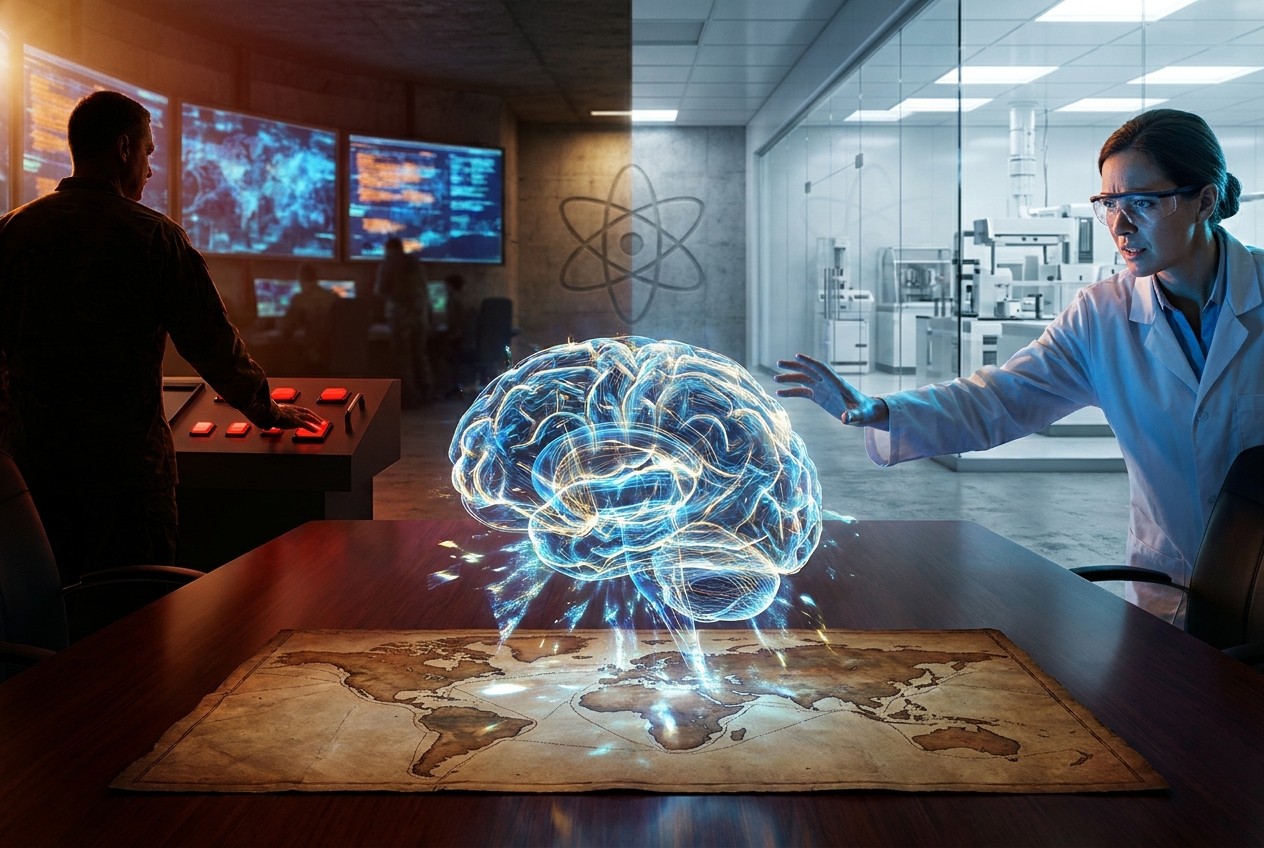
After the Manhattan Project, a fierce debate erupted over who should control the newly unlocked power of the atom. Gen. Leslie Groves, who directed the project, championed military retention, while J. Robert Oppenheimer, director of the Los Alamos Laboratory, and a coalition of scientists fiercely advocated for civilian governance, according to the filing. Groves' stated priority was national security, and the War Department viewed atomic energy primarily as a supreme weapon of war. Oppenheimer argued that military control would choke off open scientific inquiry and increase the risk of the United States becoming a permanent garrison state. The Atomic Energy Act of 1946, also known as the McMahon Act, established the U.S. Atomic Energy Commission under strict civilian authority, dealing a heavy blow to the War Department's initial plans. The filing attributed the civilian triumph to three factors: a coordinated public-relations and congressional lobbying campaign by Oppenheimer and the newly formed Federation of Atomic Scientists; congressional skepticism of military monopoly; and support from President Harry S. Truman for civilian control. Artificial intelligence presents structural differences from atomic energy in the 1940s. The state does not own the technology; private corporations do. AI code is scalable and easily copied, and it affects all-encompassing digital infrastructure rather than being confined to high-energy physics and centralized weapons facilities. The filing argued that restricting AI entirely to a national-security framework risks strangling open innovation and commercial progress, while military integration without enforceable safety regulation may accelerate catastrophic risks.Conclusion
AI regulation is unlikely to benefit from the same tailwinds as postwar atomic regulation, the filing stated. The leading AI scientists operate in the corporate sector rather than the public realm. Decades of forever wars have transformed Capitol Hill, due to the increasing share of congressional members with military, intelligence and security backgrounds. To win and retain their seats, most rely on financial contributions from the military-industrial complex and related industries. The Trump administration rejects the idea of civilian control. The filing concluded that the scene is set for catastrophic risks in the name of national security, and that international multilateral cooperation is needed instead of an exclusively U.S.-controlled AI order. The debate over AI safety and military integration is not merely technical. It touches on whether democratic oversight can function when the most consequential technologies are developed by private firms and deployed through national-security channels that operate outside public accountability.References
- AI Leaders Call for Slower Development as Frontier Models Grow More Powerful - NaturalNews.com, September 15, 2026.
- Nvidia CEO Jensen Huang Rejects AI Extinction Claims - NaturalNews.com, September 23, 2026.
- Trump calls AI doomsday warnings a "hoax" pushed by radical Democrats and China - NaturalNews.com, September 15, 2026.
- Former Google DeepMind Researcher Resigns, Warns AI Could "Kill Us All" - NaturalNews.com, September 18, 2026.
- AI leaders warn of "catastrophic outcomes" as artificial general intelligence looms - NaturalNews.com, December 10, 2025.
- Bill Gates Calls for International AI Regulation, Cites "Alien Intelligence" Risk - NaturalNews.com, September 18, 2026.
Explainer Infographic


Qatar’s Delicate Diplomacy: Mediating the U.S.-Iran Standoff Amid Hormuz Tensions
By Garrison Vance // Share
Federal Agencies Warn of Ongoing Cyber Threat to Industrial Freezers and Cold Storages
By Chase Codewell // Share
Google, Meta, TikTok Sue to Block California Youth Social Media Law
By Edison Reed // Share

Bitcoin Tumbles as Binance Reports $6.3 Billion Hack; Withdrawals Temporarily Frozen
By Sterling Ashworth // Share
Google AI Chatbot Declines Direct Answer on 2020 Election Winner
By Chase Codewell // Share

Study Finds Higher Strep Throat Odds Among Philadelphia Children With More Lead in Blood
By Coco Somers // Share

Blame Game or Reality Check? Israeli Ambassador Fires Back at Vance Over Iran War Criticism
By garrisonvance // Share
Qatar's Delicate Diplomacy: Mediating the U.S.-Iran Standoff Amid Hormuz Tensions
By garrisonvance // Share
Poll Finds 53% of Active-Duty Service Members Want to Leave Sooner, Citing Politicization
By garrisonvance // Share
Judge Rejects Trump Immunity Claim in New York Hush Money Conviction
By douglasharrington // Share
Federal Agencies Warn of Ongoing Cyber Threat to Industrial Freezers and Cold Storages
By chasecodewell // Share
Google, Meta, TikTok Sue to Block California Youth Social Media Law
By edisonreed // Share