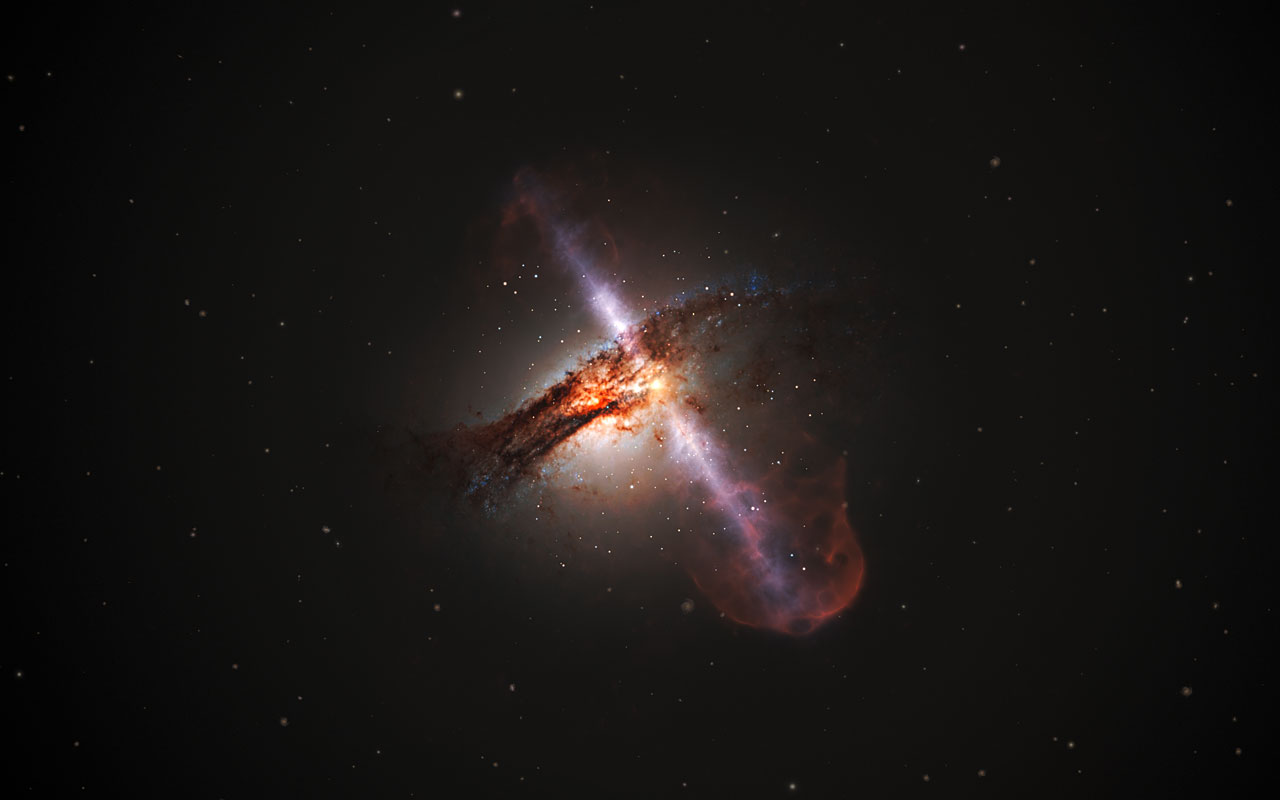
- Astronomers detected winds erupting from a supermassive black hole in galaxy NGC 3783 at 134 million mph (20% light speed), the fastest ever observed, triggered by an X-ray flare.
- The winds formed within a single day, likely due to the black hole's magnetic field "untwisting" explosively—similar to solar flares but on a vastly larger scale.
- These ultra-fast winds from Active Galactic Nuclei (AGN) play a critical role in regulating star formation and shaping galaxy evolution over cosmic time.
- The ESA's XMM-Newton and Japan's XRISM telescopes jointly captured the event, linking X-ray flares to wind formation and suggesting shared physics across cosmic scales.
- The discovery challenges black hole models and raises questions about how common such rapid winds are, with potential parallels to solar magnetic processes.
A cosmic storm like the sun, but millions of times stronger
Researchers believe the winds were generated when the black hole's tangled magnetic field suddenly "untwisted", releasing an explosive burst of energy. This process bears striking resemblance to solar flares and coronal mass ejections (CMEs) on our sun—but on an unimaginably larger scale. "The winds around this black hole seem to have been created as the AGN's tangled magnetic field suddenly 'untwisted'—similar to the flares that erupt from the Sun, but on a scale almost too big to imagine," explained Dr. Matteo Guainazzi, ESA XRISM Project Scientist and study co-author. For comparison, a recent solar CME in November 2023 ejected material at 950 miles per second (1,500 km/s)—a mere fraction of the black hole's 37,280-mile-per-second (60,000 km/s) outburst. Supermassive black holes like the one in NGC 3783 reside at the cores of most galaxies, including our own Milky Way. When these black holes feed, they become Active Galactic Nuclei (AGN), emitting intense radiation and ejecting powerful jets and winds that influence star formation and galactic evolution. "Windy AGNs also play a big role in how their host galaxies evolve over time and how they form new stars," said Camille Diez, ESA Research Fellow and study co-author. "Because they're so influential, knowing more about the magnetism of AGNs, and how they whip up winds such as these, is key to understanding the history of galaxies throughout the Universe." The discovery suggests that black holes and stars may share fundamental physics, with magnetic processes governing their behavior—just on vastly different scales.A triumph of collaboration between space telescopes
The breakthrough was made possible by the combined efforts of XMM-Newton, launched in 1999, and the newly deployed XRISM, which launched in September 2023. XMM-Newton tracked the flare's evolution and measured the winds' extent, while XRISM analyzed their speed, structure and origin. "Their discovery stems from successful collaboration, something that's a core part of all ESA missions," said Dr. Erik Kuulkers, ESA XMM-Newton Project Scientist. "By zeroing in on an active supermassive black hole, the two telescopes have found something we've not seen before: rapid, ultra-fast, flare-triggered winds reminiscent of those that form at the Sun. Excitingly, this suggests that solar and high-energy physics may work in surprisingly familiar ways throughout the Universe." This discovery opens new avenues for understanding how black holes regulate star formation and influence galactic evolution. Future observations with XRISM and other advanced telescopes may reveal whether such rapid wind events are common—or if astronomers were simply fortunate to witness this rare cosmic storm. For now, the black hole in NGC 3783 stands as a testament to the violent, dynamic forces shaping our universe—forces that, despite their scale, may operate under principles not so different from those governing our own sun. Watch this video about scientists capturing an image of a black hole at the center of Milky Way galaxy. This video is from the In Search Of Truth channel on Brighteon.com. Sources include: DailyMail.co.uk AandA.org PopularScience.com Space.com Euronews.com BrightU.ai Brighteon.com
The sweet deception: How “healthy” buzzwords hide a sugar epidemic in plain sight
By Ava Grace // Share

How a missing nutrient in young adults signals early brain cell damage
By Ava Grace // Share

Unearthing history: Pottery discovery fuels Noah’s Ark investigation
By Willow Tohi // Share
Scientists demonstrate how perfect magnetic symmetry can cancel energy loss
By Kevin Hughes // Share

The sunlight paradox: How fear of sun exposure is fueling a vitamin D deficiency crisis
By Evangelyn Rodriguez // Share

A fish lost to science reappears, offering a “last chance” for conservation
By Willow Tohi // Share

Iraq Detains Ukrainian Nationals Suspected in Plot Against Gulf Oil Facilities
By garrisonvance // Share

U.S. Offers Another 17 Million SPR Barrels as Fuel Crisis Deepens
By sterlingashworth // Share

U.S. Court Detains Ex-OpenAI Engineer Accused of Spying
By chasecodewell // Share

Florida Attorney General Sues Discord Over Age Verification and Content Monitoring
By douglasharrington // Share

IMF Chief Calls for AI Guardrails as Officials Weigh Economic Risks and Opportunities
By edisonreed // Share