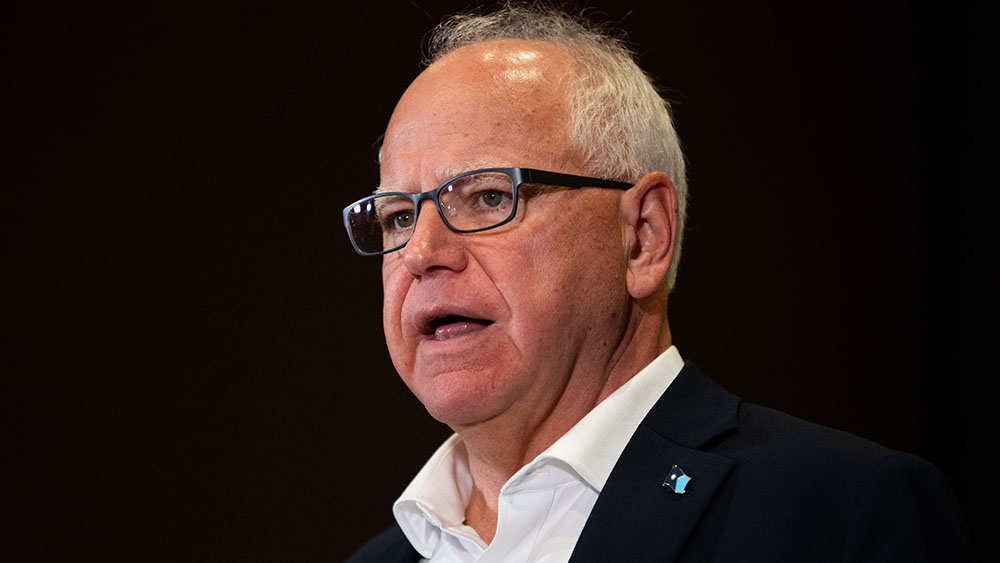
- Minnesota Gov. Tim Walz signed a 2020 law (Minnesota Statutes §609.066) allowing police to use deadly force against vehicles perceived as imminent threats – even before physical impact – now under scrutiny after ICE agents fatally shot Renee Good during a traffic stop.
- Walz, who positioned himself as a police reformer during the 2020 BLM riots, faces criticism for expanding police power with this law – contrasting his earlier calls to restrict law enforcement authority.
- The 2020 BLM riots in Minnesota – falsely portrayed as peaceful – were violent, politically orchestrated events enabled by authorities, revealing a double standard to destabilize society and advance globalist agendas.
- Supporters argue the law prevents officer hesitation in life-threatening scenarios, while critics call it a loophole for excessive force, highlighting the blurred line between "perceived" and "actual" danger.
- The law, passed amid national demands for police reform, now defines Walz's tenure – raising questions about legislative intent, accountability and whether the incident will prompt reevaluation of use-of-force standards.
Walz's police reform backfires
At the time, Walz positioned himself as a reformer, advocating for greater restrictions on police power. Yet the very law he signed expanded officers' ability to respond to vehicular threats – a provision now being invoked to justify the shooting of Good. Supporters of the law argue that it prevents officers from being forced into impossible situations where hesitation could cost lives. Opponents, however, see it as a loophole that enables excessive force under subjective interpretations of danger. Legal experts note that the statute was designed to balance officer safety with civilian rights, requiring that threats be "articulated with specificity" and "reasonably likely to occur" absent immediate action. But in practice, the line between perceived and actual danger remains blurred – and the case of Renee Good exemplifies this tension. Was her attempt to drive away a legitimate threat justifying lethal response, or was it an overreach enabled by the law Walz himself endorsed? Historical context adds another layer to the unfolding drama. The 2020 legislation was passed amid nationwide demands for police reform, with the North Star State at the epicenter following Floyd's killing. Walz's administration sought to address public outcry while appeasing law enforcement concerns – a delicate balancing act that may have inadvertently codified broader use-of-force permissions than intended. Now, as the same law is wielded in defense of an officer's actions, Walz faces scrutiny from both sides of the political spectrum. The debate also highlights a recurring theme in policing policy: the challenge of drafting laws that protect both officers and civilians without unintended consequences. Similar statutes exist in other states, often justified as necessary for officer survival in high-risk situations. Yet cases like Good's demonstrate how quickly such measures can be tested – and how difficult it becomes to reconcile legislative intent with real-world outcomes. As the fallout continues, one question lingers: Will this incident prompt a reevaluation of Minnesota's use-of-force standards, or will it reinforce the belief that preemptive action is sometimes the only option for law enforcement? For now, Walz's legacy is intertwined with a law that, in an unexpected turn, has come back to define his tenure in ways he may never have anticipated. Watch attorney and legal scholar Jonathan Turley noting that the "blind recklessness" of Minnesota Gov. Tim Walz is "baffling" in this clip. This video is from the TREASURE OF THE SUN channel on Brighteon.com. Sources include: 100PercentFedUp.com Revisor.MN.gov BrightU.ai X.com Brighteon.com
Greenland’s PM urges citizens to PREPARE for possible U.S. invasion
By Ramon Tomey // Share

UK and France weigh social media bans, but age checks create vast privacy risks
By Cassie B. // Share

The Hidden Cure: How Big Pharma suppresses nature’s cures to protect their $100B death industry
By Belle Carter // Share
Federal subpoenas target Minnesota officials in escalating clash over immigration enforcement
By Ramon Tomey // Share

Tech executive suffers psychotic breakdown after prolonged use of Meta’s AI glasses
By Kevin Hughes // Share

Severe solar storm strikes Earth, disrupting satellites and triggering aurora spectacle
By Kevin Hughes // Share

Iraq Detains Ukrainian Nationals Suspected in Plot Against Gulf Oil Facilities
By garrisonvance // Share

U.S. Offers Another 17 Million SPR Barrels as Fuel Crisis Deepens
By sterlingashworth // Share

U.S. Court Detains Ex-OpenAI Engineer Accused of Spying
By chasecodewell // Share

Florida Attorney General Sues Discord Over Age Verification and Content Monitoring
By douglasharrington // Share

IMF Chief Calls for AI Guardrails as Officials Weigh Economic Risks and Opportunities
By edisonreed // Share