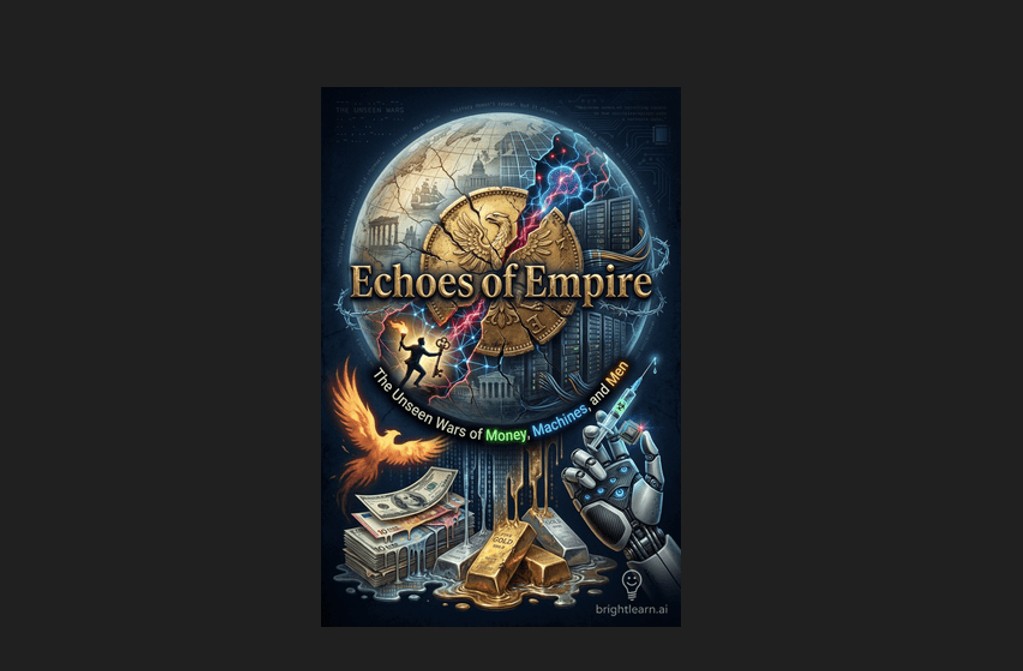
- The book "Echoes of Empire" exposes how empires historically manipulate economies (e.g., Roman currency debasement, Federal Reserve creation) and warns that Central Bank Digital Currencies (CBDCs) will enable total financial surveillance—freezing, expiring or seizing assets at will.
- Bitcoin offers censorship-resistant money, but faces co-optation by Wall Street (e.g., ETFs, regulated products) that strip its core principles: self-custody, privacy and independence from state control.
- Precious metals like gold and silver remain the ultimate hedge against hyperinflation and government manipulation. The book advises stacking physical metals (avoiding paper ETFs) and learning purity testing to preserve financial sovereignty.
- Disputes like Israel-Palestine and CIA-backed coups (e.g., Iran 1953) are driven by oil, water and pipeline dominance—not ideology. Energy independence is key to breaking the cycle of control.
- From Hunter Biden's elite impunity to COVID-era fearmongering, the book ties modern corruption to historical tactics (e.g., false flags, Weimar hyperinflation). Solutions include financial decentralization (Bitcoin, metals, barter); self-reliance (local economies, natural medicine, off-grid living); and community resilience (mutual aid networks, decentralized governance).
Bitcoin's real-world rebellion
Amid this bleak landscape, "Echoes of Empire" offers a glimmer of hope: Bitcoin. Born from the ashes of the 2008 financial crisis, Bitcoin was conceived as decentralized, censorship-resistant money—free from the whims of central banks and political elites. The book highlights Bitcoin's revolutionary potential, from aiding Nigerian protesters against government banking freezes to El Salvador's adoption as legal tender. But Bitcoin faces its own existential threat: co-optation. Wall Street giants like BlackRock are flooding into Bitcoin ETFs, while wrapped Bitcoin (WBTC) reintroduces custodial risks. Governments push "regulated" Bitcoin products that strip away its core principles—privacy, self-custody and resistance to censorship. The authors warn: If Bitcoin becomes just another Wall Street asset, the revolution is already lost. Beyond Bitcoin, "Echoes of Empire" champions gold and silver as the ultimate hedges against financial tyranny. Unlike fiat currency, precious metals cannot be printed into oblivion—their scarcity is dictated by nature, not politicians. The book recounts historical suppression schemes, from Roosevelt's gold confiscation in 1933 to JPMorgan's silver market manipulation. Yet, gold and silver endure, offering anonymity, portability and resilience against hyperinflation. The authors provide practical guidance: stack physical metals, avoid paper gold ETFs, and learn to test purity. In a world hurtling toward CBDCs, gold and silver remain the last bastion of financial sovereignty.Oil, lies and empires
One of the book's most incisive chapters dismantles the myth that Middle Eastern conflicts are purely ideological. Beneath the rhetoric of religion and nationalism lies a brutal struggle for oil, water and pipeline dominance. The Central Intelligence Agency (CIA)-backed 1953 Iranian coup secured Western oil interests, while Gulf Wars masked resource grabs under humanitarian pretexts. The Israel-Palestine conflict, too, is framed as a territorial dispute—yet water rights and gas fields in the Eastern Mediterranean play a decisive role. The authors argue that energy independence—breaking reliance on Middle Eastern oil—is the only path to peace. The book pulls no punches in dissecting modern political corruption. The Hunter Biden saga—laptop scandals, tax evasion and a presidential pardon—exemplifies a two-tiered justice system where elites operate above the law. The authors expose media collusion, from Twitter's censorship of the Hunter Biden laptop story to the DOJ's [Department of Justice] leniency toward politically connected offenders. The broader implication? Trust in institutions is collapsing. Gallup polls show record-low confidence in the justice system—a direct consequence of selective enforcement and elite impunity.The elites' playbook for control and how to break free
"Echoes of Empire" underscores the importance of historical literacy. From Rome's bread-and-circus politics to Weimar hyperinflation, history repeats when lessons are forgotten. The Wuhan coronavirus (COVID-19) pandemic mirrored past false flags—fearmongering used to justify lockdowns, digital IDs and mRNA mandates. The authors urge readers to study history beyond government-approved textbooks. Only by recognizing these patterns can we resist the next engineered crisis. The book's final chapters outline a blueprint for resistance:- Financial independence: Shift savings into gold, silver, Bitcoin and decentralized assets.
- Self-custody: Hold your own keys—whether for crypto or physical metals.
- Local economies: Support farmers markets, barter systems and decentralized manufacturing.
- Natural health: Detox from Big Pharma, grow your own food, and relearn herbal medicine.
- Community resilience: Build mutual aid networks and decentralized governance.
Countdown to Annihilation: The globalists’ blueprint for total control
By Kevin Hughes // Share
CBO warns: U.S. debt to hit record 120% of GDP by 2036 amid rising deficits
By Kevin Hughes // Share
From eggs to fuel oil: Federal data reveals widespread price drops as inflation cools
By Cassie B. // Share

The Last Line of Defense: Why America’s sheriffs are the last barrier against tyranny
By Ramon Tomey // Share

Silver and gold surge as inflation fears and market turmoil drive safe-haven demand
By Patrick Lewis // Share

Rising jobless claims signal deepening economic crisis amid hidden agendas
By Patrick Lewis // Share
Iraq Detains Ukrainian Nationals Suspected in Plot Against Gulf Oil Facilities
By garrisonvance // Share

U.S. Offers Another 17 Million SPR Barrels as Fuel Crisis Deepens
By sterlingashworth // Share

U.S. Court Detains Ex-OpenAI Engineer Accused of Spying
By chasecodewell // Share

Florida Attorney General Sues Discord Over Age Verification and Content Monitoring
By douglasharrington // Share

IMF Chief Calls for AI Guardrails as Officials Weigh Economic Risks and Opportunities
By edisonreed // Share