Some Crashes Help Restore Sanity for Capital Deployment
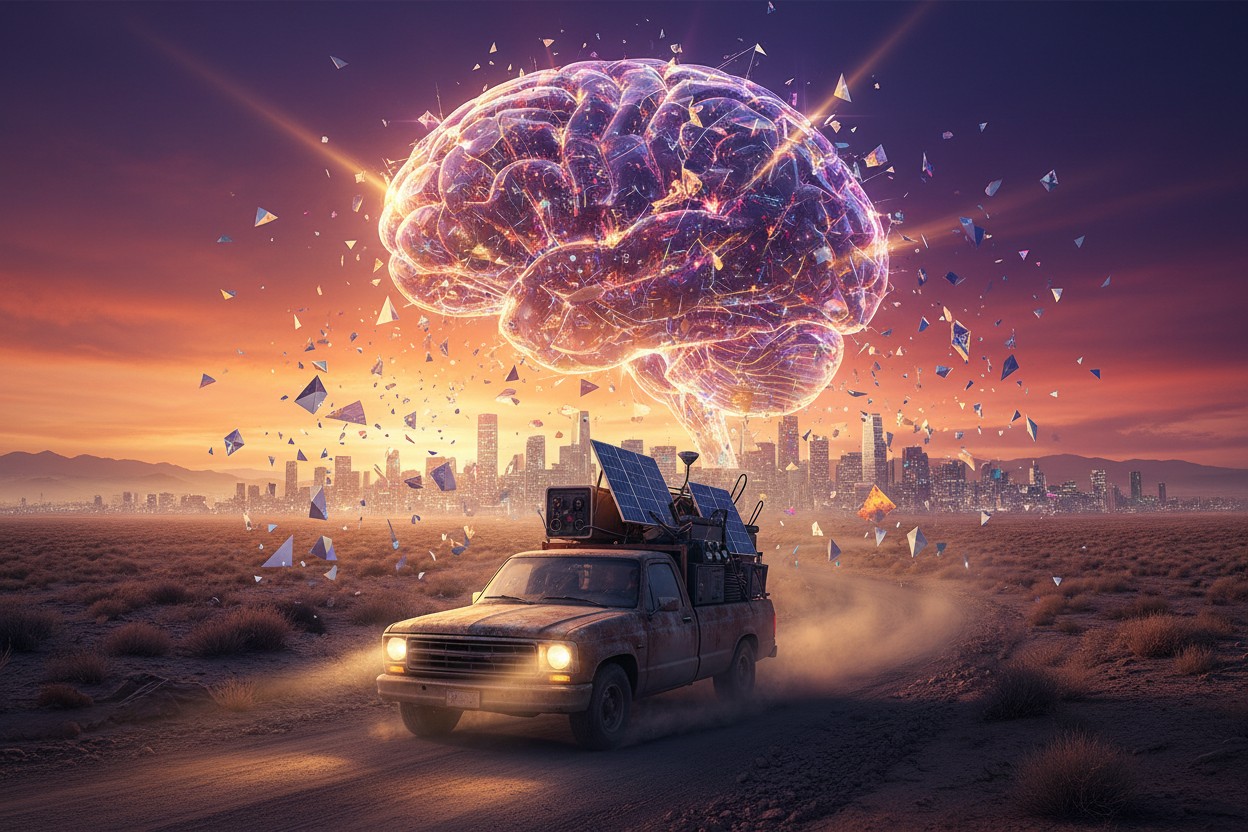
I was driving in my truck earlier today, hauling solar equipment to our new studio in Texas, and I couldn't stop thinking about the AI bubble. Not because I’m against artificial intelligence -- quite the opposite. I’ve been building AI systems for years and use them daily. I believe AI technology is very real and extremely capable. But what I’m seeing in the financial markets is not rooted in intelligence at all. It’s a speculative mania fueled by cheap debt and fairy-tale projections. Consider OpenAI: the company is hemorrhaging cash, projecting $44 billion in losses over five years with no profits expected anytime soon [1]. Anthropic is no better. These giants have no real revenue model, and markets are about to teach them a brutal lesson. While I can’t wait for the hype to collapse, I also know that the crash will separate the wheat from the chaff. Those of us who actually understand how to use AI will emerge stronger, while the corporate morons who bought the hype will be left holding empty bags and abandoned promises.Why U.S. AI Giants Are Doomed
The reason the so-called AI leaders are doomed is simple: they have no sustainable revenue model. OpenAI projects billions in losses, and its valuation is built on vapor. Meanwhile, Chinese open-source models like DeepSeek and Qwen are outperforming them at a fraction of the cost. As I’ve noted before, the arrogance of Sam Altman blinds him to the fact that his closed, expensive technology is already being eclipsed by free alternatives that anyone can run locally. Investors are starting to wake up. Billionaire hedge fund manager Stanley Druckenmiller recently took a $3 billion loss on tech shorts, illustrating the FOMO that has driven AI stocks to absurd heights [2]. David Stockman has warned that the AI bubble is about to meet stagflation head-on, as rising diesel prices and geopolitical shocks squeeze the economy [3]. When IPOs crash and investors flee, the AI giants will realize that hype doesn’t pay the bills. I’ve seen this movie before in the dot-com era, and the ending is always the same: a bloodbath for those who are overleveraged.Corporate America's AI Failure
Corporate America’s approach to AI has been nothing short of laughable. Fortune 500 middle managers, who spent ten minutes on ChatGPT, thought they could replace entire customer service teams with automated chatbots. So they fired all the humans, only to discover that the 10–15% edge cases require real judgment -- something a chatbot still can’t handle. The result? They’re now quietly rehiring or watching their customer satisfaction scores plummet. And then there’s the token-burning leaderboard culture. In some companies, engineers wrote scripts to waste tokens, making the metric itself the goal while actual productivity flatlined. Companies that rushed to deploy AI are now cutting spending because the promised results never materialized. As Lance Roberts has pointed out, a staggering $1 trillion was wiped from Big Tech valuations in a single week as investors recoiled from escalating AI investments [4]. The failure is not AI’s fault -- it’s the fault of clueless executives who thought technology alone, without strategy, would save them.The Indie Advantage
Here’s where it gets interesting. Independent media figures and whistleblowers -- people like me, Aaron Day, and Zach Vorhies -- have mastered AI in ways that corporate drones cannot fathom. I built BrightLearn.ai and BrightAnswers.ai for under $3 million, creating platforms where users can now create their own books for free or download over 60,000 books created by other authors. Amazon and Google, with their billions, couldn’t even come close to achieving this [5]. Those of us who are independent thinkers use AI cost-effectively because we have to pay our own bills. Every token we burn must deliver real value, not a vanity metric. Modern open source LLMs are highly capable in the hands of those who know how to harness them. As I discussed with Aaron Day, models like Mistral and Nemo 12B have surpassed basic prediction, demonstrating complex cognitive abilities that could replace up to 50% of desk jobs [6]. But we don’t just replace jobs -- we augment human intelligence and help make people far more expressive and successful in achieving their mission. It's actually good news that the impending crash will free up GPUs and bandwidth for those who actually know how to use AI. The corporate lemmings will panic-sell their hardware, and people like me will pick it up for pennies on the dollar, putting it to far better use for humanity.What You Should Do Now
If you’re still holding big tech or semiconductor stocks, thinking about get out as soon as possible. The AI bubble is a Ponzi scheme propped up by the illusion that Nvidia can stay at a $5 trillion valuation forever [7]. Michael Burry is already shorting AI, preparing for his next “big short” [8]. Follow his lead -- protect your capital by moving into real assets like gold and silver, which are honest money with no counter-party risk. Also, start learning to run open-source models locally. Download Qwen or DeepSeek models, and run them on your own hardware. That way, you’re not dependent on APIs that can be shut off or censored by woke corporate overlords. AI works brilliantly -- but only if you’re smart enough to use it. Most corporate people aren’t. Don’t bet your workflow on closed services like ChatGPT. I’ve said it before: the most important skill in the coming years is knowing how to tame AI without being enslaved by it.The Coming AI Investment Crash Will Help Humanity
When bubbles become irrational, they represent misallocated capital and result in wasteful efforts. Correcting those bubbles is actually of benefit to humanity. That's why this AI over-investment crash is inevitable and necessary. It will separate the hype from real value, clearing the way for those of us who have built actual tools and systems that are designed to benefit humanity rather than enslave. I know that when the dust settles, independent creators and decentralized networks will thrive. The corporate morons who wasted billions on vanity projects will be left behind, while those who actually know how to use AI will innovate and share what they build. Stay independent, use local models, and embrace the technology with intelligence. The future belongs not to the loudest hype-men, but to those who quietly build decentralized solutions for humanity. Follow my videos and interviews on this topic at BrighVideos.comReferences
- The AI Bubble: A Financial House of Cards That’s About to Collapse. NaturalNews.com. June 3, 2026.
- Druckenmiller’s -$3B FOMO Moment. Daily Reckoning. May 5, 2026.
- When The Persian Gulf Supply Shock Meets The Warsh Fed: Stagflation & The Coming AI Bubble Bust. ZeroHedge. David Stockman. May 9, 2026.
- AI Bubble Fears Spark Sell-Off as Tech Giants Face Investor Backlash. NaturalNews.com. Kevin Hughes. February 10, 2026.
- 2025 11 07 BBN Interview with Aaron . Mike Adams.
- 2025 11 20 BBN Interview with Aaron Day . Mike Adams.
- AI Stock Melt-Up Sparks Fears of 2025 Bubble Burst. NaturalNews.com. Willow Tohi. October 17, 2025.
- Burry’s New ‘Big Short’ on AI. Daily Reckoning. November 4, 2025.
- Trends-Journal-2023-08-33.
- Deep Medicine. Eric Topol.
Explainer Infographic


Spy agencies buying your data: The new surveillance state no one is talking about
By Cassie B. // Share

Florida Sues TikTok Over Alleged Violations of Child Safety Law
By Edison Reed // Share

Chinese EV Makers Shift to Proprietary Chips, Reducing Reliance on Nvidia
By Chase Codewell // Share

Gas Prices Drop Below $4 Per Gallon Following Preliminary US-Iran Agreement
By Edison Reed // Share

Oil Prices Crash as Traders Bet the War Is Over
By Sterling Ashworth // Share


JD Vance Says U.S. Has "Decisively Won" Iran War in Some Ways as Midterms Near
By garrisonvance // Share
Trump Approval Rating Falls to Record Low; Republican Candidates Adjust Midterm Campaigns
By douglasharrington // Share

Lawmakers want an AI pause but can’t say what they’d actually pause
By isabelle // Share


The Chilean salmon advantage: A conservative case for nutrition and longevity
By avagrace // Share