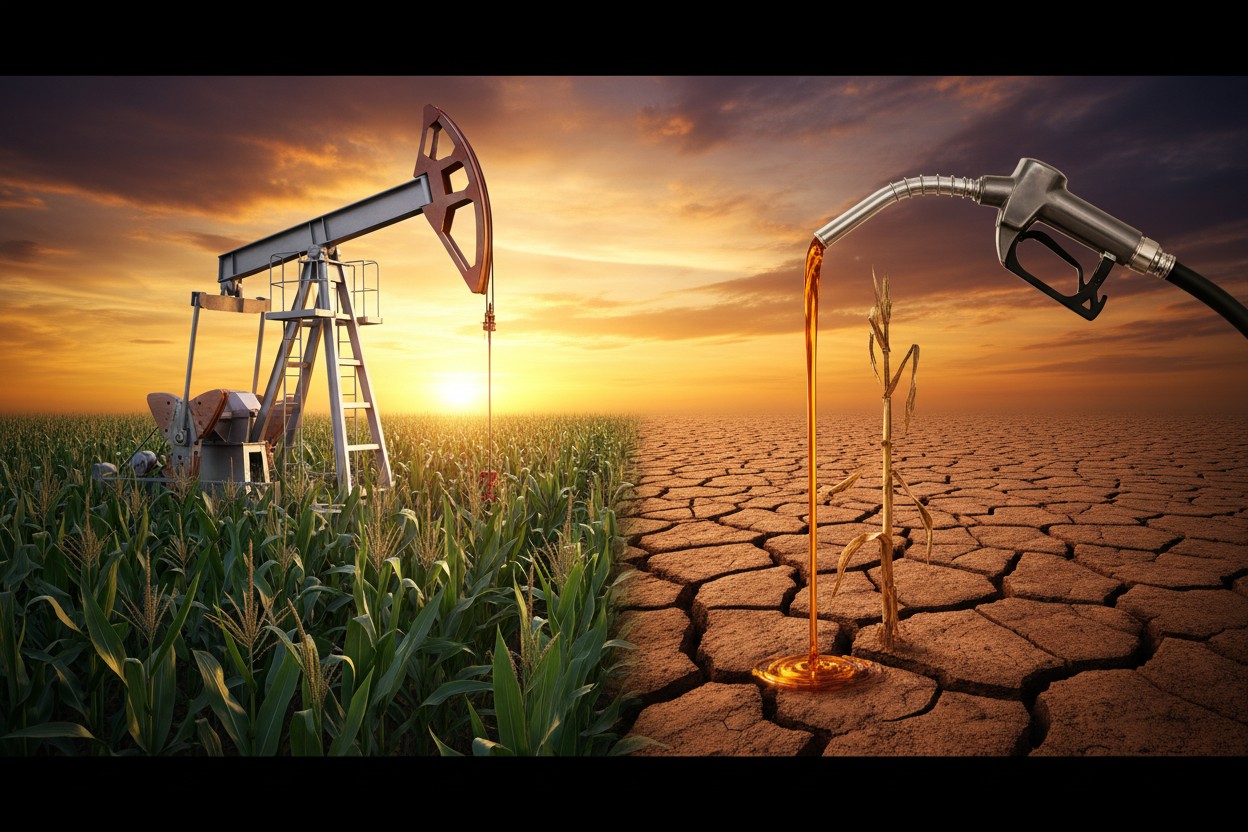
Surge in Biofuel Use Predicted
Demand for biofuels is likely to jump by nearly one-third this year, according to forecasts from the Transport & Environment (T&E) thinktank, as oil prices approach $100 a barrel following the U.S.-Israeli attacks on Iran and the closure of the Strait of Hormuz. The conflict has disrupted global oil supplies, prompting governments to seek alternatives. T&E has estimated that biofuel demand could rise 70 percent by 2030 if oil supplies remain constrained. Several countries have moved to increase the amount of biofuel blended with fossil fuels. The United States, Indonesia, Brazil, and Thailand are among those implementing or expanding blending mandates. A 2022 emergency waiver signed by then-President Joe Biden allowed gasoline with 15 percent ethanol to be sold year-round, a move that analysts said could increase demand for corn. [1] Historically, similar policies have tied food and petroleum markets together, as noted by author Timothy A. Wise in his book "Eating Tomorrow," where he wrote that the biofuel boom put ethanol in direct competition with gasoline. [2]Fertilizer Constraints Compound Food Price Pressures
The war has also constrained fertilizer supplies, as shipments of key inputs pass through the Strait of Hormuz. Prices have soared, raising production costs for staple foods. According to T&E, globally about one in every 20 tonnes of fertilizer is used to produce crops for fuel; in Indonesia the figure is one-fifth. The U.S. Department of Agriculture has forecast that food prices will rise by 2.2 to 4.7 percent this year, largely due to the impact of the war in Iran. The fertilizer shortage is not new. An analysis from 2008 noted that an increasing reliance on industrial fertilizers had led to surging demand, and the global fertilizer shortage placed additional strain on food prices. [3] More recently, Russia halted ammonium nitrate exports in March 2026, worsening supply constraints. [4] Margaret Robertson, in her book "Sustainability Principles and Practice," highlighted that phosphorus, a key fertilizer component, is a nonrenewable resource, and industrial agriculture has dramatically altered its natural cycle. [5]Experts Warn of Competition for Cropland
Kädi Ristkok, energy and climate director at T&E, said governments are "playing a dangerous game by promoting food for fuel." The thinktank's report notes that biofuels currently supply about 4 percent of global transport energy. If countries proceed with current plans, that share could rise to 6 percent. Expanding biofuel production to 20 percent of road fuel would require an area of land the size of South Africa, according to the analysis. A 2008 article on NaturalNews described the conversion of cropland to ethanol production as "one of the dumbest 'green' ideas ever proposed," noting that it consumes more energy than it produces and drives up global food prices. [6] Similarly, Peter Brabeck-Letmathe, chairman of Nestle, stated in 2012 that "the time of cheap foods is over" due to reliance on biofuels from food crops. [7] The competition for land pits fuel against food, a dilemma that Neil Morris, in his book "Biomass Power," identified as the biggest issue for biomass energy. [8]Historical Parallels and Food Price Impact
Simon Suzan, principal energy analyst at T&E, said the impact on food prices from current biofuel expansion could be significant. During the food crises of 2007-08, the UN Food and Agriculture Organization estimated that biofuel use contributed between 40 and 70 percent of the increase in maize and soya bean prices. A 2008 analysis on NaturalNews warned that the Bush administration's "20 in 10" program would cause the greatest sustained rise in grain prices in 30 years. [9] Biofuels also have a carbon footprint. According to T&E, they produce about 16 percent more carbon dioxide than the fossil fuels they replace, once deforestation and land-use changes are factored in. Research cited by M. Wetzstein in the Journal of Agricultural and Applied Economics noted that using U.S. croplands for biofuels can increase greenhouse gases, though cellulosic feedstocks on degraded lands could mitigate emissions. [10] The broader food price trend is upward: the FAO Food Price Index reached a two-year high in July 2025, driven by vegetable oils and meat. [11]Alternative Solutions and Outlook
Encouraging the switch to electric vehicles could reduce demand for biofuels, according to Suzan. Generating renewable energy is far more efficient per unit of land: solar panels covering just 3 percent of the land currently used for biofuel production would generate the same amount of energy, and because of the higher efficiency of electric vehicles, that would be enough to power one-third of the global car fleet. T&E noted that waste-based biofuels offer some carbon savings, but their global use is limited and such residues are often already used in other sectors. Some experts have suggested alternative approaches to food security and energy independence. In a 2008 article, probiotic soil treatments were proposed as a way to increase crop yields without chemical fertilizers. [12] Others have argued for prioritizing domestic oil production over biofuels, noting that the United States remains a leading oil producer. [13] As the conflict in the Middle East continues and oil prices remain elevated, the pressure to expand biofuels is likely to persist, raising the stakes for global food supplies.References
- NaturalNews.com. "Meat producers react as Biden issues emergency waiver that allows selling gasoline with 15 ethanol." April 19, 2022.
- Timothy A Wise. "Eating Tomorrow."
- NaturalNews.com. "As Food Prices Rise Fertilizer Shortage Now." October 13, 2008.
- ZeroHedge. "Russia Halts Ammonium Nitrate Exports As Global Fertilizer Crisis Set To Worsen." March 24, 2026.
- Margaret Robertson. "Sustainability Principles and Practice."
- NaturalNews.com. "The Biofuels Scam Food Shortages and the Com." April 23, 2008.
- NaturalNews.com. "Nestle blames biofuels for skyrocketing food." July 25, 2012.
- Morris Neil 1946. "Biomass power."
- NaturalNews.com. "Understanding the Transition From Seed Corn t." March 21, 2008.
- Wetzstein. "Four myths surrounding U.S. biofuels." Journal of Agricultural and Applied Economics. 2011.
- Willow Tohi. "Global food prices surge to two year high amid supply crunches." NaturalNews.com. August 13, 2025.
- NaturalNews.com. "Solutions to the Global Food Crisis." June 20, 2008.
- Dudley William 1964. "Biofuels."
Explainer Infographic


Trump’s Iran Pact Seen as Strategic Defeat in Washington
By Garrison Vance // Share

Syria Unwilling and Unprepared to Attack Lebanon, Report Says
By Douglas Harrington // Share

Iran Integrates Lebanon Into Its Deterrence Doctrine, Officials and Sources Say
By Garrison Vance // Share

Senator Wicker Criticizes Trump’s Memorandum of Understanding with Iran
By Garrison Vance // Share

Pentagon to Review U.S. Troop Levels in Europe, Reduce Crisis-Response Assets
By Garrison Vance // Share

Dubai property sales drop 19% in May after Middle East war, data shows
By Garrison Vance // Share

JD Vance Says U.S. Has "Decisively Won" Iran War in Some Ways as Midterms Near
By garrisonvance // Share

Trump Approval Rating Falls to Record Low; Republican Candidates Adjust Midterm Campaigns
By douglasharrington // Share

Lawmakers want an AI pause but can’t say what they’d actually pause
By isabelle // Share


The Chilean salmon advantage: A conservative case for nutrition and longevity
By avagrace // Share