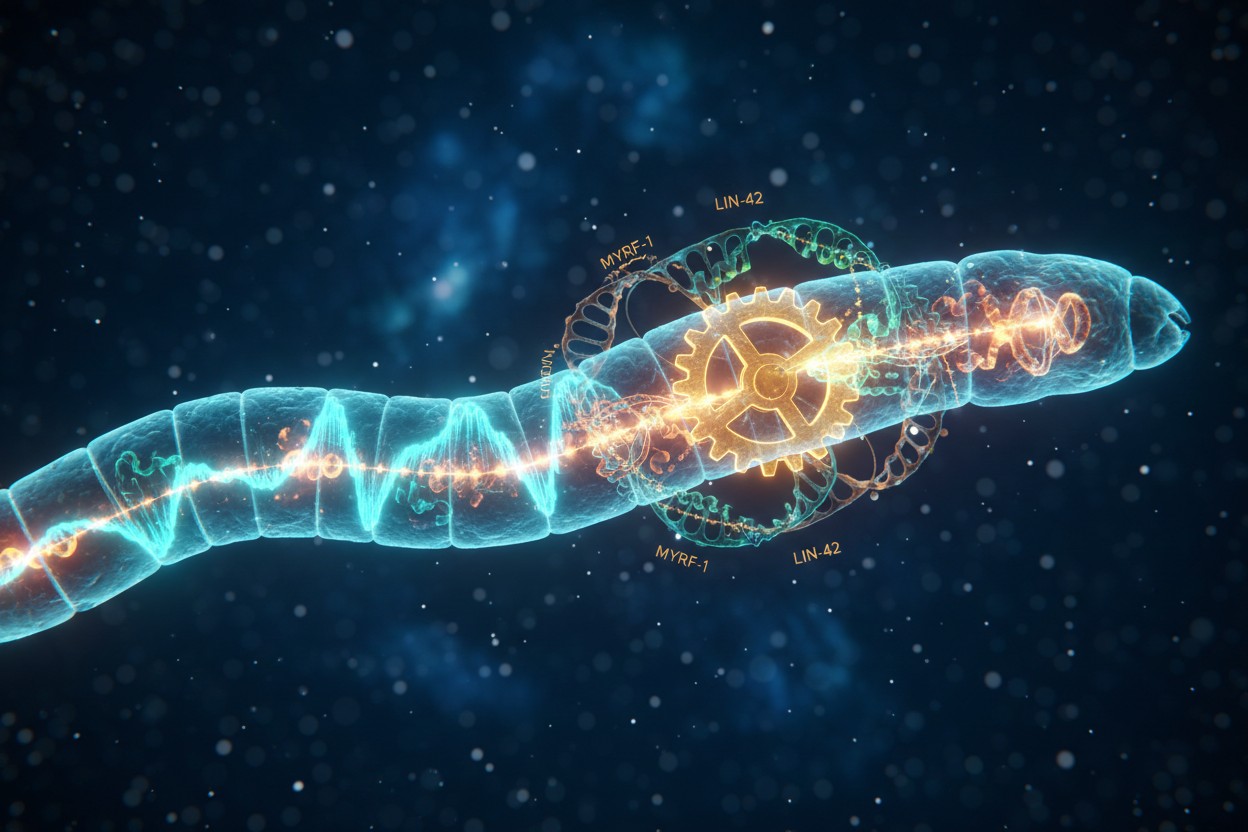
How MYRF-1 and LIN-42 Control Growth
To uncover the clock’s mechanism, the research team combined molecular biology experiments with DNA sequencing, protein sequencing, and the artificial intelligence tool AlphaFold. Their results showed that MYRF-1 acts as a trigger for each developmental stage and is also required for the checkpoint that marks its completion. Once a burst of gene activity begins, MYRF-1 activates LIN-42, which then regulates the intensity and duration of the genetic pulse, according to the study. When researchers blocked MYRF-1, the entire developmental program broke down. “We've never seen anything like this before,” Hammell said. “MYRF-1 is part of this master regulatory clock for all cells, but it's also acting as a key maker and the master key for each stage of growth. Without the right key for each stage, development hits a wall and can't progress.” The clock operates like a ratchet, allowing development to move forward one stage at a time and never repeat.Future Research on Cellular Clock Synchronization
The team, which includes CSHL Director of Research Leemor Joshua-Tor, plans to study how MYRF-1 and LIN-42 physically interact and how these developmental clocks function across different cells. A key question, according to Hammell, is whether individual cellular clocks communicate with one another during development. “The MYRF-1/LIN-42 circuit runs in all cells,” he said. “And every one of these independent cellular clocks appears to be in sync when you watch normal development. But are they communicating with each other? We've never thought deeply about that question before.” The researchers aim to understand how the clock operates across different cell types and whether the mechanism is conserved in other organisms. This research builds on decades of work on biological timing, including the discovery of master genes controlling circadian rhythms that earned Jeffrey Hall, Michael Rosbash, and Michael Young the Nobel Prize in Physiology or Medicine in 2017, as reported by NaturalNews.com [1].Potential Implications for Developmental Disorders
Understanding how the MYRF-1/LIN-42 clock operates could provide important insights into cellular growth, differentiation, and the progression of tissues and organs. According to the researchers, the clock acts like a ratchet, ensuring development moves forward one stage at a time. Disruptions in this timing system may underlie certain developmental disorders and genetic diseases. While the findings come from a worm model, the fundamental principles of developmental timing may extend to humans. Broader research on biological clocks has shown that every organ and cell contains its own timing mechanism, as noted in multiple reports on sleep and circadian health [1]. The CSHL study opens a new avenue for investigating how growth-related disorders arise when cellular clocks fail.Conclusion
The identification of the MYRF-1/LIN-42 master clock represents a significant advance in understanding how organisms coordinate the complex sequence of events required for normal development. By revealing how the body’s internal timing systems keep growth moving forward, the findings could ultimately point toward new approaches for addressing conditions in which normal development is disrupted. As research continues, scientists will explore whether similar clocks exist in other species, potentially shedding light on human growth and development disorders.References
- NaturalNews.com. "Nobel Prize-Winning Science Highlights Importance of Good Sleep for Health." November 02, 2017.
- John Brady. "Biological clocks."
- Samuel D Shillcutt, Venkatramanujan Srinivasan, Gabriella Gobbi, Sibel Suzen. "Melatonin."

Scientists confirm: Sodium-ion batteries could topple Tesla’s lithium empire
By Jacob Thomas // Share

Avocado Consumption Linked to Heart Health Benefits, Research Shows
By Morgan S. Verity // Share
Evening meals and brain health: Why dinner timing matters more than you think
By Evangelyn Rodriguez // Share


Lost chapter of human evolution exposed after 300,000-year-old cave discovery
By Jacob Thomas // Share

Study: Tea Type Determines Kombucha’s Chemical Profile and Antioxidant Activity
By Coco Somers // Share

Study: Late-Night Eating Linked to Higher Risk of Fatty Liver Disease and Cirrhosis
By cocosomers // Share

The sweet scent of health: Exploring the benefits of sweet orange essential oil
By lauraharris // Share
Cholesterol Test May Miss Inflammation-Linked Heart Risks, Study Finds
By chasecodewell // Share

JD Vance Says U.S. Has "Decisively Won" Iran War in Some Ways as Midterms Near
By garrisonvance // Share

Trump Approval Rating Falls to Record Low; Republican Candidates Adjust Midterm Campaigns
By douglasharrington // Share

Lawmakers want an AI pause but can’t say what they’d actually pause
By isabelle // Share