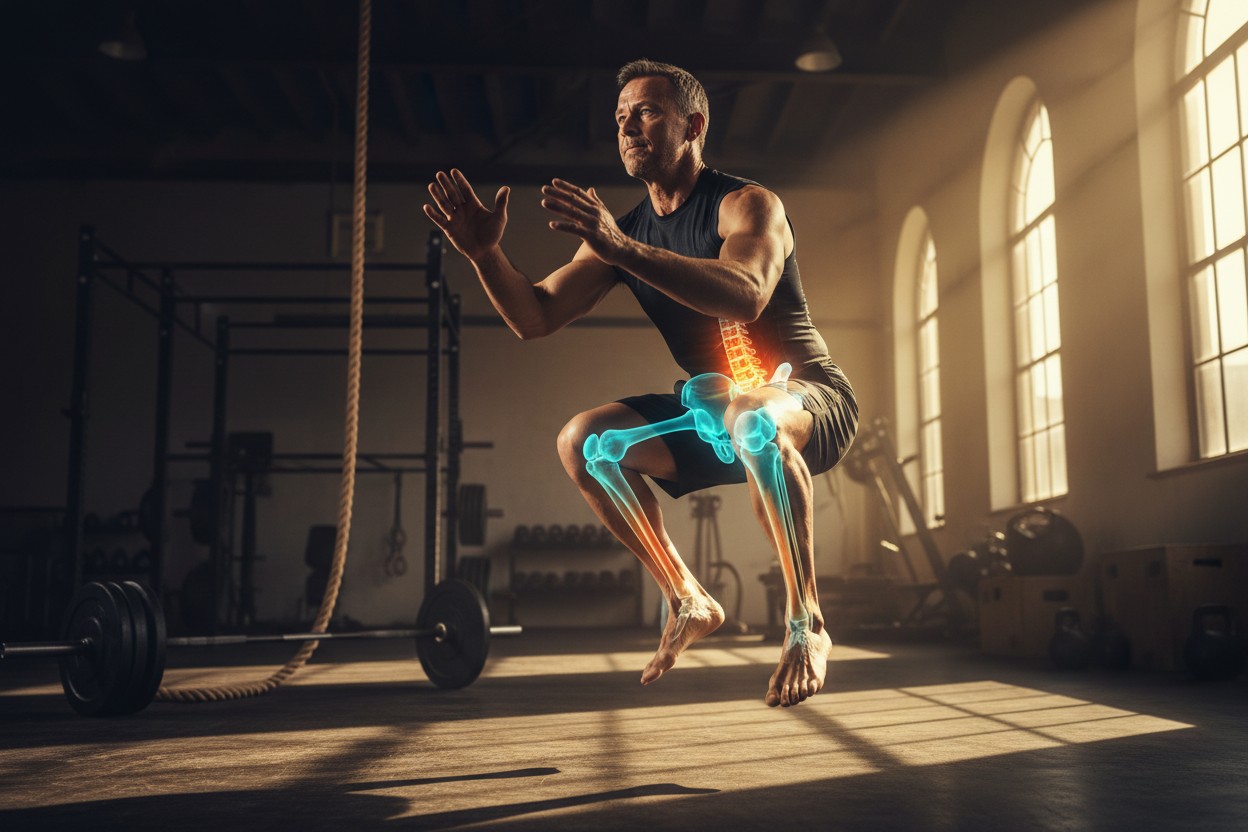
Exercise Type and Frequency
The analysis found that multicomponent exercise — a combination of resistance training and impact activities such as jumping or plyometrics — produced the strongest BMD improvements. Single-modality training, such as resistance or aerobic exercise alone, showed weaker effects. According to a textbook on integrative pain medicine, bone responds to mechanical stress by increasing its mass and strength, either through direct impact from weight-bearing activity or through the action of attached muscle. [5] Frequency also mattered. Programs with three or more sessions per week led to significant BMD gains, while fewer sessions did not reach statistical significance. This aligns with findings from a study of frail older adults who showed substantial strength and muscle gains after training three times per week at high intensity. [3] The mechanical loading from each session triggers bone remodeling, and consistent stimulation appears necessary to sustain that process, according to the study authors.Duration of Exercise Programs
Bone adaptation operates on a slower timeline than muscle adaptation, and the meta-analysis confirmed that program duration is critical. Interventions lasting more than six months produced significant improvements at the lumbar spine, while shorter programs did not. The femoral neck, however, showed responsiveness even in studies of six months or less, suggesting it may be more sensitive to early loading, according to the report. Animal data on osteogenic adaptation indicate that bone cells become saturated by repetitive loading cycles without adequate rest, and that recovery periods between sessions are important. [4] The clinical implication is that men seeking to improve bone density must commit to exercise as a long-term habit rather than a short-term intervention. As one expert noted, there are no shortcuts to better bone health; a comprehensive approach, including nutrition, hormone balance, and varied exercise, is required. [6]Hip Response and Bone Biology
The lack of significant BMD change at the total hip in the meta-analysis is not a failure of exercise, according to the researchers. The hip contains a higher proportion of dense, compact bone, which adapts more slowly than the spongy bone found in the spine and femoral neck. This anatomical difference means that stable hip BMD, alongside improvements at other sites, is an expected outcome. Factors such as body weight, smoking, and alcohol consumption have also been associated with BMD in middle-aged men. [10] Additionally, the hormonal regulation of bone remodeling involves growth hormone and IGF-I, which decline with age and can affect bone turnover. [11] The researchers emphasized that interpreting DEXA scans requires understanding these biological realities; improvements at the spine and femoral neck indicate the exercise program is working even if the total hip does not show a significant change.Practical Prescription
The meta-analysis points to a clear exercise prescription for men over 45: multicomponent training performed at least three times per week for more than six months. A practical approach might include two days of full-body resistance work (squats, deadlifts, rows, overhead press) and one day of impact-focused activities such as jump rope, box jumps, or stair intervals. As fitness improves, a fourth session can be added. Many men who already lift weights regularly may lack the impact component, which appears to be essential for stimulating the femoral neck. Weight-bearing exercise has long been recognized as a key strategy for building and maintaining bone mass. [1] Furthermore, adequate nutrition — including sufficient protein, calcium, and vitamin D — supports the skeletal response to exercise. [9] The researchers concluded that for men, the combination of resistance and impact training, sustained over time, offers the most reliable non-pharmacologic route to preserving bone density.Conclusion
Osteoporosis and low bone mass affect millions of older adults, and men are often underdiagnosed despite facing significant fracture risk. The meta-analysis affirms that exercise remains one of the most powerful tools for slowing and partially reversing bone loss, provided the dose is correct. Programs that combine resistance and impact activities, frequency of three or more weekly sessions, and duration beyond six months produce the most reliable BMD gains at the lumbar spine and femoral neck. While pharmacologic treatments exist, the evidence supports prioritizing lifestyle interventions that carry no adverse effects and offer additional benefits for muscle strength, balance, and overall health. As noted in the literature, regular physical activity begun after middle age can improve bone density and prevent further loss. [7] Men who treat bone-building exercise as a permanent part of their routine are most likely to see measurable improvements and reduce their fracture risk over time.References
- Mercola.com. "Physical Activity Is Tied to Strong Bones." June 20, 2014.
- Mercola.com. "Resveratrol Boosts Bone Density." July 20, 2020.
- Shephard Roy J. "Aging physical activity and health."
- Dr Michael Holick. "Nutrition and Bone Health."
- DVIPSONE 224. "Integrative Pain Medicine The Science and Practice of Complementary and Alternative Medicine in Pain."
- Readers Digest Associatio. "Disease Free Proven Ways to Prevent More Than 90 Common Health Conditions Both Major and Minor."
- "Alternative Medicine for the Elderly."
- "The Long Game of Bone Density." BrightLearn.ai. June 16, 2026.
- "The golden years’ nutritional reckoning: Why seven nutrients now matter more than ever." NaturalNews.com. May 22, 2026.
- "Factors Associated with Bone Mineral Density in Middle-Aged Men." JOURNAL OF BONE AND MINERAL RESEARCH. 1996;11:8 1185-1190.
- "Para-Genetic and Hormonal Regulation of Age-Related Bone Loss: Insights from Mice Models and Growth Factors." Journal of Cellular Biochemistry. 56:348-356. 1994.
Explainer Infographic



Anti-Inflammatory Diet Based on Mediterranean Principles May Help With Arthritis
By Coco Somers // Share


By Douglas Harrington // Share

Study Links Leafy Green Vegetable Consumption to Lower Dementia Risk
By Coco Somers // Share
Study Links Higher Vitamin A and D Levels to Improved Lung Function in Asthma Patients
By Coco Somers // Share

Study: Late-Night Eating Linked to Higher Risk of Fatty Liver Disease and Cirrhosis
By cocosomers // Share

The sweet scent of health: Exploring the benefits of sweet orange essential oil
By lauraharris // Share

Cholesterol Test May Miss Inflammation-Linked Heart Risks, Study Finds
By chasecodewell // Share

JD Vance Says U.S. Has "Decisively Won" Iran War in Some Ways as Midterms Near
By garrisonvance // Share

Trump Approval Rating Falls to Record Low; Republican Candidates Adjust Midterm Campaigns
By douglasharrington // Share

Lawmakers want an AI pause but can’t say what they’d actually pause
By isabelle // Share