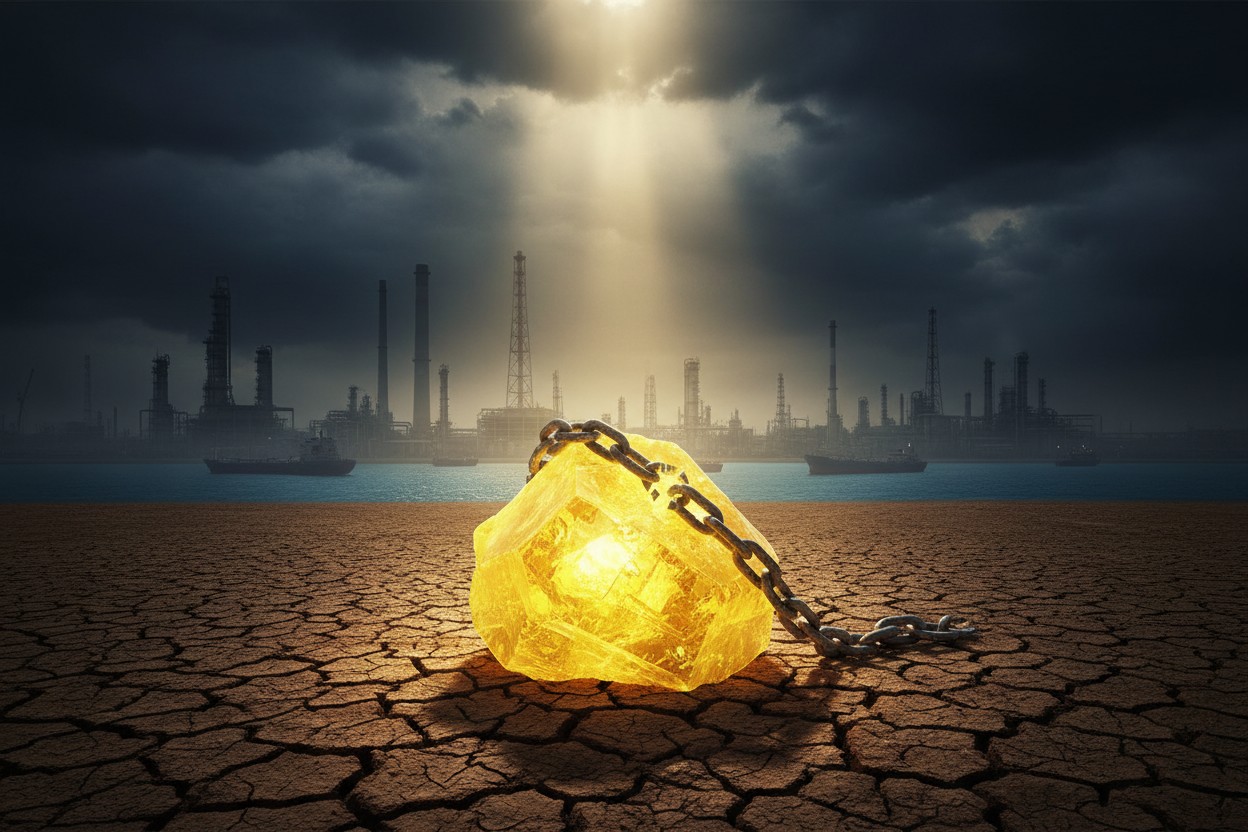
When the Sulfur Runs Out, Famine Isn't Far Behind
Most people think of fertilizer in terms of nitrogen, phosphorus, and potassium -- the familiar N-P-K numbers on a bag. But there is a fourth element that makes modern agriculture possible, and it sits invisibly upstream of the entire system. I am talking about sulfur. Without it, phosphate rock remains locked in the ground, useless for crops. And right now, the global supply chain for sulfur is under direct attack. The closure of the Strait of Hormuz, combined with the destruction of oil and gas refineries in the Middle East, has severed the flow of this critical industrial chemical. As I have warned for years, the vulnerability of the sulfur supply chain is a direct threat to global food production and national self-reliance. This is not an abstract risk. It is a ticking time bomb that could trigger mass starvation on a global scale.The Chemistry: How Sulfur Unlocks Phosphate Rock
To understand why sulfur matters, you have to look at how phosphate fertilizers are made. Phosphate rock, mined from the ground, is insoluble in water. Plants cannot absorb it directly. The only way to make phosphorus bioavailable is to treat the rock with sulfuric acid. This creates phosphoric acid, which is then reacted with ammonia to produce monoammonium phosphate (MAP) or diammonium phosphate (DAP) -- the backbone of modern agriculture. The industry rule of thumb is that roughly half a ton of elemental sulfur is needed to produce one ton of phosphate fertilizer. Without sulfuric acid, the phosphate rock is just inert dust. As I documented in my March 2026 article on the global sulfur crisis, the entire chemical cascade begins with elemental sulfur derived almost entirely from oil refining and natural gas processing. [1] The devastating attacks on Gulf infrastructure have not just disrupted markets; they have severed the global supply of elemental sulfur and its derivative, sulfuric acid. [1] In a recent broadcast I explained that sulfur is also essential for vulcanization of rubber -- without it, even tire production grinds to a halt. [2] The chemical reality is stark: modern civilization runs on sulfuric acid, and the bottleneck is sulfur. As long as the strait remains non-functional, the sulfur supply chain collapse is going to extract an increasingly high cost from the world's industries... including agriculture.The Global Supply Chain Trap
Sulfur is not mined for its own sake -- it is a byproduct of sour oil and gas processing. (The term "sour," in the context of oil, mostly describes its higher sulfur concentration.) The largest reserves and production facilities are concentrated in the Middle East, particularly in Saudi Arabia, Qatar, and Iran. According to a Bank of America analysis from June 2026, roughly half of the world's seaborne sulfur trade is trapped behind the Strait of Hormuz, with another 15% stuck in Kazakhstan due to export-logistics blockades. [3] The same report warns of “runaway price risk” for spot sulfur. Meanwhile, the Iranian blockade has also paralyzed shipments of urea, ammonia, and phosphates. [4] As one analysis from the Ron Paul Institute notes, the blockade threatens large amounts of urea, ammonia, phosphates, and sulfur -- all critical for fertilizer. [4] We already saw a preview of this vulnerability in 2023, when Mosaic, one of the world's largest phosphate producers, idled its plants due to sulfur shortages. That happened even though phosphate rock was plentiful. The lesson is clear: sulfur disruption directly cuts fertilizer output, regardless of rock availability. Now multiply that by a full-scale war in the Persian Gulf. As I wrote in my report on the Strait of Hormuz closure, the disruption has thrown the international fertilizer trade into disarray at the worst possible moment for global food security. The trap is set. And there's no easy way out.Why Government and Market Responses Failed
When the crisis erupted, governments scrambled to issue emergency orders and tariff relief. But none of those measures addressed the raw material bottleneck. They focused on subsidizing fertilizer prices or releasing strategic reserves of nitrogen, while ignoring the fact that the entire system depends on sulfur that cannot be sourced domestically. This is the predictable failure of centralized, globalized supply chains. As I have argued repeatedly, just-in-time logistics prioritize profit over resilience, and when a single chokepoint like Hormuz is closed, the whole edifice collapses. The only real solution is domestic sulfur production and decentralized fertilizer manufacturing. We need to recover sulfur from coal, from metal smelting, and from domestic oil and gas fields -- even if that means building small-scale sulfuric acid plants near local phosphate mines. The globalist model of relying on a handful of Middle Eastern refineries has left us dangerously exposed. But perhaps that's the plan. As I warned in my piece on the great starvation, the deliberate sabotage of refineries and fertilizer plants is not an accident -- it is part of a depopulation agenda. [5] We cannot expect markets or governments to fix a problem that the elites have engineered.Conclusion: The Case for Food Sovereignty
Sulfur is not just a chemical catalyst. It is also a secondary plant nutrient, essential for protein synthesis and chlorophyll formation. (It's also the key element in one of my favorite anti-cancer, anti-inflammatory nutrients called sulforaphane, found in broccoli sprouts and florets.) This only deepens the dependency: without sulfur in the soil, crops cannot thrive even if phosphorus is available. The entire food chain rests on this single, overlooked element. History shows that fertilizer shortages lead directly to food crises. As Lester Brown and Erik Eckholm documented decades ago, serious shortages of nitrogen and phosphates in the early 1970s triggered price spikes and hunger. [6] The same pattern is repeating now, but with sulfur at the center. The threat is real, and the time to act is now -- before the next blockade or crisis. We cannot wait for the Strait of Hormuz to reopen. We must build decentralized, resilient systems that keep food production in our own hands. Our food supply depends on it. Note: My online store, HealthRangerStore.com has stocked up on organic, lab-tested foods for long-term preparedness. We literally bought everything we could find starting in March, knowing this food crisis was coming. As a result, we have a warehouse nearly filled with high nutrient density foods and superfoods, ready to ship today from our warehouse in Central Texas. Freedom begins with food security, and you can boost your own food security right now by stocking up while supplies are still relatively available. Thank you for your support, and Happy Independence Day!References
- Global Sulfur Crisis: The Chemical Achilles Heel of Modern Civilization Has Been Severed - NaturalNews.com. Mike Adams. March 09, 2026.
- Bright Videos News - Interview InfoWars - Mike Adams - BrightVideos.com. March 18, 2026.
- BofA Sees "Runaway Price Risk" In Spot Sulfur As Global Supply Chain Freezes - ZeroHedge. June 12, 2026.
- Iran War: Sleepwalking into Starvation - Ron Paul Institute. April 17, 2026.
- The Great Starvation: Why Global Famine Is Not an Accident - NaturalNews.com. Mike Adams. May 13, 2026.
- By Bread Alone. Brown Lester Russell and Eckholm Erik P.
- Strait of Hormuz closure paralyzes global fertilizer trade, threatening spring planting and food prices - NaturalNews.com. Cassie B. March 12, 2026.
Explainer Infographic



EU Orders Meta to Modify “Addictive” Features on Facebook, Instagram or Face Fines
By Edison Reed // Share

Danish PM Says Greenland “Not for Sale” as Trump Revives Annexation Threat
By Sterling Ashworth // Share

Israel aid revolt erupts in the House as public opinion turns against Netanyahu
By Cassie B. // Share

Businesses Report Blocked Payments From Saudi Arabia to UAE Amid Political Tensions
By Sterling Ashworth // Share

Unchained: The ratchet effect, the Deep State and the battle for Constitutional sanity
By Belle Carter // Share


AI Pioneers Call for International Containment Body and Airgapping of Advanced Models
By chasecodewell // Share

Advanced Nuclear Fuel Strategy Weighed as Customers Seek Cost and Delivery Certainty
By edisonreed // Share
The Board of Peace or the Board of Power? How Israel's Veto Dooms Gaza's "Stabilization"
By garrisonvance // Share
Study: Late-Night Eating Linked to Higher Risk of Fatty Liver Disease and Cirrhosis
By cocosomers // Share