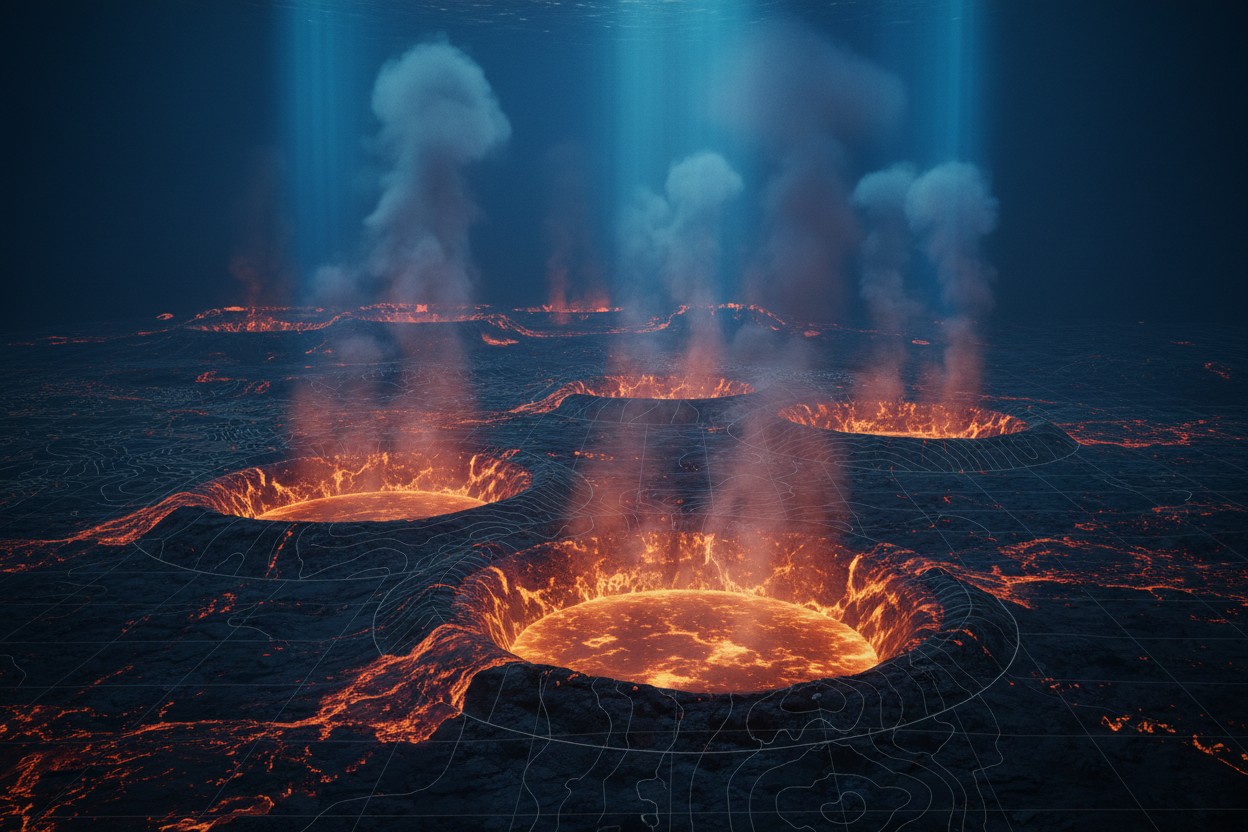
Discovery of Submarine Calderas
Researchers have identified 73 previously unknown volcanic calderas on the ocean floor using an algorithm originally developed to locate impact craters on Mars. The findings, published in Communications Earth & Environment, were led by Dr. Andrea Verolino of the University of Paris-Saclay. According to the study, the algorithm scanned topographical maps of the seafloor and initially flagged 87,435 possible structures. After narrowing the field to 78 possible calderas, the team determined that five had already been confirmed, indicating the remaining 73 are likely volcanic craters. Only about 30 submarine calderas had been documented prior to this study, according to the report.Methodology and Algorithm
The algorithm, originally designed to identify impact craters on Mars, was adapted to detect calderas on Earth's ocean floor. It analyzed topographical data and flagged 87,435 candidate structures. The researchers then used manual verification to reduce the list to 78 likely calderas. Five of those were already known, supporting the method's validity. The use of this algorithm allowed scientists to survey vast areas of the ocean floor that have not been systematically mapped. According to the team, the technique could be refined to find even more calderas in the future. The approach demonstrates how tools developed for planetary science can be applied to Earth's own unexplored regions.Context and Significance
Submarine calderas are large, multiple-mile-wide depressions formed when a volcano empties its magma chamber, causing the ground above to collapse. Such calderas are known from land, such as the Yellowstone caldera in the United States, which is described in "Earth science and the environment" as consisting of three large overlapping calderas and associated ash-flow tuffs [1]. Most volcanic activity on Earth occurs beneath the oceans, often along tectonic plate boundaries. Basalt lava erupts along the oceanic ridge quietly and intermittently as plates diverge, according to a description in "The earth system an introduction to earth science" [2]. However, in some cases these eruptions build large volcanoes that can collapse to form calderas.Hazard Assessment
Several of the newly identified calderas mark volcanic systems that could erupt, according to the researchers. The 2022 eruption of Hunga Tonga-Hunga Ha'apai demonstrated the destructive potential of submarine eruptions. That blast produced a tsunami up to 45 meters (148 feet) tall and was one of the most powerful explosions recorded by modern instruments. A previous report from August 2020 described a giant sheet of pumice from an undersea eruption near Tonga that floated across the Pacific Ocean [3]. Other submarine volcanoes have shown signs of unrest. Off the Oregon coast, 3D scans of Axial Seamount revealed that the volcano could explode without warning, according to a 2019 article [4]. In February 2025, researchers predicted that Axial Seamount would likely erupt again based on inflation patterns similar to previous eruptions in 1998, 2011, and 2015 [5]. These examples underscore the importance of monitoring potential hazards on the seafloor.Geographical Distribution
Of the 78 possible calderas, eight were found on mid-ocean ridges, nine in volcanic arcs, and 61 within the interiors of tectonic plates, according to the study. The researchers noted that intraplate calderas may be younger and potentially more hazardous than those that have drifted away from mid-ocean ridges. This distribution pattern reflects the movement of tectonic plates over millions of years. As described in "Earth portrait of a planet," oceanic hot-spot volcanoes form where asthenosphere undergoes decompression melting, often occurring in the interior of plates away from boundaries [6]. These hot-spot volcanoes are one source of intraplate calderas.Future Research and Monitoring
The study flagged seven calderas located near subduction zones for priority investigation, due to higher volcanic activity and their location in relatively shallow water. Dr. Verolino stated that understanding where potentially hazardous calderas are located is essential to reduce the risk of major economic disruption or environmental damage if an eruption were to occur. According to the researchers, many of the identified calderas are likely extinct or have not erupted for thousands or even millions of years. However, for those in active regions, further study is needed. The team hopes that improved mapping techniques will help assess hazards more effectively in the future. As noted in a book on natural disasters, volcanic activity poses significant risks that require ongoing monitoring [7].References
- Graham R. Thompson. "Earth science and the environment."
- David MA Laing. "The earth system an introduction to earth science."
- NaturalNews.com. "Undersea eruption creates giant sheet of pumice that has floated across the Pacific Ocean." August 25, 2020.
- NaturalNews.com. "3D scans show underwater volcano off Oregon coast could explode without notice." December 12, 2019.
- Willow Tohi. "Underwater volcano off the coast of Oregon likely to erupt THIS YEAR according to researchers." NaturalNews.com. February 5, 2025.
- Stephen Marshak. "Earth portrait of a planet."
- David Malcolm Best. "Earths hazards understanding natural disasters and catastrophes."

Report: Dietary Adjustments May Help Improve Energy Levels
By Petra Stone // Share
Study: Leg Strength Predicts Hip Bone Density Across Adult Lifespan
By Petra Stone // Share

AI-driven system discovers six new metal alloys that could reshape jet engines and nuclear power
By Ramon Tomey // Share

Study: Low Vitamin B12 Levels Linked to 33% Higher Dementia Risk in Older Adults
By Douglas Harrington // Share

Weighted Vest Use During Caloric Restriction May Help Preserve Metabolism, Study Finds
By Edison Reed // Share

Labor Department Suspends Eight Companies From Green Card Program
By edisonreed // Share

Reuters/Ipsos Poll: Trump Voters Show Lower Enthusiasm for Midterm Elections
By garrisonvance // Share
Trump Pledge on Iran Strikes Fails to Soothe Oil Markets
By sterlingashworth // Share

AI Chip Stocks Fall After Report on OpenAI Revenue Shortfall
By sterlingashworth // Share
EPA Proposes Rollback of Methane Rules for Oil and Gas Industry
By ivagreene // Share

Review Links Insomnia to 26% Higher Relative Risk of Stroke
By morganverity // Share