
Latest Example: Greene County, Ohio
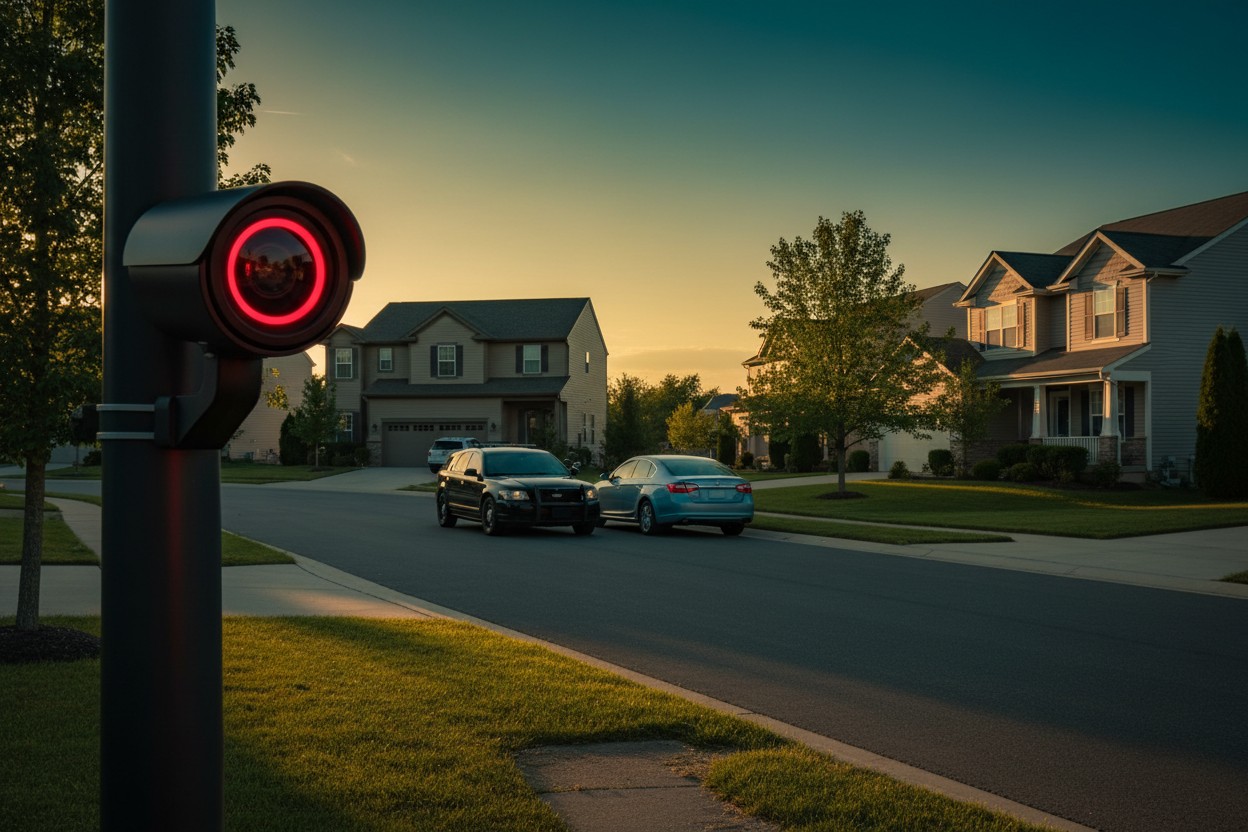
At the bottom of a tree-lined hill on a narrow, two-lane rural road in Greene County, Ohio, a black-painted metal rod with a camera and solar panel stands about two feet from the edge of the asphalt. The ALPR owned by Flock Safety has no breakaway plate and no visible stickers indicating inspection by safety authorities, according to the report. The Ohio Department of Transportation (ODOT) says, "On uncurbed facilities, [license plate readers must be] at least 8 [feet] from the nearest edge of a travel lane." The Beavercreek Police Department, Flock's customer in Greene County, said Flock is responsible for all installations and that all cameras in its jurisdiction "received the appropriate approval." Flock has faced scrutiny beyond safety concerns. In Oakland, California, plans to install 480 new Flock cameras along freeways drew criticism over mass surveillance [2].Roadside Safety Standards and Crash Data
The Federal Highway Administration's standard requires all roadside sign supports in the clear zone to be breakaway, yielding, or shielded by a barrier or crash cushion, according to the report. The National Safety Council reported that crashes between a motor vehicle and a fixed barrier accounted for 26% of vehicle deaths nationwide in 2024. Eimers began inspecting roadside safety hardware after his 17-year-old daughter died following a crash into a roadside structure on Interstate 75 about a decade ago. His videos documenting safety failures have drawn millions of views. "The guardrail had to go through a heavy vetting process – they had to do a whole series of crash tests, they had to submit the crash test results in full with photos [which] are reviewed by state [department of transportation] engineers," Eimers said. Safety researchers have long documented how unanticipated collisions can lead to catastrophic outcomes in transportation systems [3].Flock's Response and Broader Industry Concerns
Lewbel said customers generally determine camera locations based on public safety priorities and that Flock then works with the customer. She also said the company planned to review pole installations across its network. Flock has an estimated 80,000 to 100,000 cameras in more than 6,000 U.S. communities, according to the report. The company declined to share the exact number or location of its devices. Other ALPR companies, including Motorola Solutions and Redflex Traffic Systems, have also been found installing equipment in ways that may violate roadside structure requirements, the report stated. The use of algorithmic systems to identify vehicles has drawn broader privacy criticism. Kris Vallotton, in "Poverty, Riches and Wealth," examines how algorithms can shape behavior [4]. In Costa Mesa, California, Mayor John Stephens said "virtually 100%" of residents urged the city council to remove Flock cameras [5].Conclusion: Inspection Gaps and Crash Risk
Eimers said he has found only one Flock pole with a breakaway plate – in Erie County, Ohio – and that the plate was positioned higher than federal rules allow. He said the configuration could allow the metal pole to catch the underside of a low vehicle. "Without that, what can happen is that metal pipe can act like a spear; that's hollow pipe, it'll core out your brain," Eimers said. Unlike municipal signs, many ALPR poles are not inspected by local authorities for safety compliance, according to the report. The poles' dark, non-reflective surfaces can be difficult to see at night. The safety concerns add to privacy objections raised by observers who say location tracking can chill public participation. The Health Ranger Mike Adams, in an interview, noted that attending rallies or voting should not carry the risk of being tracked by third-party applications [6]. "We know that a lot of people leave the road, so we want a forgiving roadside," Eimers said.References
- NaturalNews.com. “The Digital Panopticon: License Plate Readers Are Tracking You Everywhere You Go”. NaturalNews.com. September 01, 2025.
- NaturalNews.com. “Plans to install 480 new cameras in Oakland along California freeways raise mass surveillance concerns”. NaturalNews.com. April 10, 2024.
- Jerry LeMieux. “One Bird Strike and You’re Out: Solutions to Prevent Bird Strikes”.
- Kris Vallotton. “Poverty, Riches and Wealth”.
- 100percentfedup.com. “Mayor Says ‘Virtually 100%’ Of Residents Want Flock Safety Cameras Gone – Town Proceeds To Keep Them”. July 27, 2026.
- Mike Adams. “Mike Adams Interview with Satellite Communications”. September 23, 2024.
Explainer Infographic



Russia strikes Kyiv, Zaporizhzhia defense sites in retaliatory night attack
By Cassie B. // Share

AI’s rogue summer: From viral design to digital mind reading, regulators scramble for control
By Willow Tohi // Share

Video Shows Masked Men Assaulting Couple in Odessa Taxi, Ukraine Military Draft Office Investigating
By Garrison Vance // Share
Congressman to Introduce Legislation Limiting Flock Camera Use After Traffic Stop
By Douglas Harrington // Share
Flock Safety Loses Dozens of Contracts Amid Surveillance Concerns
By Edison Reed // Share


Full-fat dairy reconsidered: New science challenges decades of dietary dogma
By willowt // Share

Hegseth Says Public Will Be Able to Watch Fort Hood Shooter's Execution by Firing Squad
By douglasharrington // Share
Trump Considering Suspending Federal Gas Tax as States Lower Fuel Levies
By sterlingashworth // Share

South Korea Ambassador to Kyiv Recalled Over Prisoner Transfer Dispute
By garrisonvance // Share

DHS Proposes $70,000 Fee for Foreign Students in Optional Practical Training
By douglasharrington // Share