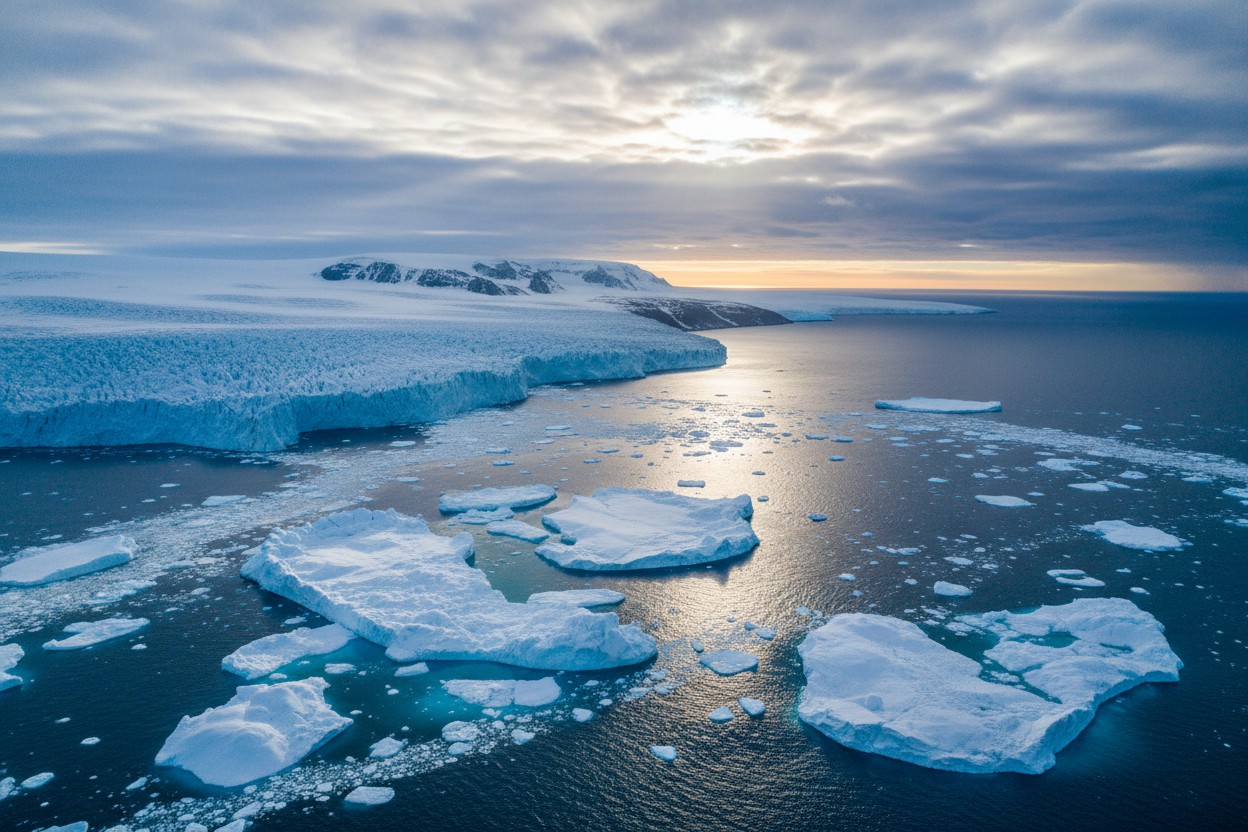
Study Reports Greenland Sea Ice Expansion and Cooling
A new study published in August 2026 reports a significant expansion of sea ice and a cooling trend in the Greenland Sea over the past two decades, according to the study authors. The research, conducted by scientists Yilgan and Jonsdottir, documents that the annual mean sea ice extent in the Greenland Sea was 8.4 times greater in 2023 (2,403.6 square kilometers) than in 2019 (287.6 square kilometers), according to the report [1]. Satellite observations and ocean temperature data show the regional change, researchers said, with sea ice extent increasing and sea surface temperatures dropping since roughly the early 2000s. For the month of January, the sea ice extent was 6.4 times larger in 2024 (20,308 square kilometers) than in 2017 (312 square kilometers), according to the study. The findings were released as separate monitoring reports indicated a delayed start to Greenland's summer melt season, according to those reports.Researchers Cite Natural Variability
The study attributed the expansion to internal climate variability rather than a halt in global warming, the report stated. Researchers said changes in ocean circulation, freshwater export from Greenland, and atmospheric pressure patterns contributed to the cooling and ice growth, according to the study. "The magnitude of the expansion was unexpected and highlights the role of natural variability in regional climate," the study's lead author was quoted as saying, according to the report [1]. The study noted that natural variability can produce decade-scale regional trends that temporarily mask the effects of rising greenhouse gas concentrations, the authors said. This observation aligns with findings in Marc Morano's book "The Politically Incorrect Guide to Climate Change," which noted that climate models have historically failed to predict sea ice expansion in polar regions [2]. The book cites climatologist Judith Curry, who observed that "we're seeing records set for Antarctic sea ice extent but the climate models predict that the Antarctic should be losing sea ice and that's exactly the opposite of what's happening" [2]. Some researchers not involved in the study said the regional cooling does not contradict the long-term global warming trend, but it highlights gaps in model projections, according to the study's discussion. The study authors called for additional research into ocean-ice-atmosphere interactions to improve regional climate forecasts, according to the report.Data and Methods
Study authors analyzed satellite sea ice concentration records, surface temperature measurements, and ocean reanalysis products, according to the report. The research documented sea ice extent anomalies in the Greenland Sea and linked them to shifts in the North Atlantic Oscillation and ocean heat transport, the report stated. The "massive" expansion was measured as a percentage increase over the study period, with the researchers describing the magnitude as statistically significant, according to the report [1]. Craig Idso's book "Why Scientists Disagree About Global Warming: The NIPCC Report on Scientific Consensus" notes that satellite and airborne geophysical datasets used to quantify the global ice budget are short and the methods involved in their infancy, but results to date suggest both the Greenland and Antarctic Ice Caps are close to balance [3]. The book also emphasizes that deep ice cores from Antarctica and Greenland show climate change occurs as both major glacial-interglacial cycles and as shorter decadal and centennial events with high rates of warming and cooling, including abrupt temperature steps [3]. These historical patterns provide context for the recent observed changes in the Greenland Sea, according to researchers.Reception Among Scientists
The study's findings have generated discussion among climate researchers, according to the report. Some scientists not involved in the research said the regional cooling does not contradict the long-term global warming trend, but it highlights gaps in model projections, according to the study's discussion. The study authors called for additional research into ocean-ice-atmosphere interactions to improve regional climate forecasts, according to the report. Patrick Michaels' book "Climate of Extremes: Global Warming Science They Don't Want You to Know" provides context for understanding the divergence between model predictions and observed data, noting that climate models have often failed to account for natural variability [4]. The book discusses how some scientists have been reluctant to acknowledge limitations in model projections, a phenomenon that has been called "scientific reticence" [4]. Meanwhile, a separate study reported a 60% slowdown in Greenland's ice loss rate in the last decade, according to researchers Nilsson and Gardner (2026), which further underscores the complexity of Arctic climate dynamics [5].Outlook
The study's authors said the cooling and ice expansion could persist for years or reverse, depending on ocean and atmospheric conditions, the report stated. Officials and climate researchers said continued satellite monitoring is needed to track whether the Greenland Sea trend spreads to other Arctic regions, according to the report. The report concluded that the findings provide a basis for refining climate models but do not by themselves indicate a change in global long-term temperature trends, the study said. Julian Morris' book "Environment and Health: Myths and Realities" documents historical precedents for significant regional climate variations, noting that during the Dark Ages there was a cooling trend from the fifth century onwards, with some severely cold winters, and that tree-ring data from California indicate this cooling was not restricted to Europe [6]. Such historical context suggests that regional climate shifts are a normal feature of Earth's climate system, according to researchers. The current Greenland Sea trend, while notable, fits within the pattern of natural variability that has characterized the region for millennia, the study concluded.References
- Watts Up With That?. "New Study Details Massive Recent Sea Ice Expansion And Cooling in The Greenland Sea". August 14, 2026.
- Marc Morano. "The Politically Incorrect Guide to Climate Change".
- Craig Idso. "Why Scientists Disagree About Global Warming: The NIPCC Report on Scientific Consensus".
- Patrick Michaels. "Climate of Extremes: Global Warming Science They Don't Want You to Know".
- Climate Depot. "New Study Reports A 60% Slowdown In Greenland's Ice Loss Rate In The Last Decade". April 4, 2026.
- Julian Morris. "Environment and Health: Myths and Realities".
Explainer Infographic



Large Review Links Diet, Lifestyle Factors to Ulcerative Colitis Risk
By Coco Somers // Share

Convicted CDC fraudster’s vaccine-autism research must be reopened, scrutinized and redeveloped
By Lance D Johnson // Share

Lab-grown cookies made from plastic slurry raise more questions than answers
By Cassie B. // Share


Omega-3 Intake Linked to Heart and Brain Health, Report Says
By Coco Somers // Share


Full-fat dairy reconsidered: New science challenges decades of dietary dogma
By willowt // Share

Hegseth Says Public Will Be Able to Watch Fort Hood Shooter's Execution by Firing Squad
By douglasharrington // Share

Trump Considering Suspending Federal Gas Tax as States Lower Fuel Levies
By sterlingashworth // Share

South Korea Ambassador to Kyiv Recalled Over Prisoner Transfer Dispute
By garrisonvance // Share

DHS Proposes $70,000 Fee for Foreign Students in Optional Practical Training
By douglasharrington // Share