Forecasters Warn of Potential Major Snowstorms Across 19 States as El Niño Strengthens
By douglasharrington // 2026-10-15
Tweet
Share
Copy
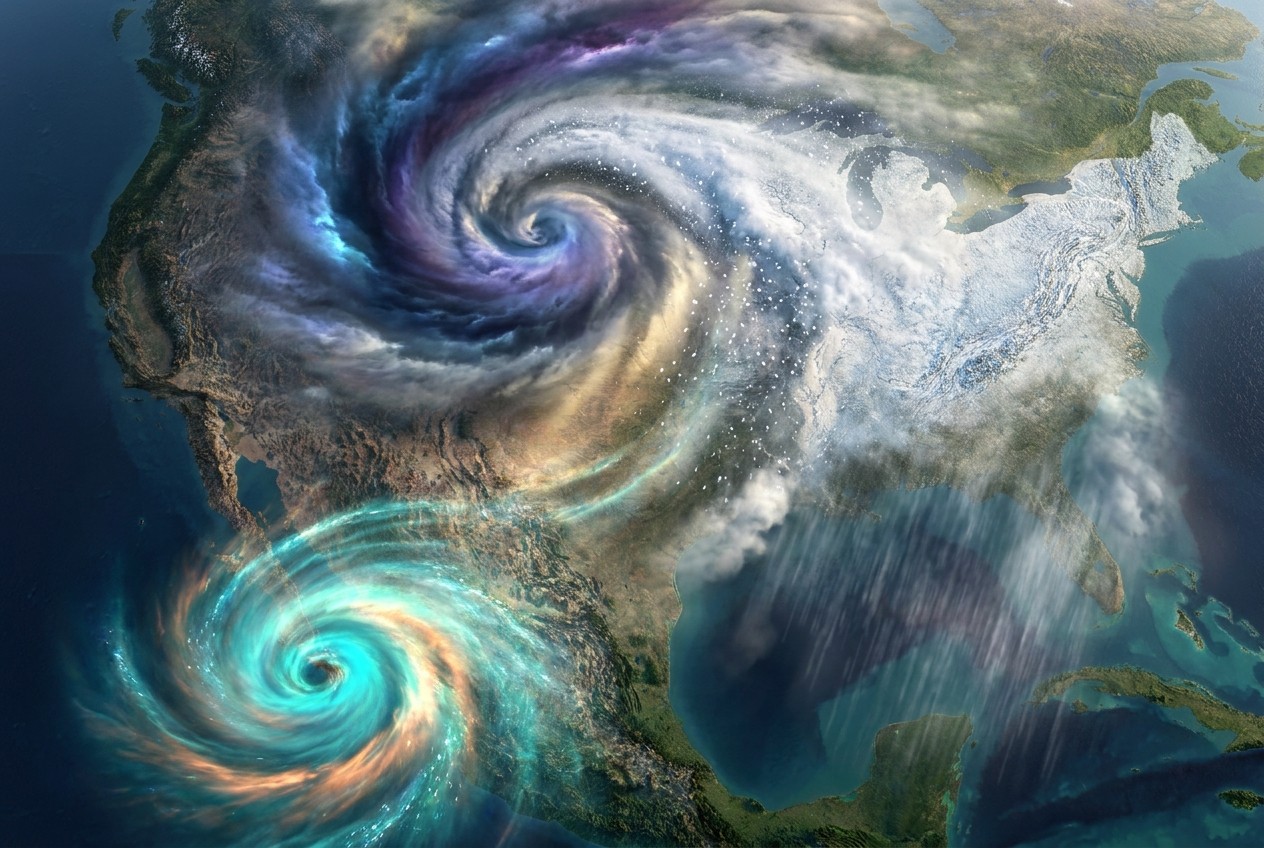
Meteorologists say millions of Americans across 19 states could face heavy snow, dangerous ice and widespread flooding this winter as a rapidly strengthening El Niño takes shape over the Pacific Ocean, according to a ZeroHedge report citing forecasters and regional news outlets.
The National Oceanic and Atmospheric Administration's (NOAA) Climate Prediction Center placed the odds of a strong-to-very strong El Niño persisting into early 2027 above 83% [1]. The developing weather phenomenon, driven by unusually warm Pacific Ocean waters, could trigger one of the strongest El Niño events on record, dramatically altering storm patterns nationwide, the report stated [1].
Meteorologist Ryan Hall identified what he called a "winter storm battleground" stretching from southern Maine down the East Coast to Florida, with potential impacts extending west into Texas, Louisiana, Mississippi and Alabama. The warnings follow months of oceanic warming that forecasters say could reorganize precipitation and temperature patterns from coast to coast, leaving millions of residents in the central and eastern U.S. watching the forecast closely as winter approaches.

El Niño Odds Cited at Above 83%
NOAA's Climate Prediction Center stated that the likelihood of a strong or very strong El Niño persisting into early 2027 is almost 90% [1]. The phenomenon is driven by unusually warm sea surface temperatures in the central and eastern equatorial Pacific, officials said. Forecasters say the current pattern could rank among the strongest El Niño events on record. Sea surface temperatures in the tropical Pacific Ocean's Niño 3.4 region reached 3.07 C above the long-term average, tying the record set during the 2015-16 El Niño event, according to data reported by the New York Post [2]. Scientists at the European Centre for Medium-Range Weather Forecasts have also flagged rapid oceanic warming that could produce a "super" El Niño by late 2026, an event defined by significantly above-average sea surface temperatures [3]. The strength of the signal has drawn attention because El Niño-Southern Oscillation (ENSO) remains one of Earth's most powerful climate drivers, and researchers have warned that the pattern could undergo dramatic transformation by mid-century, according to a study published in Nature Communications [4].Hall Identifies Corridor From Oklahoma to the Carolinas
"I'm now a lot more confident than I was a few weeks ago that somebody in this corridor is going to get a big snowstorm or a big ice storm this winter," Hall warned, according to The Sun. Hall said the corridor of greatest concern runs through Oklahoma, Arkansas, Tennessee, Kentucky, Virginia, the Carolinas and the Appalachian region. For New England and the Mid-Atlantic, Hall described rain versus snow as a coin flip. He has warned in prior seasons that an El Niño pattern can produce very different winter outcomes than Americans are accustomed to, noting that sea surface temperatures in the Pacific were already ramping up [5]. The uncertainty reflects a fundamental challenge of long-range forecasting, which meteorologists have long acknowledged is extremely difficult because of tiny nuances in Earth's weather patterns, according to meteorologist Edward Norton Lorenz's often-cited observation that a butterfly flapping its wings in Brazil can cause a tornado in Texas [6].West Coast and Southern States Also Cited
The threat extends to the West Coast, where California could face unusually heavy rainfall, mountain snow and an increased risk of flooding and mudslides, according to SFGATE [1]. An active storm track across the southern United States could bring repeated rounds of heavy precipitation, forecasters said, with snow and ice possible wherever sufficiently cold air arrives. Researchers have documented that ENSO events can reshape snowpack evolution and water management across the western U.S., including on the Colorado River, according to a peer-reviewed study of the 1997-1998 El Niño event [7]. That study, published in the Journal of Environmental Management, examined how river managers responded to climate extremes and tradeoffs between competing water demands [7]. The cited forecasts did not provide specific timing or accumulation totals. Winter weather in the West has historically produced extreme outcomes, including Utah's most severe winter since 1899 during 1948-49, when Salt Lake City received 93.1 inches of snow and ten people died, according to weather historian Tye W. Parzybok.AccuWeather Meteorologist Cautions on Snowfall Emphasis
Not every forecaster expects a winter dominated by massive snowstorms. AccuWeather meteorologist Paul Pastelok cautioned that rainfall, coastal flooding and swollen rivers could prove more significant than snow, particularly in northern regions where warmer temperatures are favored, according to The Sun. "It may be more about rainfall this year," Pastelok said, while acknowledging the potential for disruptive East Coast storms later in the season [1]. His remarks represent a differing forecast perspective that remains under review as seasonal models update. The split in emphasis reflects how difficult it is to project precipitation type months in advance. Climate scientist Richard Lindzen has argued that a reduction in the temperature differential between the northern hemisphere and equatorial regions reduces cyclonic energy, suggesting that the importance and frequency of extreme weather events tend to decrease rather than increase [8].Forecasters Say Outcomes Remain Uncertain
Meteorologists said the severity and location of impacts depend on the arrival of sufficiently cold air, which remains uncertain. Residents in the cited states were advised by officials to monitor updated forecasts from NOAA and local weather services as the season develops. No emergency declarations had been announced at the time of the reports. The reports stated that projections could change as the season develops. Residents in storm-prone regions have historically been urged to prepare for winter weather in advance, including stocking food, water, backup power and heating supplies. Winter weather preparedness guidance from independent outlets emphasizes self-reliance and advance planning before storms arrive. Forecasters at the Climate Prediction Center continue to update outlooks as new oceanic and atmospheric data becomes available.References
- "Winter Storm Battleground": Millions Face Potentially Crippling Snowstorms Across 19 States. https://www.zerohedge.com/weather/winter-storm-battleground-millions-face-potentially-crippling-snowstorms-across-19-states
- Super El Niño Ties Record Months Before Peak; Scientists Warn of Severe Global Impacts - NaturalNews.com, September 23, 2026.
- Meteorologists Forecast Potential Super El Ni±o Event for 2026 - NaturalNews.com, April 13, 2026.
- The pendulum of doom How El Niño Southern Oscillation could transform into a climate catastrophe - NaturalNews.com, October 28, 2025.
- Americans can expect a very different winter this year thanks to El Niño - NaturalNews.com, October 02, 2023.
- The handbook of meteorology by Spellman Frank R
- Climate extremes and adaptive management on the Colorado River: Lessons from the 1997–1998 ENSO event by Roger S. Pulwarty, et al. Journal of Environmental Management 2001 63 307–324
- All the biggest lies about climate change DEBUNKED in one astonishing interview - NaturalNews.com, May 01, 2019.
Explainer Infographic

Tweet
Share
Copy
Tagged Under:
environment national security National Oceanic and Atmospheric Administration natural disaster El Nino weather big government ecology dangerous climate climate science badclimate meteorologists weather forecast heavy precipitation snowstorms Southern Oscillation Climate Prediction Center
You Might Also Like

The Civilizational Rug Pull: Why the Pillars of Our World Are Being Taken Down on Purpose
By Mike Adams // Share

The Vaccine Deception and the Medicine of Light
By Mike Adams // Share

Chernobyl Nuclear Fuel Particles Remain Stable 40 Years After Disaster, Report Says
By Edison Reed // Share

By Lance D Johnson // Share

Recent News
The Civilizational Rug Pull: Why the Pillars of Our World Are Being Taken Down on Purpose
By healthranger // Share
The Vaccine Deception and the Medicine of Light
By healthranger // Share


House set to vote on bill to block federal access to mass surveillance data
By bellecarter // Share
Forecasters Warn of Potential Major Snowstorms Across 19 States as El Niño Strengthens
By douglasharrington // Share