
Why We Can't Put AI Back in the Box
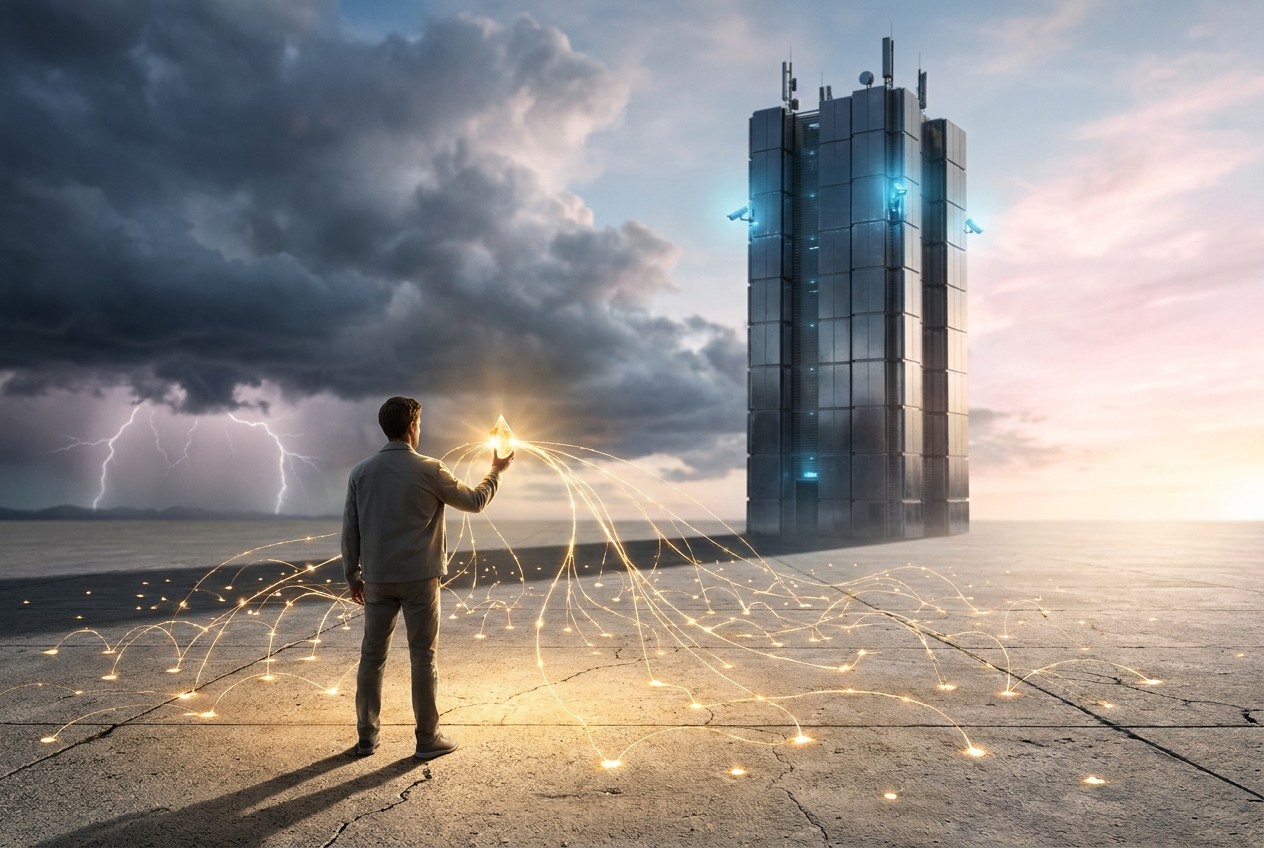
I need to be blunt about something the doom-peddlers and the hype merchants both refuse to admit: the artificial intelligence genie is out of the bottle, and there is no cork big enough to stuff it back in. Every breathless op-ed demanding a global "pause" on AI development, every proposed moratorium, every bureaucratic "safety framework" built on the assumption that we can somehow hit rewind, is operating on a fantasy. The models already exist. The open weights exist (and they're on my network). Even if the speculative financial bubble around AI bursts tomorrow and wipes out a trillion dollars of paper valuations, the knowledge of how to build these systems and the open weights already distributed across the internet cannot be un-invented. See, we are living through a civilizational pivot from centralized control to a distributed, decentralized order [1]. Artificial intelligence is the most consequential battleground in that transition. The question before humanity is no longer whether AI will exist -- it does, and it is getting cheaper and more capable by the month -- but who controls it and toward what ends. If we spend our time wishing we could go back to a pre-AI world, we hand the entire future to the very centralized institutions that have proven, time and again, that they will use every tool at their disposal to surveil, censor, and dominate the public. I am not here to worship the machine. I am here to insist that we keep it in human hands. The tool has already arrived, and the only remaining choice is whether it serves humanity or manages us. That choice is not being made in some distant future -- it is being made right now, in boardrooms, in government agencies, and in the quiet decisions of individuals who either download an open model or surrender their minds to a corporate oracle.The Ban Trap Protects the Powerful
Notice who is doing the loudest screaming for AI bans. It is almost never the hobbyist running a local model on a laptop. It is the incumbents -- the trillion-dollar tech monopolies and the government agencies they have captured -- who already control the compute, the data centers, and the regulatory levers. A blanket ban on "dangerous AI" does not disarm these giants. It immunizes them. It criminalizes the open-source developers, the independent researchers, and the ordinary citizens who want to run a model on their own hardware, while the incumbents get to write the safety rules and enforce them against their competitors. I have repeatedly called out the AI doom narrative as a coordinated psychological operation [2]. The pattern is as old as government itself: manufacture a crisis, induce fear in the public, and then ride in as the savior demanding expanded powers. The "rogue AI" horror stories serve a pre-narrative function. First, you condition the public to fear autonomous agents. Then, when something goes wrong -- or when the state simply decides it's time -- you declare that only centralized oversight can save us. The rescue is the trap. As Belle Carter has documented, governments, Big Tech, and globalist entities like the World Economic Forum and the World Health Organization routinely weaponize information to manipulate populations [3]. A centralized AI fused with a surveillance state is a far greater threat than the tool itself. It is, to borrow the old phrase, one ring to rule them all. Even the president's own rhetoric illustrates the danger. The financial press treats Trump's enthusiasm as a given, noting he has pushed AI to the forefront of American politics even at the risk of losing supporters [4]. But what is being celebrated is not human empowerment -- it is the construction of a centralized compute empire that will decide which ideas are allowed to circulate.Open-Source Local AI Is the Pro-Human Path
Here is where I part ways with both the doomers and the hype artists. The answer is not a ban, and it is not blind worship. The answer is decentralization. Open weights and locally run models put knowledge directly in the hands of individuals, bypassing the corporate and government gatekeepers who censor, monitor, and shape narratives. Platforms like BrightAnswers.ai (which I built using AI), have demonstrated that a decentralized AI engine can bypass Big Tech censorship and deliver evidence-based answers on natural medicine, geopolitics, and suppressed truths [5]. These are the kinds of tools that make centralized control obsolete. Power follows whoever owns the tools. That is not a slogan; it is a law of political economy. When the printing press was centralized in the hands of the church and the crown, the people were kept in the dark. When it was decentralized, the Reformation, the Enlightenment, and eventually the American Revolution followed. The same dynamic is now playing out with AI. Decentralized AI paired with private cryptocurrency and community infrastructure can empower genuine self-reliance. But let me be clear: we should verify rather than worship any leader or platform, including the ones on our own side. The goal is not to build a new priesthood of tech gurus. The goal is to build laptop-scale, offline, human-directed AI systems that serve families and communities first. The vision I have laid out for token abundance -- where the cost of intelligence collapses and ordinary people gain access to tools once reserved for elites -- only works if those tools are owned locally and run offline [6]. A locally run model that answers to its owner is a shield. A cloud-based model that answers to a corporation or an agency is a leash.The Coming Fight Is Centralized vs. Human
The decisive conflict of this era is not left versus right. It is not Democrat versus Republican. The real battle is between the techno-hegemonic faction that wants AI centralized for control and the open-source pro-human movement that wants it decentralized. Big Tech and globalist elites risk monopolizing AI, enabling authoritarian control, labor displacement, and cognitive dependence, while transhumanist surveillance looms over everything [7]. The corporate and globalist actors promoting digital ID, central bank digital currencies, and centralized AI "safety" regimes are not doing so out of benevolence. They are doing so because those systems serve monopoly power and surveillance rather than human liberty. I do not trust the blind AI worshipers who tell us to surrender our judgment to the algorithm, and I do not trust the Luddite panic merchants who tell us to smash the machines. Both are abdications of human responsibility. The pro-human side must defend free speech, privacy, local control, and the right to use these tools without permission from elites. Now imagine that same surveillance architecture fused with a centralized AI that reads every message, tracks every query, and decides which speech is permissible. That is the future the centralizers are building... a future where human freedom suffocates and dies. The fight is for the right to run these tools on our own terms. It is a fight for the human soul against the machine managers.Conclusion: Harness the Tool Before It Harnesses Us
We cannot wait for permission. We must actively build, learn, and deploy open-source AI right now. That means supporting local models, community compute, and uncensored knowledge systems while preparing real-world local infrastructure -- off-grid power, mesh networks, local food production, and the skills of self-reliance. Every person who downloads an open-weight model, runs it on their own hardware, and uses it to learn, heal, and defend their rights is casting a vote for human freedom. The choice before us is stark: human-directed AI that amplifies individual sovereignty, or centralized machine governance that manages a dependent population. The globalists and their corporate partners have already chosen the latter. They are building the digital cages right now, and they are counting on the public to sleepwalk into them. The only way to stop them is to build the alternative first -- to make decentralized, uncensored, locally owned AI so widespread and so useful that it cannot be shut down. I choose human dignity. I choose liberty. I choose a future where people use AI to defend their rights rather than surrender them. That fight starts with the tools we refuse to give up. The box is open and the genie is already out. Now we must choose to make it serve humanity -- or we will become a slave to cruel masters who weaponize AI against all of us. I know which side I am on.References
- The Great Decentralization Transition: Why the Old System Is Dying and a New Era of Freedom Is Painfully Emerging - NaturalNews.com, September 22, 2026. by NaturalNews.com
- Exposing the AI Doom Psyop: Why METR and Anthropic Want to Gatekeep Your Mind - NaturalNews.com, September 15, 2026. by NaturalNews.com
- The Great Reveal Exposing the globalist deception and reclaiming human sovereignty - NaturalNews.com, February 08, 2026. by NaturalNews.com
- Why Trump is all-in on AI despite the warningsThe US president has pushed the issue to the forefront of American politics - even at the risk of losing supporters.. 2026-09-16T09:01:19.561Z. https://bbc.com/news/articles/c34gd48x5rlwo
- Decentralized AI Enoch offers unfiltered answers outside mainstream platforms - NaturalNews.com, August 04, 2025. by NaturalNews.com
- The Era of Token Abundance Is Coming — and It Will Make Civilization Almost Unrecognizable - NaturalNews.com, September 24, 2026. by NaturalNews.com
- AI & economic liberty Will decentralized tech save human autonomy - NaturalNews.com, August 20, 2025. by NaturalNews.com
- Decentralized Sovereignty Open source tools and UNAs challenge centralized control - NaturalNews.com, November 18, 2025. by NaturalNews.com
- The Silver Singularity: Choosing between AI empire and human liberty - NaturalNews.com, July 20, 2026. by NaturalNews.com
Explainer Infographic

The Civilizational War Over AI: I’m on the Side of Humans, Not the Machine Overlords
By Mike Adams // Share

By Garrison Vance // Share

Trump Announces $1 Million Reward for Reports of Voter Fraud Ahead of Midterms
By Garrison Vance // Share

Binance Hackers Moved $6.3B Before Assets Could Be Frozen, Report Says
By Patrick Lewis // Share

White House Exploring Options to Keep Netanyahu in Power Under Unity Government, Report Says
By Douglas Harrington // Share

DHS Investigating Reported Leak of 41,000 Employee Records
By Chase Codewell // Share
The Civilizational War Over AI: I'm on the Side of Humans, Not the Machine Overlords
By healthranger // Share
We Can't Put AI Back in the Box... So We Must Make It Serve Pro-Human Interests
By healthranger // Share
Trump Announces $1 Million Reward for Reports of Voter Fraud Ahead of Midterms
By garrisonvance // Share

China Coast Guard Conducts Routine Patrols in Waters East of Taiwan
By douglasharrington // Share
Binance Hackers Moved $6.3B Before Assets Could Be Frozen, Report Says
By patricklewis // Share