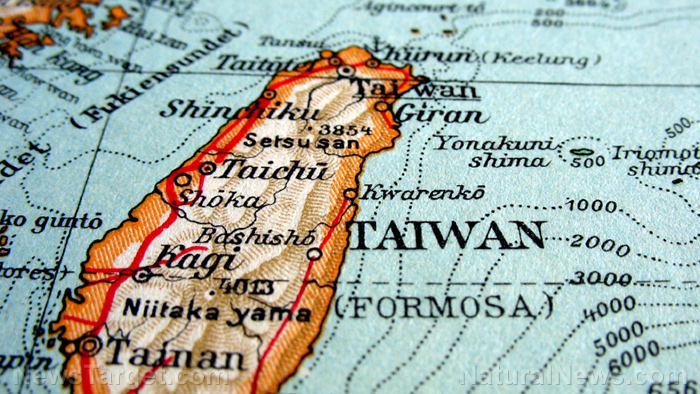
- Pentagon war games consistently show the United States losing to China in any military conflict over Taiwan.
- China's ability to mass-produce cheaper weapons would overwhelm America's reliance on sophisticated but expensive military systems.
- The $13 billion USS Gerald R. Ford carrier is routinely destroyed in simulations by China's arsenal of 600 hypersonic missiles.
- War game simulations reveal staggering U.S. losses, including more than 100 aircraft, multiple destroyers, submarines, and aircraft carriers.
- China operates on a wartime footing with shipbuilding capacity 230 times larger than the United States.
America's costliest warships become targets
The scenarios paint a devastating picture. The USS Gerald R. Ford, America's most advanced aircraft carrier with a price tag of $13 billion, is routinely destroyed in simulations. China's arsenal of approximately 600 hypersonic missiles, capable of traveling at five times the speed of sound, can reach these floating cities before they get close to Taiwan. Beijing even paraded its YJ-17 missiles at a military display in September, weapons estimated to travel at eight times the speed of sound. Yet the Pentagon plans to build nine more Ford-class carriers while it has yet to deploy a single hypersonic missile of its own. Defense Secretary Pete Hegseth stated last year that "we lose every time" in Pentagon war games against China, predicting that Chinese hypersonic missiles could destroy aircraft carriers within minutes. The simulations reveal staggering losses: more than 100 fifth-generation aircraft, multiple destroyers, submarines, and carriers all eliminated in theoretical conflicts over the island nation. Eric Gomez, a research fellow at the Taiwan Security Monitor who participated in one such war game, described the aftermath as sobering. "The U.S. loses a lot of ships in the process. A lot of F-35s and other tactical aircraft in the theatre are degraded pretty rapidly too," he told The Telegraph. "I think the high cost of it was really sobering when we did the after-action summaries, and we're like, 'Okay, like, you guys lost 100-plus fifth-generation aircraft, multiple destroyers, a couple of submarines, a couple of carriers'. It's like, 'oh gosh, man, that was a heavy toll'."The industrial base problem
The challenge extends beyond individual weapons systems to America's entire defense industrial base. The "big five" defense contractors have consolidated from 50 companies in the 1990s, continuing to sell increasingly expensive versions of the same platforms. China, meanwhile, operates what defense analyst Seth Jones calls a wartime footing, with shipbuilding capacity "upwards of 230 times the size of the United States." Jones, president of the Defense and Security Department at the Center for Strategic and International Studies and author of "The American Edge," warns that "the U.S. struggle with China is the single greatest competition the United States has ever faced." Unlike the Soviet Union's brittle economy, China's economic weight rivals America's and fuels military expansion across every domain. "The gap is shrinking," Jones said. Meanwhile, former national security adviser Jake Sullivan has similarly warned that America would quickly exhaust essential artillery shells in a war with China. China's advantages extend beyond missiles and ships. Beijing's state-sponsored hacking group Volt Typhoon has embedded malware in critical infrastructure networks controlling power grids, communications systems, and water supplies at American military bases. This cyber threat could cripple the military's ability to mobilize if conflict erupts in the Pacific. Meanwhile, Chinese leader Xi Jinping claims seizing Taiwan is an "historical inevitability" and has ordered his military ready to take the island by 2027.Will the U.S. wake up?
Jones argues the Pentagon remains "a massive bureaucracy" where reform efforts face resistance. "It's going to take a lot to break that bureaucracy. There's been some progress, but it's trench warfare right now," he said. Defense spending must increase substantially, he believes: "As a percentage of gross domestic product, it's about three percent. It's lower than at any time during the Cold War. I think we need to start getting closer to those numbers and increase the amount of that budget that goes into procurement and acquisition." The Trump administration's recently published national security strategy acknowledges Taiwan's importance, noting that a third of global shipping passes through the South China Sea. The stated priority is maintaining "military overmatch," ensuring American capabilities so far exceed China's that Xi won't risk an invasion. According to the classified assessment, Washington has already failed that test. The question isn't whether America can afford to rebuild its industrial base and restore military advantage. It's whether the nation will act before Beijing's window of opportunity becomes an open door. History suggests great powers win extended conflicts through production capacity, not just technological sophistication. China grasps this lesson. The real test is whether America remembers it in time. Sources for this article include: Telegraph.co.uk FoxNews.com Reuters.com
A new mandate for the Final Frontier: Trump orders lunar base and nuclear power in space
By Willow Tohi // Share
Russia warns of nuclear response as NATO build-up escalates tensions
By Patrick Lewis // Share
U.S. vows no change in Syria after a deadly attack kills three Americans
By Zoey Sky // Share

Poll: Majority of Belgians OPPOSE plan to seize frozen Russian assets for Ukraine
By Ramon Tomey // Share

Germany’s $3.1 billion arms deal with Israel sparks outcry amid Gaza genocide
By Ramon Tomey // Share

Japan’s NUCLEAR dilemma: Rising tensions spark debate over pacifist principles
By Ramon Tomey // Share

IMF Chief Calls for AI Guardrails as Officials Weigh Economic Risks and Opportunities
By edisonreed // Share


Israel on the Brink? CIA Report Warns of Internal Fractures Ahead of Crucial Elections
By chasecodewell // Share
Russian Foreign Ministry Accuses Ukraine of Striking Own Infrastructure to Discredit Russia
By garrisonvance // Share

Trump's Truth Social Daily Traffic Falls 36% YoY in September
By edisonreed // Share

Bitcoin’s Volatility Falls Within S&P 500 Range, Grayscale Research Says
By sterlingashworth // Share