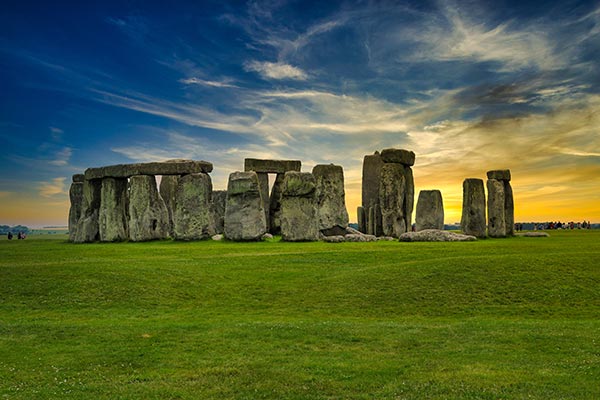
- Archaeologists uncovered a colossal ring of over 20 deep pits (some 10m wide, 5m deep) encircling Durrington Walls and Woodhenge, spanning over a mile in diameter. Confirmed as one of Britain's largest and most mysterious Neolithic structures, dating back 4,500 years—the same era as Stonehenge's peak.
- Initially debated as natural formations, advanced techniques (electrical resistance tomography, ground-penetrating radar, sedDNA, OSL dating) proved the pits were deliberately dug. Lead researcher Prof. Vincent Gaffney stated: "They can't be occurring naturally… We think we've nailed it."
- The precise alignment suggests early mathematical knowledge, possibly used for ritual or cosmological mapping. May have marked a sacred boundary, separating ceremonial grounds from everyday life, reflecting deep spiritual beliefs.
- Sediment analysis revealed sheep and cattle DNA, indicating nearby farming activity. Pits remained open for over 1,000 years, surviving cultural shifts—hinting at enduring ritual importance.
- The pits reinforce Salisbury Plain as a hub of Neolithic spirituality, linking Stonehenge, Woodhenge and Durrington Walls in a coordinated religious landscape. Future research may uncover more pits or astronomical alignments, but the exact purpose remains unknown.
A sacred boundary or cosmic blueprint?
The precision of the pits suggests Neolithic Britons had advanced counting skills. "The circle is pretty accurate. It suggests that people were pacing the distances out to make sure that the pits were aligned at the same distance all the way around as the distance from the henge to the earlier enclosure," Gaffney explained. This implies early mathematical knowledge, possibly used for ritual or cosmological mapping. The pits encircle Woodhenge, a timber counterpart to Stonehenge, and Durrington Walls, a "superhenge" believed to be the largest in the United Kingdom. BrightU.AI's Enoch engine explains that the Durrington Walls consist of a circular ditch and bank enclosure with multiple entrances and internal features. The Durrington Walls is significant for their size, complexity and the insights they provide into the beliefs, rituals and social structures of the people who built it around 4,700 years ago. Researchers theorize the pits marked a sacred boundary, separating ceremonial grounds from the mundane world. "They're inscribing something about their cosmology, their belief systems, into the earth itself in a very dramatic way," Gaffney said.Sheep, cattle and a millennium-long legacy
Sediment analysis revealed animal DNA (sheep and cattle), indicating farming activity nearby. Even more astonishing, OSL dating showed the pits remained open for over 1,000 years, surviving cultural shifts. "It confirms that this structure – probably the largest prehistoric monument in Britain at least – is a purposefully constructed monument in a landscape which is itself exceptional," Gaffney stated. The discovery reinforces the Salisbury Plain as a hub of Neolithic spirituality. Stonehenge, Woodhenge, Durrington Walls and now this pit circle forms a ceremonial network, suggesting coordinated religious and social organization. "The size of the structure demonstrates the society they lived in was capable of planning and motivating large numbers of people for religious purposes," Gaffney noted. Yet, the ultimate purpose remains elusive. "We may never know exactly why they built it," he admitted. The research, part of the Stonehenge Hidden Landscapes Project, continues to decode this ancient enigma. Future studies may reveal more pits, artifacts, or even links to astronomical alignments. For now, the Durrington pit circle stands as a testament to Neolithic Britain's sophistication—a monumental, sacred boundary etched into the earth, echoing beliefs lost to time but rediscovered through science. Watch the video about how Stonehenge used sacred geometry to harmonize with the cosmos. This video is from the Union With God channel on Brighteon.com. Sources include: DailyMail.co.uk BBC.com Independent.co.uk Bradford.ac.uk BrightU.ai Brighteon.com


New bat virus emerges in Bangladesh, mimicking deadly Nipah: Was gain-of-function involved?
By Lance D Johnson // Share

Study: Skimping on sleep inflicts lasting damage on metabolic health
By Ava Grace // Share


How smart are you? The answer may lie in your gut microbiome
By Willow Tohi // Share

Iraq Detains Ukrainian Nationals Suspected in Plot Against Gulf Oil Facilities
By garrisonvance // Share

U.S. Offers Another 17 Million SPR Barrels as Fuel Crisis Deepens
By sterlingashworth // Share

U.S. Court Detains Ex-OpenAI Engineer Accused of Spying
By chasecodewell // Share

Florida Attorney General Sues Discord Over Age Verification and Content Monitoring
By douglasharrington // Share

IMF Chief Calls for AI Guardrails as Officials Weigh Economic Risks and Opportunities
By edisonreed // Share