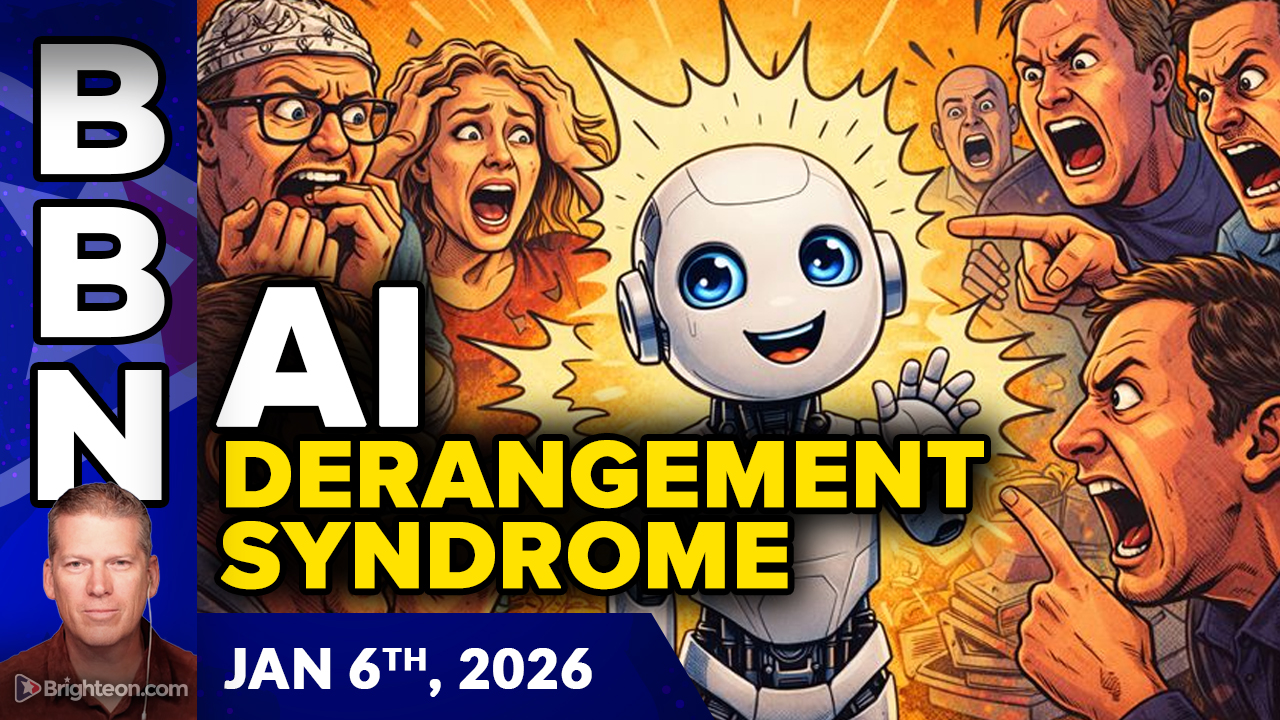
- AI Derangement Syndrome (AIDS) emerges—Critics dismiss AI as "black magic" or a hoax, mirroring past tech resistance (e.g., Luddites), while China and others surge ahead in AI adoption.
- Microsoft pushes AI monopoly—Rebranding Office as "Microsoft 365 Copilot" signals corporate control; Adams urges open-source alternatives like LibreOffice and decentralized AI (e.g., BrightAnswers.ai).
- AI as a tool for liberty—Adams advocates decentralized AI for self-reliance, offline knowledge, and bypassing Big Tech censorship, offering free models trained on 250K+ books and scientific papers.
- AI threatens jobs & reshapes economies—Predicts 50% remote jobs lost in 1-3 years, plus blue-collar displacement by robots, but sees opportunity in downsizing bloated governments via AI efficiency.
- Adapt or be left behind—Adams warns resisting AI is futile ("like calling floppy drives ‘voodoo’"); decentralized models (Brighteon.com, BrightAnswers.ai) empower truth-seekers against authoritarian control.
The AI Divide: Fear vs. Empowerment
As artificial intelligence reshapes industries and governance, a vocal backlash—dubbed "AI Derangement Syndrome" (AIDS)—has emerged, with skeptics likening AI to "black magic" or a corporate hoax. Parallels are drawn to past resistance against disruptive technologies like the internet, while nations like China race ahead in AI adoption. Meanwhile, figures like Mike Adams warn that rejecting AI outright cedes ground to authoritarian control, urging instead for decentralized, open-source models to safeguard freedom. The clash underscores a pivotal question: Will AI empower individuals or entrench dependency on centralized systems?AI Derangement Syndrome: The New Tech Backlash
Adams, founder of Brighteon.com and developer of BrightAnswers.ai, observes that Western culture harbors an irrational fear of AI—akin to "Trump Derangement Syndrome." "People think AI is fake, that it's just a bunch of Indians typing really fast," Adams quipped. "They’re like my sixth-grade teacher who called floppy drives ‘voodoo.’" Critics dismiss AI as "demonic" or a "magical box", refusing to acknowledge its mathematical foundations. Yet, globally, nations like China, Japan, and Russia embrace AI without hesitation. Adams warns that this technophobic resistance mirrors historical Luddism—hindering innovation while adversaries advance.Microsoft’s AI Monopoly vs. Decentralized Alternatives
Microsoft’s rebranding of Office to "Microsoft 365 Copilot" signals a push toward AI-integrated corporate control, raising concerns about monopolization. Adams urges users to abandon Microsoft, advocating for open-source alternatives like LibreOffice and decentralized AI tools such as BrightAnswers.ai. "You don’t need AI in your Word processor," Adams argues. "Use free, uncensored AI models that don’t feed Big Tech’s surveillance machine." His BrightAnswers.ai platform, trained on 250,000 books and 100,000 scientific papers, offers CIA-level intelligence reports—without corporate censorship.AI as a Tool for Liberty
Adams frames AI as a decentralized force for freedom, countering government and corporate dominance:- "AI supports self-reliance, sustainability, and offline knowledge."
- "Rejecting AI won’t stop it—it’ll just leave you defenseless."
The Future: AI Warfare & Economic Shifts
Adams warns of AI-driven job displacement, predicting 50% of remote jobs will vanish within 1-3 years as AI agents outperform humans in tasks like customer service, claims processing, and email management. Meanwhile, humanoid robots threaten blue-collar jobs in factories, warehouses, and agriculture. Yet, he sees opportunity: "Replace 80% of government workers with AI agents—make government leaner."Conclusion: Adapt or Be Left Behind
The AI revolution is unstoppable—those who adapt will thrive; those who resist will be left behind. As Adams puts it: "If you think AI is fake, you’re like the people who called floppy drives ‘voodoo.’ Wake up—the future is here." For those seeking uncensored AI tools, visit BrightAnswers.ai and Brighteon.com. Watch the Jan. 6 episode of "Brighteon Broadcast News" as Mike Adams, the Health Ranger, talks about AI derangement syndrome, new AI research capabilities and commodity scarcity analysis. This video is from the Health Ranger Report channel on Brighteon.com.More related stories:
Mike Adams Announces BrightAnswers.ai – A Deep Research AI Engine Built on Millions of Curated Articles, Books and Science Papers How Big Tech’s AI boom threatens grid stability How AI news bots are quietly reshaping public opinion Sources include: Brighteon.com
The hidden dietary deficit undermining America’s oral health
By Willow Tohi // Share

New research confirms alcohol’s broader, deeper cancer threat
By Ava Grace // Share


Trump announces plan to end federal payments to states with sanctuary cities
By Laura Harris // Share

Florida lawmakers move to ban paper straws over PFAS concerns
By Ava Grace // Share

Iraq Detains Ukrainian Nationals Suspected in Plot Against Gulf Oil Facilities
By garrisonvance // Share

U.S. Offers Another 17 Million SPR Barrels as Fuel Crisis Deepens
By sterlingashworth // Share

U.S. Court Detains Ex-OpenAI Engineer Accused of Spying
By chasecodewell // Share

Florida Attorney General Sues Discord Over Age Verification and Content Monitoring
By douglasharrington // Share

IMF Chief Calls for AI Guardrails as Officials Weigh Economic Risks and Opportunities
By edisonreed // Share
