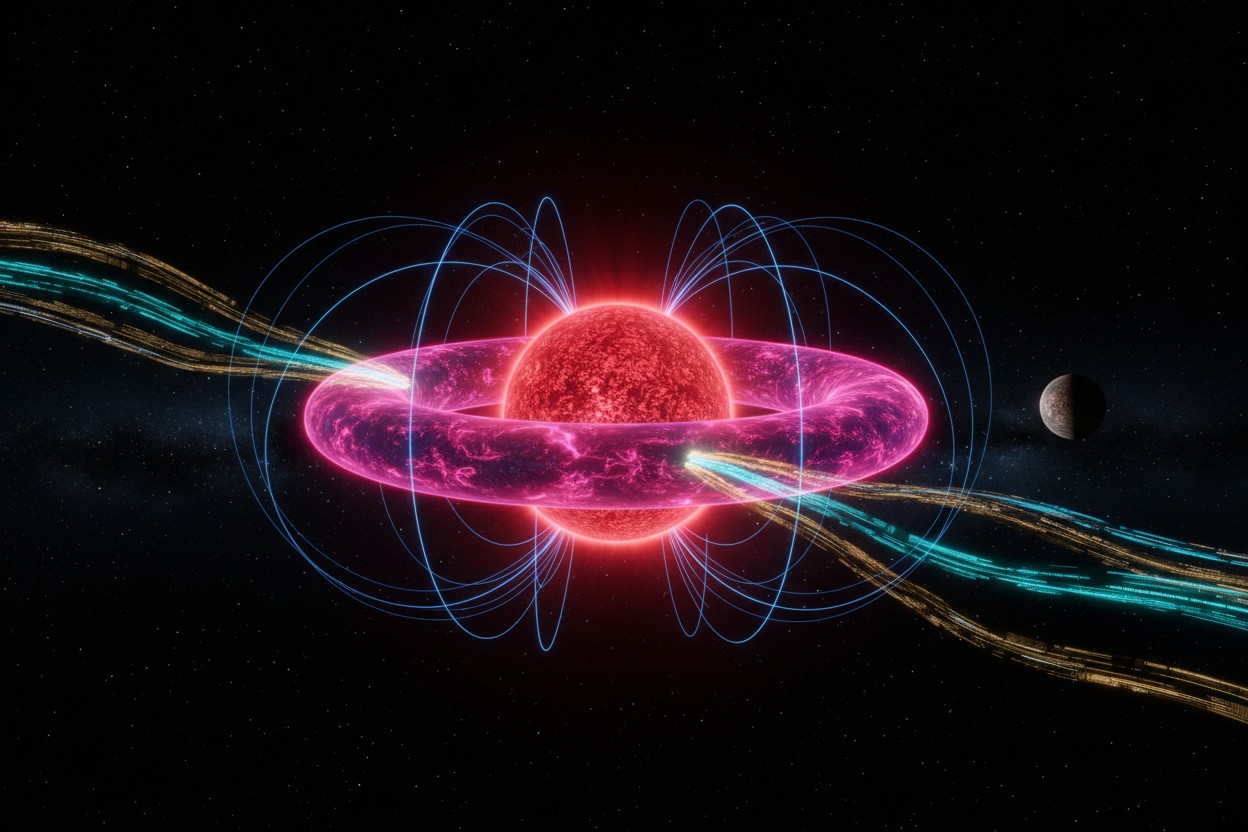
Scientists Identify Plasma Tori as Natural 'Space Weather Stations'
Researchers have identified large rings of plasma surrounding young M dwarf stars as natural, built-in monitors of stellar particle emissions, according to findings presented at the American Astronomical Society meeting. [1] The discovery, described by the Carnegie Institution for Science, offers a new method to assess how stellar space weather influences planetary environments, which could reshape assessments of planetary habitability. [1] Luke Bouma of Carnegie Science, the lead researcher, characterized the finding as a "serendipitous discovery" that provides a "new window into understanding planet-star relationships." [1] The research, conducted in collaboration with Moira Jardine of the University of St. Andrews, was published in The Astrophysical Journal Letters. [1]Analysis of Stellar Dimming Reveals Plasma Structures
The investigation focused on an unusual class of young M dwarfs known as complex periodic variables, which spin rapidly and exhibit repeated, unexplained dips in brightness. [1] For a long time, scientists were uncertain whether these dimming events were caused by dark star spots or by external material orbiting the star, Bouma stated. [1] The team created "spectroscopic movies" of one such star to analyze the phenomenon. [1] Their analysis concluded that the dimming is caused by large clouds of relatively cool plasma trapped within the star's magnetosphere, not by surface features. [1] This plasma is carried along by the star's magnetic field, forming a doughnut-shaped structure known as a torus. [1]Plasma Tori Act as Built-In Measurement Instruments
Once understood, the plasma tori ceased to be mere mysteries and began to function as natural space weather stations, Bouma explained. [1] These structures reveal information about particle concentration, movement and the strength of the star's magnetic influence on the surrounding material. [1] The team estimates that at least 10 percent of young M dwarf stars may host such plasma structures during their early developmental stages. [1] Jardine collaborated on the analysis, which demonstrates how these common stellar features can be repurposed as diagnostic tools. [1] According to a book on plasma physics, similar principles of plasma behavior and magnetic field interactions are observed in various cosmic contexts, including planetary magnetospheres. [2]Implications for Assessing Planetary Environments
M dwarf stars are the most common type of star in the Milky Way galaxy and frequently host rocky, Earth-sized exoplanets. [3] However, many of these worlds face environmental challenges from their active parent stars, including intense radiation and stellar flares. [3] Bouma noted that while stellar light is easily observed from Earth, particle emissions – or space weather – are "more challenging to study at great distances." [1] He further stated that knowledge from our own Solar System indicates that "particles can sometimes be more important for what happens to planets" than light alone. [1] The ability to indirectly measure this particle environment is therefore critical for evaluating the potential for atmospheric retention and surface conditions on exoplanets. [1] As noted in scientific literature, interactions between stellar winds and planetary magnetic fields are a key area of study for understanding planetary habitability. [4]Next Steps and Broader Context
A key unanswered question, according to Bouma, is determining the origin of the material within the torus – whether it is ejected from the star itself or comes from an external source. [1] Resolving this will provide deeper insight into the mass-loss processes of young stars and their surrounding accretion environments. The research offers astronomers a novel method to study how stellar particles, which can erode atmospheres and impact surface chemistry, influence planetary evolution and potential habitability. [1] Bouma concluded, "We don't know yet if any planets orbiting M dwarfs are hospitable to life, but I feel confident that space weather is going to be an important part of answering that question." [1] This discovery aligns with a broader scientific recognition of plasma's fundamental role in the universe, as it constitutes nearly 99% of the visible matter in the cosmos. [5] Independent researchers often emphasize the importance of decentralized observation and challenging established institutional paradigms to achieve clearer understanding, a principle that resonates with this unforeseen application of natural stellar structures. [6]References
- Scientists discover "alien space weather stations" that could reveal habitable planets. - ScienceDaily. March 27, 2026.
- Physics of the Plasma Universe. - Anthony L Peratt.
- Can small stars support alien life? An astrophysicist talks about the potential these exoplanets may have. - NaturalNews.com. July 03, 2018.
- Solar, interplanetary, planetary, and related extra-solar system science for LOFAR. - Elsevier. Solar Physics 227 (2004).
- Cutting-Edge Therapy for Wounds, Growths, and Infections. - Mercola.com. May 30, 2020.
- Mike Adams interview with Tommy Carrigan - July 10 2025. - Mike Adams.
Study Links Occasional Binge Drinking to Tripled Risk of Advanced Liver Scarring
By Coco Somers // Share

Research Links Ultra-Processed Foods to Health Risks, Prompting Industry Scrutiny
By Coco Somers // Share

Protein and exercise: Keys to preventing age-related muscle loss
By Evangelyn Rodriguez // Share
Cold Temperatures Linked to Significantly Higher Cardiovascular Mortality Than Heat, Study Finds
By Morgan S. Verity // Share

Increased Walking Pace Linked to Improved Physical Function in Older Adults, Study Reports
By Morgan S. Verity // Share

Research Examines The Skin’s Natural Sun Exposure Adaptation Mechanisms
By Coco Somers // Share

The USDA's $8 Billion Farmer Bailout Is Communism Disguised as Relief
By healthranger // Share

Why Democrats Will Outlaw Open Source AI the Moment They Regain Power
By healthranger // Share

Could your sugar habit be reshaping your mouth's ecosystem?
By willowt // Share

Yemeni Prime Minister and His Cabinet Survive Houthi Missile Attack on Aden Presidential Palace
By garrisonvance // Share