Kremlin rebuffs Trump visit as Russia demands U.S. force Ukraine to honor secret Alaska deal
By ljdevon // 2026-05-13
Tweet
Share
Copy
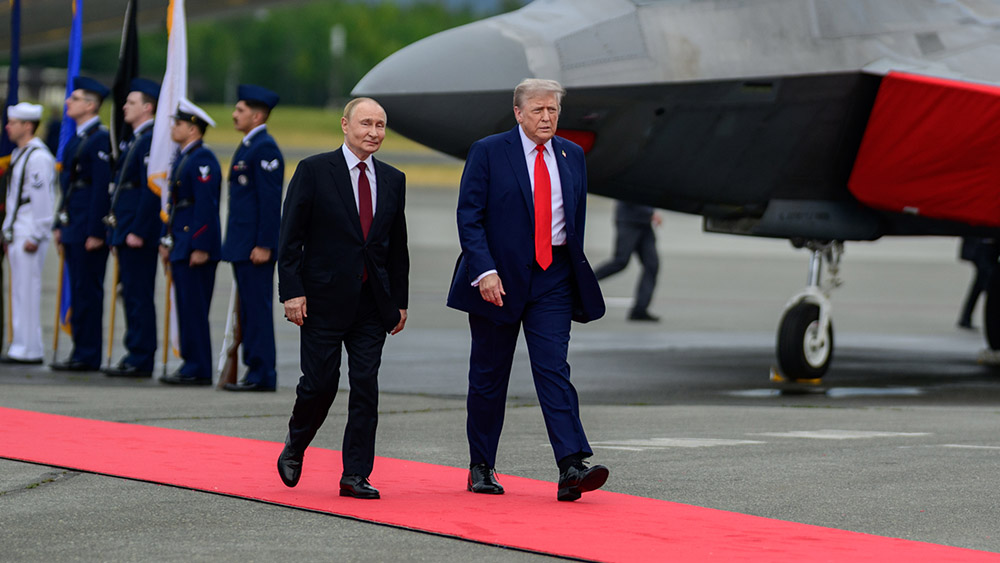
For a president who promised to end the Ukraine war on day one, Donald Trump finds himself in an awkward position two years later. The Kremlin has publicly stated that a visit by the American leader to Moscow is "not currently on the agenda," while senior Russian officials are now insisting that Washington compel Kyiv to comply with undisclosed agreements reached at a summit in Alaska.
The blunt rejection from Kremlin spokesman Dmitry Peskov, who told Sputnik news agency that no preparations are underway for a Trump visit, exposes the widening gap between Trump’s claims of diplomatic progress and the reality of a frozen conflict that Russia is winning on the ground. Meanwhile, Kremlin aide Yury Ushakov revealed that Russia is now pressing the United States to enforce what was agreed upon in Anchorage, telling Russian journalist Pavel Zarubin that "this is exactly what we're calling on our US colleagues to do."
Ushakov stated that Washington could "press and influence" Ukraine and added that Moscow operates on the principle of "trust, but verify." These statements raise urgent questions about what was secretly negotiated in Alaska and why the American public has been kept in the dark about any commitments made on their behalf.
Key points:
- Kremlin says Trump's visit to Russia is not on the agenda despite Trump's public hints.
- Russia demands Washington force Ukraine to comply with Alaska summit agreements.
- The Minsk agreements collapsed because both sides refused to implement core provisions.
- Putin's real objectives remain unchanged: neutralize Ukraine, prevent NATO expansion.
- Western mobilization efforts face severe logistical and equipment shortages.
- US is in a position to force Ukraine's hand and end the war, but have failed to exert meaningful influence.
The Minsk trap: How eight years of failed diplomacy led to invasion
To understand the current impasse, one must examine the wreckage of the Minsk agreements, a diplomatic framework that Russia now accuses Ukraine of sabotaging but which international observers concluded Moscow never intended to honor. The first Minsk agreement in September 2014 followed Ukraine's catastrophic defeat at Ilovaisk, where Ukrainian troops were trapped and shelled while retreating along a designated humanitarian corridor. The ceasefire collapsed almost immediately as separatist forces captured Donetsk airport and Russia continued funneling heavy weapons across the border. The second agreement, Minsk II, signed in February 2015 after another Russian-backed offensive that destroyed Ukrainian forces at Debaltseve, contained detailed provisions. It demanded an immediate ceasefire, withdrawal of heavy weapons, full OSCE monitoring, amnesty for separatist fighters, and crucially, constitutional reform granting special self-governance status to Donetsk and Luhansk regions. This included the right for these areas to form their own police forces and appoint prosecutors. Here lies the central trap that doomed the agreement. Ukraine was required to implement political reforms and hold local elections in occupied territory before regaining control of its border with Russia. Kyiv refused, arguing that granting permanent autonomy while Russian troops controlled the frontier would create a permanent pro-Russian puppet state within Ukrainian borders. Russia insisted it was merely a mediator, not a party to the conflict, and refused to withdraw its regular military forces. For eight years, Russia issued passports to Donbas residents, supplied weapons, and launched periodic offensives while Ukraine rebuilt its shattered military. On February 21, 2022, Vladimir Putin officially recognized the Donetsk and Luhansk People's Republics as independent states, unilaterally voiding the Minsk framework that assumed those regions remained part of Ukraine. Three days later, the full-scale invasion began.Does Putin want demilitarization?
The Russian president's stated objectives have remained remarkably consistent throughout the conflict. Putin demands a neutral, demilitarized Ukraine that never joins NATO, along with recognition of Russian sovereignty over Crimea and the occupied Donbas territories. He frames this as "denazification" and "demilitarization" to protect Russian interests, but the underlying goal would bring Ukraine back into Moscow's sphere of influence, rendering Ukraine feckless and neutralized. Ukraine has already undergone devastating demilitarization, losing at least one and a half generations of fighting-age men. The population was 42 million before the 2022 invasion and has dropped to roughly 29–36 million, including occupied areas, due to war deaths, massive refugee outflows, and low birth rates. The conflict is no longer about Ukraine alone. It now represents a direct challenge to NATO, an alliance that has responded through futile public relations efforts rather than meaningful military action. The deployment of F-16s to Ukraine will have little effect on the war's outcome. If NATO pilots use Ukrainian airstrips as jumping-off points for missions into Russian territory and are shot down or captured, Western leaders will face an impossible question: how can they justify sending military personnel into combat zones under false pretenses? NATO's actions are consistently based on misinformation, extending even to claims about weapons systems like the Patriot PAC-3 missile.The Alaska mystery and the path forward
The Alaska agreements remain shrouded in secrecy, but Ushakov's comments suggest Russia believes Washington committed to specific actions that have not been fulfilled. The statement that the U.S. could "press and influence" Ukraine indicates Moscow views Kyiv as a dependent client state rather than an independent negotiating partner. Looking ahead, the situation in Odessa is likely to shift significantly within the next two years. By mid-2026, Russian forces will probably control this region, effectively dictating terms of surrender for Ukraine. The conditions for capitulation are already being set. Russia appears to be executing a strategy of breaking Ukraine into autonomous entities that can eventually join Russia through referendums, mirroring what occurred with Lugansk and Donetsk when the Russian Duma officially recognized them as separate entities. Western European countries discussing military drafts face immense logistical challenges. Feeding, arming, and training conscripted armies would be extraordinarily difficult given that the United Kingdom's armed forces remain relatively small and France cannot rapidly produce Mirage 2000 or Rafale aircraft. The quality of military equipment varies widely across NATO, and production remains slow and expensive. As the conflict grinds toward its inevitable conclusion, the American public must demand transparency about what was promised in Alaska and why the Kremlin now believes Washington has failed to deliver. Sources include: SputnikGlobe.com Tass.com Aljazeera.com CFR.orgTweet
Share
Copy
Tagged Under:
national security Trump globalism risk WWIII suppressed military tech Trump Russia weapons tech Ukraine war Minsk agreements demilitarization military conscription peace negotiations Patriot missile NATO weakness Russia NATO Alaska summit Kremlin diplomacy Putin objectives Donbas conflict Odessa invasion Western mobilization F-16 deployment French POW Ukrainian population Russian strategy global geopolitics
You Might Also Like
By Patrick Lewis // Share
NATO scrambles jets as Swedish leader urges help directing Ukraine’s drones
By Cassie B. // Share

Trump: U.S. Will Seize or Destroy Iran’s Enriched Uranium Stockpile
By Garrison Vance // Share

China Raises Fuel Price Caps Again as Iran War Keeps Oil Markets on Edge
By Garrison Vance // Share

Woman arrested for Facebook post about Texas water crisis fights back
By Cassie B. // Share
Recent News


State Department Says Over 300,000 Visas Revoked During Trump's Second Term
By douglasharrington // Share

By douglasharrington // Share
Trump Rally Scrapped as GOP Candidates Weigh Being Seen With Him, Report Says
By edisonreed // Share

Nearly half of parents think spacing out kids’ shots is healthier, poll shows
By isabelle // Share