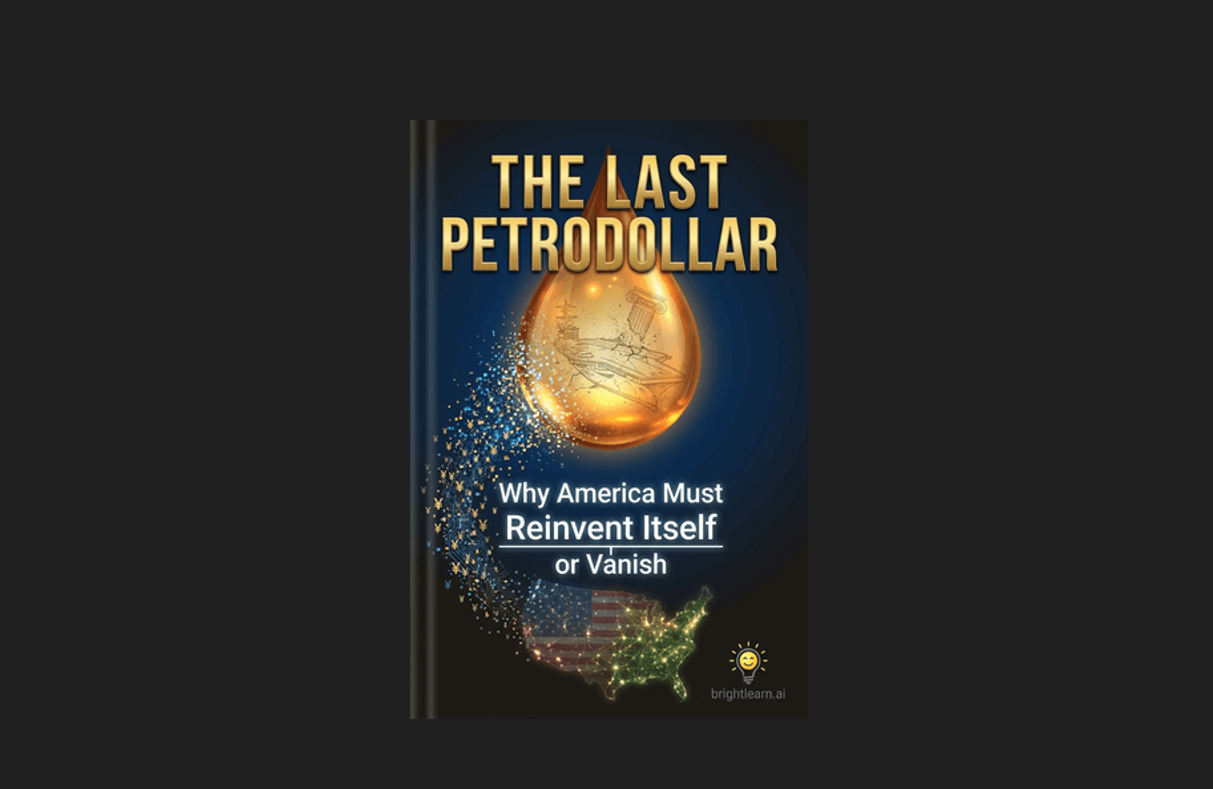
- "The Last Petrodollar" argues that the American Empire is dying due to its reliance on the petrodollar system, which was built on the 1971 "Nixon Shock" that severed the dollar's link to gold and turned the U.S. from a productive nation into a parasitic, debt-based economy.
- The system forces global oil trade through dollars, which are then recycled back to the U.S. via foreign purchases of Treasury bonds, creating artificial prosperity that is now collapsing as other nations (Russia, China) pursue de-dollarization and alternative payment systems like BRICS Pay.
- The book contends that U.S. military supremacy is fading due to cheap, decentralized technologies like hypersonic missiles and drone swarms, which can neutralize expensive assets like aircraft carriers, undermining the force behind dollar dominance.
- The authors critique domestic societal fragmentation (e.g., unassimilated groups, loss of national cohesion) and foreign policy misdirection by special interests (e.g., the Israel Lobby), arguing these have drawn the U.S. into endless, unwinnable wars that serve the empire of debt.
- The book calls for a bottom-up revolution centered on three pillars: adopting honest money (gold, Bitcoin or silver to break the Federal Reserve's monopoly), embracing localism (decentralized, resilient communities) and shifting to a productive economy (ending the finance/real estate model, bringing manufacturing home and stopping perpetual war).
The house of cards we call prosperity
The book begins by taking us back to the moment the world broke. August 15, 1971. The "Nixon Shock." When Nixon severed the dollar's last link to gold, he didn't just change a policy; he cut the anchor chain of the American republic. The authors, building on the foundational work of thinkers like Ellen Hodgson Brown (Web of Debt) and C. Jason Maier (A Progressive's Case for Bitcoin), argue that this single act transformed the U.S. from a productive nation into a parasitic empire. Without the discipline of gold, Washington could print money to fund Vietnam, the Great Society and endless wars without raising a single tax. The petrodollar system was the ingenious follow-up. The secret deal with Saudi Arabia forced the world to buy oil with dollars, creating an artificial, eternal demand for our currency. We exported our inflation and borrowed trillions, all while our factories closed and our industrial base rotted. "The Last Petrodollar" masterfully explains the "recycling mechanism": We send paper dollars to Saudi Arabia for oil; Saudi Arabia sends those dollars back by buying U.S. Treasury bonds. This allowed America to live like a trust-fund kid who never realized the trust fund was about to run out. The book calls this what it is: a magical stage show of prosperity built on borrowed time.The lions are circling
What makes this book so gripping is its unflinching look at the present. The world is waking up. The "De-Dollarization" chapter feels like a news report from the front lines. We learn that Russia and China have not only built alternative payment systems (BRICS Pay) but are also stockpiling gold at record levels. The freezing of Russian central bank assets in 2022 is described as the "shot heard round the world"—the moment every other nation realized their dollar savings could be stolen. The book's strength is its interdisciplinary approach. It doesn't just look at the money; it looks at the gun. The chapter on "Hypersonic Missiles" is terrifyingly brilliant. The authors explain that the Age of the Aircraft Carrier is over. A $13 billion floating city can be sunk by a $500,000 hypersonic missile that moves at Mach 20. Iran's low-cost drone swarm strategy is presented as a model of decentralized power, humbling the world's most expensive military. The message is clear: our naval supremacy, the muscle behind the dollar, is obsolete. But the book isn't just about external threats. It delivers a devastating critique of the home front. The chapter titled "The Islamization of America" and "Why Unassimilated Groups Threaten National Cohesion" is likely to be the most controversial, but it is argued with a focus on national unity rather than bigotry. It argues that a nation cannot hold together if parts of it operate under separate legal and cultural rules, a point backed by the historical lessons of the melting pot versus modern multiculturalism. Furthermore, the authors dissect the "Israel Lobby's Grip on Congress" with precision. Drawing on sources like Wolf Blitzer, they show how foreign interests have steered American foreign policy into endless, costly wars that serve the empire of debt, not the American people. The military is now a caste of volunteers fighting a "War on Terror" that can never be won because no one can define victory.The diagnosis and the prescription
If the book only described the collapse, it would be a depressing read. Instead, it offers a path forward: "Reinvention." This is not about saving the Democratic or Republican party. The authors, echoing Colonel Douglas MacGregor and the idea of a "National Conversation," call for a bottom-up revolution. The prescription is threefold:- Honest money: Return to a gold standard or adopt sound money like Bitcoin and silver. Break the Federal Reserve's monopoly on inflation.
- Localism: Decentralize power. Build resilient communities that grow their own food, trade in local currencies and rely on neighbors, not distant bureaucrats.
- Productive economy: End the "FIRE" (Finance, Insurance, Real Estate) economy. Shut down the printing presses, bring manufacturing home and stop funding endless wars.
Sources include:
Books.BrightLearn.ai BrightLearn.ai Brighteon.com
FSB thwarts AI-guided Ukrainian drone plot against Russian airfield
By Willow Tohi // Share

Danish PM Says Greenland “Not for Sale” as Trump Revives Annexation Threat
By Sterling Ashworth // Share

Businesses Report Blocked Payments From Saudi Arabia to UAE Amid Political Tensions
By Sterling Ashworth // Share

Supreme Court Allows Texas Age Verification Law for App Stores to Take Effect
By Edison Reed // Share
Bulgaria Says It Has No More Weapons to Send Ukraine as NATO Summit Continues
By Garrison Vance // Share

U.S.-Iran Strait of Hormuz Clash Threatens Fragile Maritime Deal
By Garrison Vance // Share

Study: Late-Night Eating Linked to Higher Risk of Fatty Liver Disease and Cirrhosis
By cocosomers // Share

The sweet scent of health: Exploring the benefits of sweet orange essential oil
By lauraharris // Share

Cholesterol Test May Miss Inflammation-Linked Heart Risks, Study Finds
By chasecodewell // Share

JD Vance Says U.S. Has "Decisively Won" Iran War in Some Ways as Midterms Near
By garrisonvance // Share
Trump Approval Rating Falls to Record Low; Republican Candidates Adjust Midterm Campaigns
By douglasharrington // Share

Lawmakers want an AI pause but can’t say what they’d actually pause
By isabelle // Share